Angry Anderson dies aged 79: Rose Tattoo frontman was a ferocious rock ’n’ roll singer and youth advocate
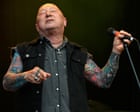
Angry Anderson has died aged 79, after he was hospitalised following a cardiac arrest while on tour in Germany with the band Rose Tattoo.
Gary Anderson was not a nice boy growing up. As one of the founding members of Melbourne motorcycle club the Vigilanties, he initially earned the sobriquet Mouse, on account of his diminutive stature. Determined to prove himself a man, he developed a penchant for taking on blokes twice his size. It earned him a new nickname: the Angry Ant.
Angry – shortened for impact – suited him better. An accomplished rabble-rouser and ferocious rock’n’roll singer, Angry Anderson ended up channelling his energy into a variety of causes, the most successful of which was the Tatts, the balls-out band (there are photos to prove it) he fronted until the end.
By Anderson’s own admission, the Angry persona was akin to a cartoon character; Buster Brown – his band before Rose Tattoo, with AC/DC’s Phil Rudd on drums – was actually named after one. In 1974 they cut an album for Mushroom, Something to Say, and built a loyal following among the local sharpies in Melbourne. But that was a mere dress rehearsal.
Rose Tattoo, formed in Sydney in 1976, were a far meaner proposition. Slide guitarist Peter Wells gave their sound much of its switchblade menace and brain-busting volume, but it was Anderson’s voice that cut through everything. In Buster Brown, he had proved himself a capable blues singer. In Rose Tattoo, he rarely bothered with such niceties; nice boys don’t play rock’n’roll.
Then there was the small matter of Anderson’s appearance. Tiny, bald and nearly fully illustrated (his upset mother told him he was scarred for life), with mirrored aviator shades and kicked-in teeth, Angry was flanked by much bigger hooligans on stage. But there was no doubting who the leader of the gang was.
The first self-titled Rose Tattoo album, released in 1978 – the same year as AC/DC’s Powerage and the Angels’ Face to Face – appeared at the height of the blood-and-thunder Alberts sound defined by producers and former Easybeats Harry Vanda and George Young. Featuring the enduring singles Bad Boy for Love and Rock ’n’ Roll Outlaw, it is a stone classic of the genre.
But mainstream Australia was nowhere near ready for the Tatts. The butchest of bands, who looked as if they’d just busted out of Pentridge, managed to get temporarily banned from Countdown after Anderson exchanged chewing gum in a kiss with guitarist Mick Cocks. Radio ignored them, crowds thinned, and the band lost momentum.
Overseas, however, it was a different story. Rose Tattoo’s fortunes changed in 1981 when their self-titled debut and its follow-up, Assault and Battery, both reached No 1 on the British heavy metal charts. At Reading festival in the UK, Anderson’s physicality was terrifying, head-butting the amplifier stacks until blood streamed down his face.
Welcomed home as conquering heroes, the band’s third album Scarred for Life yielded an Australian hit with We Can’t Be Beaten before the lineup split. What happened after that was one of Oz rock’s most unlikely transformations as Anderson slowly ingratiated himself into the nation’s heart as a youth advocate and all-round rough diamond.
There were forays into acting – a 1985 appearance as Ironbar Bassey in Mad Max Beyond Thunderdome was fully on brand – and social justice; soon he was making surprise appearances on the Midday Show with Ray Martin, then more regular ones on A Current Affair. But the biggest curveball of Anderson’s career was yet to come.
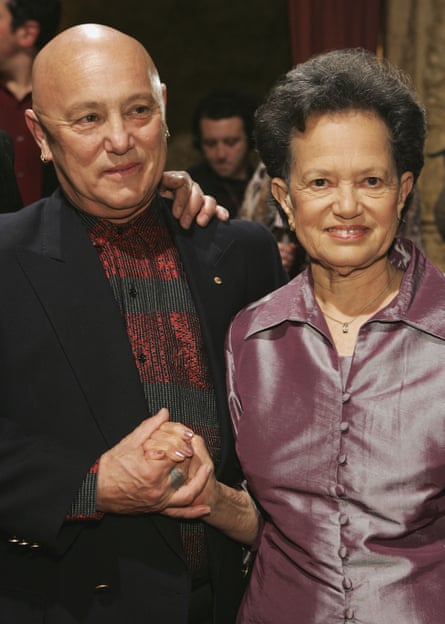
By 1987, Anderson was the sole remaining member from the classic Rose Tattoo lineup. The power ballad Suddenly, a world away from their earlier hellraising sound, was released as a solo single and became a smash when it was used to soundtrack – of all things! –the wedding of Scott and Charlene (Jason Donovan and Kylie Minogue) on Neighbours.
Suddenly went to No 2 nationally, ironically kept from top spot by Minogue’s debut single Locomotion. It also went to No 3 in the UK. For a while, Angry was everywhere – even headlining the half-time entertainment at the 1991 AFL grand final, arriving in what looked like a Batmobile to sing Bound for Glory in a legendarily off-key performance.
But by then, Anderson’s legacy was secure. Guns N’ Roses – having covered Nice Boys on their Live ?!*@ Like a Suicide EP – recruited the band to support them on their Use Your Illusion tour in 1993; the same year, Anderson was awarded an Order of Australia. In 2006, after two strong comeback albums, Rose Tattoo were inducted into the Aria Hall of Fame.
Indeed, Rose Tattoo’s imprint on Australian music has never been more obvious. You can trace their lineage through a slew of punk and hard rock bands, from the Cosmic Psychos to Amyl and the Sniffers (even the Veronicas invited Angry on stage to do Nice Boys). Their impact on the 80s new wave of British heavy metal, as well as the Gunners, was decisive.
In later life, Anderson blended charity, television and music with hard-right politics. After expressing anti-immigrant views, he appeared in SBS’s Go Back to Where You Came From in 2012. In the 2013 federal election, he stood for the electorate of Throsby in New South Wales for the National party, switching to the Australian Liberty Alliance in 2016.
Anderson also suffered significant tragedy in his life. His work with troubled youth stemmed from his own experience of child abuse; later, he stumped for men’s health after five of his early Rose Tattoo comrades succumbed to cancer. The cruellest loss of all was that of his son Liam, killed in 2018 in a case that made national headlines.
It is both true and a cliche to say Angry Anderson was a survivor. He was also a more complex, talented and three-dimensional figure than he was often given credit for. And he kept the Rose Tattoo flame burning until the end, to huge and appreciative crowds – one of the last great true believers in the remedy they call rock’n’roll.
KioskNews shows a cleaned-up reading view extracted from the publisher’s page — the original always lives on their site, not ours.