China looming, Arunachal hydel project under fresh protest shadow
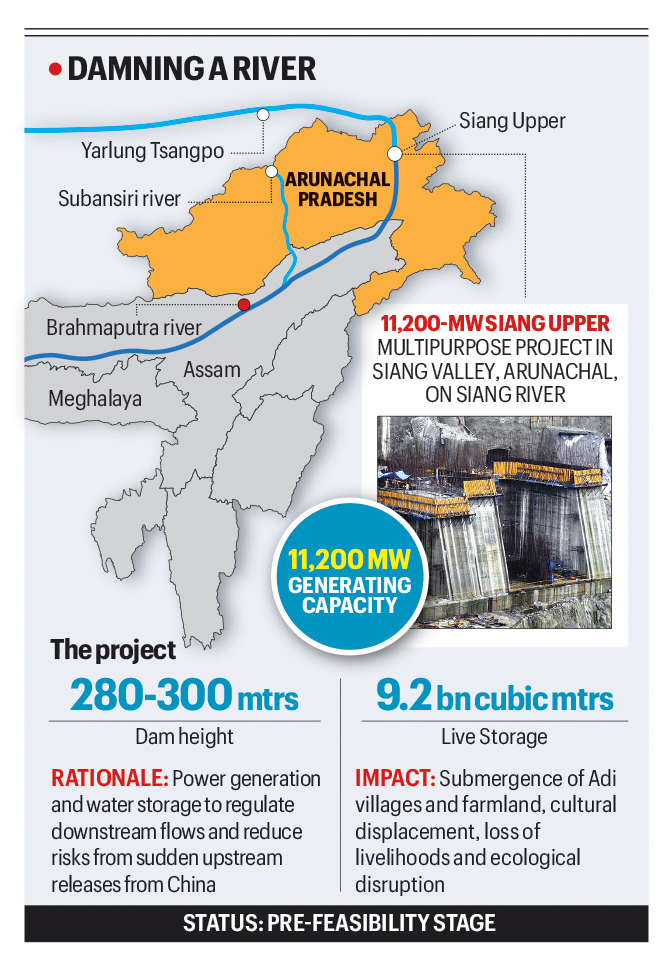
Nearly a month after columns of security personnel moved into the Ugeng-Komkar area of the Siang valley in Arunachal Pradesh, to facilitate surveys and drilling for the pre-feasibility report of the proposed 11,200-MW Siang Upper Multipurpose Project, protests against it are refusing to die down.
On October 14, four protesters were detained under the Arunachal Pradesh Unlawful Activities (Prevention) Act, 2014, triggering a fresh round of demonstrations. People hit the streets in Geku, Upper Siang, demanding the release of the four, with the Youth Wing of the Siang Indigenous Farmers’ Forum (SIFF) urging that government consultations on the project be boycotted.
For the indigenous Adi community that is anxious about displacement and livelihoods, as well as the loss of land that they link back to their ancestors, the deployment of heavy security and the arrests have only stoked fears.
In late September, Chief Minister Pema Khandu’s visit saw an attack on a local MLA’s residence by protesters, who also torched a police vehicle. Fresh clashes erupted on October 4, amid allegations of arson by protesters and excessive force by security personnel.
In a sign that the Centre was watching, on October 8, Union Minister Kiren Rijiju, who belongs to Arunachal, called for dialogue with senior members of the Adi community. “If we sit down and talk, technically, everything will be clear. We have to talk. We have to move forward,” he said.
However, the impasse has a long history.
Shifting positions
The ferocious Siang barrels through the Himalayas until it approaches the Assam plains, where it becomes the braided Brahmaputra. Its political journey, however, is marked by diversions.
In August 2010, when the Congress was in power in Arunachal, the Itanagar residence of then chairman of the Siang Peoples’ Forum and firebrand anti-dam activist Ojing Tasing was raided by police. Following this, Tasing met the UPA government’s Environment Minister Jairam Ramesh in New Delhi, demanding that hydropower projects in the Siang basin be scrapped.
Story continues below this ad
Soon after, the UPA government held a public consultation in Guwahati and Ramesh wrote to then Prime Minister Manmohan Singh, acknowledging that his arguments about the projects’ strategic significance had not convinced everyone. “There were some NGOs from Arunachal Pradesh who… said we should not make Arunachal Pradesh a pawn in the race between India and China,” he wrote.
Resistance to big dams elsewhere in Arunachal also found a voice in the opposite camp, in Tarun Vijay, former editor of the RSS mouthpiece Panchajanya and then a BJP MP. In May 2012, Vijay told the Rajya Sabha: “Government ministers tell me: ‘Tarun ji, do not concern yourself with this; perhaps people from China are instigating them.’ Is that a responsible thing to say? If people from China are indeed instigating an agitation… the Government has an even greater responsibility to send a Union minister to speak to those people.”
Campaigning in Pasighat in February 2014, before he became the Prime Minister, Narendra Modi also acknowledged the local opposition to large dams and spoke of harnessing hydropower through smaller projects while protecting the environment.
The tables turn
In a memorandum submitted this July, Arunachal Pradesh Congress Committee president Bosiram Siram argued that concerns over China’s upstream activities should not override free, prior and informed consent of local tribal communities.
Story continues below this ad
In September, Indian Youth Congress national general secretary Tarh Johny described the approach of the BJP government – in power in both the state and at the Centre now – as “dictatorship”, calling for transparency and meaningful consultation with affected people.
Now leading the charge for the Siang Upper project is Chief Minister Khandu. On September 21, he said he had instructed the Chief Secretary to act against government employees opposing the project.
The biggest U-turn is by Tasing, now among Khandu’s most vocal lieutenants and Arunachal Rural Development and Panchayati Raj Minister. The activist once opposed to the project now says: “If we don’t construct our dam, what will be the impact on us if China uses its dam as a water bomb on India?”
Attempts to approach him over his changed position were unsuccessful.
The consistent argument
Story continues below this ad
Underlining the political reversals is a strategic argument that remains consistent: India must develop its downstream water resources as China expands its hydel capacity on the Yarlung Tsangpo, as the Siang is known in upstream Tibet.
Initially, the China factor was not dominant when India proposed to harness the Siang and Subansiri rivers back in 1982. As Chinese plans on Yarlung Tsangpo emerged, New Delhi and Beijing agreed on a mechanism in 2002 for China to provide flood-season hydrological data.
In 2003, India launched a nationwide initiative to develop 50,000 MW of hydropower, with around 27,000 MW envisaged from Arunachal Pradesh, setting off a flurry of agreements with developers in Itanagar.
Then, in 2011, the government told Parliament about a Chinese run-of-the-river project upstream of Siang and stressed the need for Arunachal Pradesh and Assam to harness the Brahmaputra’s waters. In 2013, India raised concerns over additional Chinese projects on the Yarlung Tsangpo and asserted its interests as a downstream user.
Story continues below this ad
In 2017, with BJP governments at the Centre and in Arunachal, NITI Aayog proposed replacing the planned Siang Upper Stage-I and Stage-II projects with a single large storage project. The proposal has since evolved into the 11,200-MW project now at the centre of the protests.
China’s plans have also advanced. Beijing approved its 60,000-MW lower Yarlung Tsangpo hydropower project in December 2024. Comprising five cascade hydropower stations, the project seeks to harness the river’s steep descent near the Indian border — a drop of nearly 2,000 metres over a 50-km stretch.
This has sharpened concerns in India about downstream flows and sudden releases of water, reinforcing the case for storage on the Siang.
But not everybody is convinced. “There is no realistic prospect of establishing the so-called ‘first user right’ in international jurisprudence. Instead, India should demand project information and possibly assert our right to joint impact assessment to ascertain the risks posed by the dams upstream rather than blindly forcing a dam on its own people,” says Himanshu Thakkar, coordinator of the South Asia Network on Dams, Rivers and People.
The Adi way of life
Story continues below this ad
For Adi communities opposing the project, decisions about the river go beyond electricity and national security.
Their village affairs are traditionally discussed in a kebang, a council led by elders. A Bogum Bokang Kebang (supreme council) bringing together Adi clans to address questions of wider collective importance is rare. In August 2025, after a gap of 25 years, one such Bogum Bokang Kebang was held, at Geku in Upper Siang, to oppose the proposed dam and its pre-feasibility studies.
As per the SIFF, the reservoir for the project could submerge 27 villages, affect dozens more and displace 1-1.5 lakh indigenous people.
This means more than a loss of fertile villages, paddy fields, jhum cultivation orchards and livelihoods for the community. The Adis also revere the land, as they consider it as belonging to Abo Tani, their primordial ancestor, and Ane (mother) Siang, who shapes their culture and identity.
Story continues below this ad
“That is why more than the ecological or seismic concerns, which are very real, fear of losing their ways of life and right to self-determination make the Adis averse to big dams,” says a veteran energy researcher who has worked with the community in Arunachal Pradesh who does not want to be named.
Watching the standoff from Guwahati, a former member of the Adi Students’ Union, speaking anonymously, says it ultimately comes down to the core questions: “Who bears the cost of national security, who decides what development should mean, and can a river be harnessed on this scale without unmaking the lives built around it?”
The timeline
- 1982: The Brahmaputra Board proposed a dam on the Siang
- 1990s: Siang Upper, Middle and Lower dams proposed
- 2008: 9,500-MW Siang Upper declared a National Project
- 2009: NHPC divided Siang Upper into two stages, of 6,000 MW and 3,750 MW, to reduce submergence
- 2017: NITI Aayog consolidates Siang Upper Phase 1 and 2 as a 10,000-MW project
- 2025: State pushes MoUs with local communities
- 2026: Protests intensify as state mobilises forces for pre-feasibility surveys
KioskNews shows a cleaned-up reading view extracted from the publisher’s page — the original always lives on their site, not ours.