What killed Block Parent? How paranoia drove the red-and-white sign from the neighbourhood
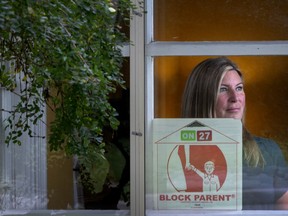
Almost 50 years later, Karon Smart can still remember being seven years old and realizing the big dog coming toward her wasn’t going to stop.
Sign In or Create an Account
“It just kept coming and coming. No matter what I did, it was coming at me,” she said.
She was living in Toronto’s Flemingdon Park neighbourhood. But her parents had already trained her on what to do in such situations.
“I looked for the Block Parent sign and ran up to the door,” she said. The woman who answered gave her a drink and a cookie while she called the police, who drove Smart home. It was the first of three times Smart would rely on a Block Parent for help while growing up.
The program, at its peak in the early 1990s, counted more than 500,000 participating households across Canada, and gave generations of children a familiar place to turn when they needed help.
Today, Block Parent has disappeared from much of the country, its decline tracing a broader shift in the way Canadians raise children, know their neighbours and think about safety.
Started in 1968 by a group of Jewish moms in London, Ontario, the Canadian program has dwindled to about 100 communities. Block Parent has even disappeared from where it started. London’s program closed in 2016.
In August, the Alberta Block Parent program formally wound down its operations. “We’ve closed the bank account and we’re all finished,” said administrator Lynn Squance.
Smart remembers when relying on the kindness of strangers was simply part of childhood. When she was 10, after her family had moved to Peterborough, Ont., she was walking just three streets over to her aunt’s house when she noticed a blue van.
“It kept going up and down the street,” she said. “I kept walking and looking and he kept following and following. I would stop and he would stop. I would walk and he would keep going.”
The Block Parent called the police, who took Smart home and contacted her parents.

Smart would use the program once more at 14, after her family moved to Toronto’s Jane and Finch neighbourhood, when she encountered a large group of kids she remembers as a “big, roving gang.”
In each neighbourhood, Smart knew there were safe houses where she could knock on the door and someone would help.
“In my day, it took a village to raise a child,” she said.
On the morning of Feb. 9, 1968, nine-year-old Frankie Jensen left his home in London, Ont., and headed for Westdale Elementary School. He vanished. Two months later, his remains were found. His murder has never been solved.
The disappearance terrified parents in London, but it also galvanized them. Eight months later, mothers from the London chapter of the National Council of Jewish Women began working with police and local school boards on an idea for making the trip between home and school safer: recruit trusted adults throughout the neighbourhood and mark their homes with a sign children could recognize from the street.
“They mobilized around this and then it sort of caught on because everyone realized this common purpose of child protection,” said Kim Varma, a professor in the Department of Criminology at Toronto Metropolitan University and co-author of Guardians of the Community: The Block Parent Program of Canada.
“At the time, many women were at home and could provide the volunteer workforce behind this kind of an approach. The buy-in from everyone was really seamless at the time.”
The circumstances of that era were well suited to the idea. Volunteers were abundant. Police worked alongside them. Schools promoted the program to families. A local Labatt employee connected the women with the brewery’s marketing department, which designed the red-and-white sign that would become familiar across Canada.
The first pilot launched in five London elementary schools in the fall of 1968. Though it drew on similar initiatives that predated it in the United States, Block Parent’s rise was uniquely Canadian.
The idea soon moved beyond London, reaching Hamilton in 1969, Sarnia in 1971 and St. Thomas in 1972, before crossing provincial borders with a program in Edmonton in 1973. By 1976, Block Parent had reached Manitoba, Quebec and British Columbia.
Over the next two decades, the program became increasingly difficult to miss. In 1981, the Block Parent flag even flew over Rideau Hall; Lily Schreyer, wife of then-governor general Edward Schreyer, was a Block Parent.
But its presence was most visible at street level. The red-and-white signs appeared in windows across the country, backed by an expanding network of local committees, police services and school boards. Children were taught what the sign meant and how to use it.
Tara Mondou, who grew up in Waterloo, Ont., area, remembers a Block Parent home along her route to school.
“Every time you left school, if you were worried about bullies or someone chasing you, you always just knew that the Block Parent was there,” she said.
By the early 1990s, more than 1,000 Canadian communities were participating in Block Parent; it had become the largest volunteer-run child safety program in Canada.
But the conditions that had allowed Block Parent to flourish were already beginning to change.
In most Canadian communities today, it’s rare to see a Block Parent sign. The program is not totally forgotten — a regular stream of would-be Block Parents still reach out to its president, but it has lost the critical mass that made it possible.
“Not a week goes by that I don’t get an email or a phone call from somebody wanting to be a Block Parent,” said Linda Patterson, president of the national Block Parent board. But in much of Canada, there is no longer a local organization to join.
The decline can be traced to a series of changes in Canadian life: fewer people at home during the day, a shrinking volunteer base, growing concerns about liability and screening and, eventually, new technology that has given parents other ways to keep track of their children.
So the very thing that was the impetus to start the program, which was the fear of child molesters or sex offenders, was the thing that shut it down
The program was built around a volunteer base that looked very different by the turn of the 21st century. In its early years, many Block Parents were mothers who were home during the day. With more women in the workforce, fewer people were available to provide a safe house or run local committees.
At the same time, becoming a Block Parent was becoming more complicated. By 2001, police checks were required for every member of a participating household over the age of 12, and in some cases fingerprinting was also required.
There was also confusion about what was expected from volunteers. “That was one of the biggest misconceptions, that you would have to leave your home and help someone or let them in your home,” said Patterson. Block Parent protocol is that the child is not supposed to enter the home, but wait outside on the porch.
By the mid to late 1990s, questions about risk and liability were also changing the relationships that had sustained Block Parent. Schools began withdrawing their support while volunteers themselves were increasingly under the microscope, despite no documented case over the program’s decades of operation in which a child was harmed or put in danger by a Block Parent.
By the early 2000s, police services were also reconsidering their role. Toronto police withdrew their support in 2003. York Regional Police followed in 2006, citing concerns about liability and whether screening could guarantee the safety of a Block Parent home. The decision also meant local programs could no longer rely on police to conduct background checks for free.
“It’s kind of ironic,” Varma said. “Block Parent was this idea of a safe stranger and that someone in your neighbourhood has been vetted by the police and is a safe person.” Over time, she said, that trust gave way to concern that a volunteer could be a potential molester.
“So the very thing that was the impetus to start the program, which was the fear of child molesters or sex offenders, was the thing that shut it down, which was the lack of trust in people.”
Technology also changed the equation. Cellphones gave children a way to call for help themselves, while GPS devices eventually allowed parents to track them from a distance.
“You can track your child all you want and they can have a phone, but if they’re walking down the street and a dog’s chasing them, how is that going to work? You’re not going to be able to help your child from afar,” Patterson said.
Block Parent tried to adapt. Patterson said the sign was changed in 2007 to include an annual sticker, provincial identification, a serial number and a security feature that prevented it from being photocopied. Prospective Block Parents underwent an in-home check and provided references.
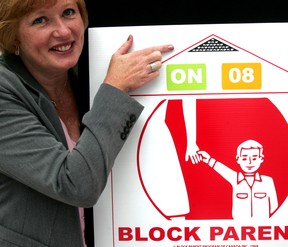
But the numbers fell quickly. In 2009, about 29,000 Block Parents remained nationwide. By 2013, the program counted 25,000 homes, concentrated largely in Alberta and Quebec, as programs closed in Ottawa, Toronto, Prince Edward Island and much of British Columbia. Two years later, the program had dwindled to 144 communities representing 6,914 homes. By 2019, only nine active Block Parent communities remained in Ontario.
And while Neighbourhood Watch programs have filled some of the gap, there’s a big difference between the two initiatives: Neighbourhood Watch is about safeguarding property, Block Parent is about looking after people.
But the Block Parent sign hasn’t disappeared completely. In a handful of places across Canada, Block Parent has managed not only to survive, but to retain a significant presence.
In Quebec, Parents-Secours still has 102 communities, with 1,594 shelter homes and 2,642 Block Parent members, according to its 2025-26 report. Quebec’s records show 194 requests for help in 2025-26, including 142 involving lost people and 14 involving injuries. Its lost-child kiosks assisted another 561 children.
There are also about 300 Block Parents in Winnipeg, along with smaller programs that have held on or been revived in parts of Ontario.
In the small lakeside town of Georgina, Ont., on Lake Simcoe near Barrie, Heather MacLaren began building a Block Parent program four years ago. Her parents were Block Parents when she was growing up in the early 1990s, and when her own daughter was young, MacLaren was a single parent who relied on the watchful eyes of trusted neighbours..
Seven people volunteered in Georgina, and a local RE/MAX representative paid for background checks. For MacLaren, the program offers something home security cameras and cellphones cannot.
“Sitting behind a screen isn’t going to save anybody,” she said
In the Waterloo region, Mondou still follows the same routine each day. The past chair of the regional Block Parent program, she is a screened and trained Block Parent.
“I wake up every morning. I open my own curtain, I put the Block Parent sign in the window and then every night when I close my curtain, I take my sign down and it stays in the same spot,” she said.
Door knocks in the area are rare. Mondou said there have been just two in the Waterloo region over the past 16 years. But she doesn’t see that as evidence that the signs have outlived their usefulness.
“When children and other members of the community see a Block Parent sign, they feel safe and secure,” she said. “They feel like they can play in the neighbourhood. They feel safe walking to the store, going to the park. So, it’s more of a sense of security by just seeing the sign.”
Patterson, who manages the national program from New Brunswick despite the province not having its own Block Parent program anymore, said the program also gives parents another layer of reassurance as their children begin venturing out alone.
“You have a lot of young parents out there who tend to be a little on the nervous side,” she said. “This is just one more program that helps them take that baby step toward allowing their children to feel independent.”
What seems to have endured is the memory of what those signs represented.
“They remember the comfort that they felt seeing those signs when they’d walk to school. For some reason it has made a comeback in people’s memories,” Varma said.
That comfort mattered even if many door knocks were more about scary dogs or scraped knees than fighting crime. “We can sort of chuckle and say this is not crime stuff, but it did give a sense of security,” Varma said. “They knew that it wasn’t just your parents who had your back, you had a neighbourhood that had your back.”
Join the Conversation
This website uses cookies to personalize your content (including ads), and allows us to analyze our traffic. Read more about cookies here. By continuing to use our site, you agree to our Terms of Use and Privacy Policy.
KioskNews shows a cleaned-up reading view extracted from the publisher’s page — the original always lives on their site, not ours.