Avideh Motmaen-Far: Ottawa must not ignore the crimes perpetrated against the Iranian people
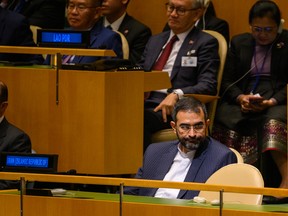
On Sept. 6, Foreign Affairs Minister Anita Anand and Finance Minister François-Philippe Champagne released a statement condemning Iran’s destabilizing actions in the Middle East: “its continued threats to vessels seeking to transit the Strait of Hormuz, its pursuit of illicit nuclear activities and its support for regional proxy groups.”
Sign In or Create an Account
Crucially, they remained silent on human rights abuses, executions and detainees. Just four days later, Human Rights Watch reported that Iranian authorities had executed 59 men on “politically motivated and vague national security charges” since March.
This weekend, Canada will present its national statement at the 81st session of the United Nations General Assembly. That statement will tell us whether the Sept. 6 omission was merely a drafting oversight or the beginning of a major policy pivot. For Canada, this question matters more deeply than it does for most of our allies, because we hold a position on this file that took over 20 years to build — and which could be lost in a single year of complacency.

Columnist Jesse Kline keeps you up to date with what’s happening in Israel and the effects of antisemitism on life here in Canada. Friday mornings.
By signing up you consent to receive the above newsletter from Postmedia Network Inc.
A welcome email is on its way. If you don't see it, please check your junk folder.
The next issue of Channel Israel will soon be in your inbox.
We encountered an issue signing you up. Please try again
For over two decades, Canada has carried the annual UN General Assembly resolution on the human rights situation in Iran. Canada’s support for the resolution — which began in 2022, according to Global Affairs Canada — gained extra prominence in 2003, when Iranian authorities tortured and killed the Iranian-Canadian photojournalist Zahra Kazemi. No other country has owned a UN human rights file with the kind of deep integration that Canada possesses.
This commitment remains vital. The most recent text, introduced by Canada with the support by over two dozen co-sponsors, was adopted by the General Assembly in December 2025 by a vote of 78-27 (with 64 abstentions). The United States co-sponsored the resolution and, in its vote explanation, specifically thanked Canada for its sustained leadership. Canadian diplomats spend countless autumn months keeping that coalition intact — and the margin of success is a direct return on their investment.
Moreover, Canada utilized that very text last year to break new ground: it was, to my knowledge, the first time transnational repression — the concerted efforts undertaken abroad to harm, silence or intimidate government opponents, including targeting their relatives inside Iran — was addressed. That language exists because Canada dared to put it there.
Canada did not take this on in the first place out of an abstract sense of idealism. It was Kazemi along with the 55 Canadian citizens and 30 permanent residents killed aboard Flight PS752 in 2020 that spurred Ottawa to action. It is an issue that has been woven into the Canadian fabric.
The 2021 census recorded 213,160 Canadian residents born in Iran, and just over 200,000 individuals claiming Iranian ethnic or cultural heritage. Members of this community face threats on Canadian soil, and relatives still trapped in Iran have been interrogated or denied travel based on things said in Toronto or Vancouver. Transnational repression is not a theoretical foreign policy concept for Canada.
That reality sets the standard against which the next Canadian statement on Iran must be judged, because the conduct being condemned has accelerated sharply. According to Human Rights Watch, at least 29 of the 59 men who were executed between March 18 and the end of August were arrested in connection with the protests in December and January. Five were subjected to public executions.
In 16 of those 29 cases, the capital charges involved no allegation that the accused had killed anyone; the alleged activity was property damage or trespass. Bahar Saba, the organization’s senior Iran researcher, cautioned that the proceedings were often “too short to establish a defendant’s guilt even for a minor offence, let alone for capital charges.”
Meanwhile, on Sept. 16, Amnesty International released a report naming 87 Iranian officials who it says should face criminal investigations for crimes against humanity during the 2022 Woman, Life, Freedom uprising, including 62 security commanders (33 from the Islamic Revolutionary Guard Corps and 27 from the police), plus 25 Ministry of Interior officials.
Tehran has made its direction painfully clear. In March, Iran’s police chief, Brig.-Gen. Ahmad-Reza Radan, warned that protesters acting “in line with the wishes of the enemy” would no longer be viewed as mere protesters: “we will see them as an enemy … and we will do to them what we do to an enemy.” This month, Radan claimed that he has so far arrested over 6,000 protesters, though human rights groups think the number may exceeded 60,000.
Currently, nobody high-profile is saying these things to Tehran. UN Secretary General António Guterres met Iranian President Masoud Pezeshkian on Sept. 1, but the discussion appears to have centred on the humanitarian and economic fallout of the conflict with the United States and navigational rights in the Strait of Hormuz. A readout of the meeting mentioned nothing about executions, detainees or protests.
That silence is Canada’s current opportunity, and it is exactly the kind of posture Canada has historically excelled at maintaining. In this regard, there are three things that Canada must do.
First, Ottawa must update last year’s resolution and table it again. The 2025 text predates both the December protests and this year’s executions. A resolution in 2026 must document the specific pattern that Human Rights Watch has uncovered: capital sentences where no killing occurred, and trials conducted within weeks of arrest. It must demand an immediate moratorium on executions in protest-related cases.
Second, Anand should name individuals from the podium. Canada already does this. It sanctioned seven Iranian officials in June 2023 — most were Revolutionary Court judges — for “their role in gross and systematic human rights violations in Iran’s criminal justice system,” and added four more December 2025.
There is also a gap Canada is perfectly positioned to fill: Iran has no ability to hold those involved in its criminal justice system to account because, as Amnesty notes, cases against security personnel are handled by military courts staffed from the security services. In January, Iran’s prosecutor general, Mohammad Movahedi Azad, declared that, “All the offenders in this matter are waging war against God.” He is not on Canada’s sanctions list.
Finally, Ottawa should commit to prosecuting foreign individuals who commit crimes against humanity. Canada’s Crimes Against Humanity and War Crimes Act has resulted in just two prosecutions in 26 years, both concerning the 1994 genocide in Rwanda — and only one conviction.
Yet both Human Rights Watch and Amnesty now urge states to launch extraterritorial investigations. An investigation focused on gathering and preserving evidence from witnesses and participants residing in Canada would be relatively inexpensive and would send a strong message.
Every tranche of Canadian sanctions this year have targeted criminal networks, weapons procurement or navigation rights. None have touched on executions. The Sept. 6 statement followed this same pattern. This drift follows a certain logic: the Strait of Hormuz is a quantifiable Canadian economic interest, and the human rights file is not.
But shipping interests are shared by many other nations, and Canada is not the country they turn to on that issue. The Iranian human rights resolution is different: it is the one file where Canadian sponsorship carries weight. Canada only holds that weight because it has raised the subject in years when raising it was difficult or inconvenient. A resolution tabled by a government that refuses to mention executions in its own statements will inevitably start to lose support.
Many Iranians arrived in Canada because of the very conduct described in Canada’s resolutions. What the Canadian delegation says inside the General Assembly is, for them, the ultimate test of whether those resolutions still hold the meaning they did when Ottawa first put them on the table.
National Post
Avideh Motmaen-Far is the president of the Council of Iranian Canadians, a commentator on Iranian and Middle Eastern affairs and a Macdonald Laurier Institute contributor.
Join the Conversation
This website uses cookies to personalize your content (including ads), and allows us to analyze our traffic. Read more about cookies here. By continuing to use our site, you agree to our Terms of Use and Privacy Policy.
KioskNews shows a cleaned-up reading view extracted from the publisher’s page — the original always lives on their site, not ours.