The bold ideas to future-proof Melbourne’s sporting heartland
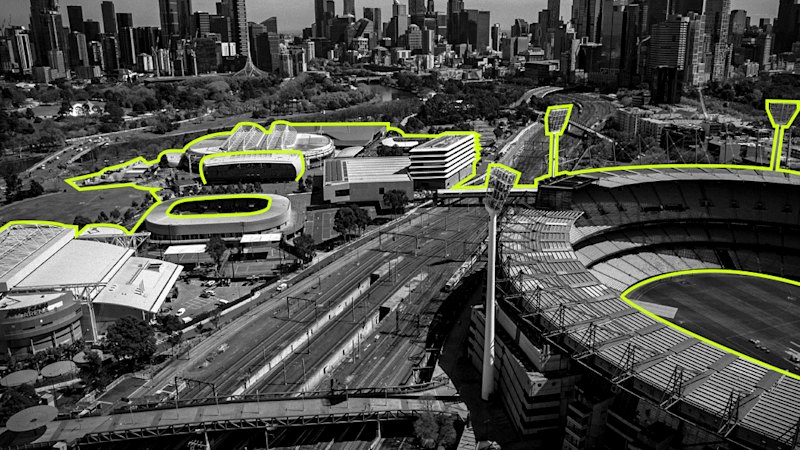
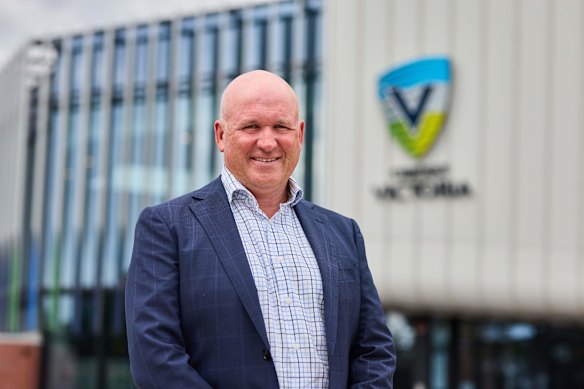
Cricket Victoria chief executive Nick Cummins still remembers the excitement when he first sat in the MCG’s brand-new 45,000-capacity Great Southern Stand just over 30 years ago.
“At the time, it was like a spaceship,” he said. “It was amazing that you could have such a big stand with so much seating and great sight lines … compared to somewhere like Victoria Park, where you had to stand on two cans so you could see over the tall person in front of you.”
Since renamed in honour of Victoria’s legendary spin bowler, the Shane Warne Stand still holds a special place in Melburnians’ hearts.
But in terms of consumer experience, in the age where anyone can watch almost any sport live from the comfort of their own home, Cummins said the MCG was at risk of falling behind.
As LA Rams president Kevin Demoff said last month, when comparing their shiny home ground, SoFi Stadium, with the Melbourne venue that hosted the first NFL match Down Under: “We play in the world’s greatest modern stadium … the MCG can be the greatest old stadium.”
Cummins said the MCG was catering predominantly for die-hard “sit down, sit still, watch the game” fans and failing to deliver for those who viewed sport more as a social experience – a segment of the market that is increasingly important for full-day events, such as Test cricket, to remain relevant and engaging.
So, how do Melbourne’s major sporting arenas compare with those around the country, and what do they need to change to remain competitive in the future? And how can Melbourne retain its much-cited status as the sports – and arts – capital of Australia?
Over the coming days, we are taking an in-depth look at Melbourne’s sport and the arts. The theme is one of the key pillars of Melbourne Assembly, a civic forum The Age is hosting later this month, bringing together industry leaders, key decision-makers and the community to shape the city’s future.
Lessons from interstate and overseas
Cummins cites interstate and American sports venues as examples of how the MCG could evolve.
“A lot of American stadiums now have these open patios where you can have almost like a barbecue deck or party deck,” the Cricket Victoria boss said. “At the AT&T Stadium where the Dallas Cowboys play, there’s a bar just below ground level ... and the players actually run through the bar to go onto the ground, and people will pay a lot of money just to be part of that.
“[In Australia] other states are building bigger venues … [with] superior facilities, including corporate hospitality, so although they might not hold as many people, the sports can make more money because they can get a more corporate return.
“We assume as Victorians that we’re entitled to these major sporting events … But other state governments are getting quite bullish in terms of challenging Victoria for that content.”
The MCG, the jewel in Melbourne’s crown, has evolved significantly over its 173 years, and its future is inextricably linked to the city’s reputation as Australia’s sporting capital. Alongside a highly competitive financial bid, the stadium was a key reason the NFL chose Victoria to host its Australian debut.
But while it retains the title of the largest stadium in the southern hemisphere, sports venues in other states have leapfrogged it in terms of consumer experience.

Perth’s Optus Stadium, which opened in 2018, is widely regarded as Australia’s most forward-leaning stadium. Among the first fully LED stadiums in the world, it features two 340-square-metre “super screens”, a light-up halo roof, adaptable seating configurations, and several open-air, pitch-facing terraces.
Other venues are on the horizon in Hobart and Brisbane, as well as major upgrades to the Queensland capital’s Suncorp Stadium, which will include Australia’s first 360-degree wrap-around LED ribbon screen, a “halo board” suspended from the stadium roof.
According to Melbourne-based venue-technology and intelligence firm PMY Group – one of the companies consulting on an MCG redevelopment business case, co-funded by the state government and the Melbourne Cricket Club – this is just the tip of the iceberg.
Chief executive Paul Yeomans said several stadiums overseas were completely rethinking the fan experience. At Intuit Dome in Los Angeles, a new NBA stadium where PMY led the technology design, fans can earn spendable loyalty points and prizes by cheering louder for the LA Clippers, with technology able to measure decibels down to a single seat.
“Going to sports games in the future will be a completely personalised, frictionless experience. Physical gates may be a thing of the past and queuing hopefully will be long gone. Venues will be able to remember who are you, where you like to sit, what you like to eat, and how you like to experience the action, and will customise their value proposition accordingly,” he said.
Melbourne’s sports precinct through the years
“They will also all be multi-use, with more collaboration between sports codes, music and entertainment to bring holistic ‘sportainment’ to life. The goal is really to sweat these infrastructure assets to maximise return on investment, so working out how to use them 365 days a year.”
How the MCG can be redeveloped to include “the contemporary facilities that athletes and spectators require” will be assessed as part of the business case, according to Development Victoria, a government planning agency. It is due to be finalised next year, with any eventual works – including to the Shane Warne Stand – expected to take at least a decade.
In the future, Yeomans said stadiums would be less like “colosseums” and more integrated with the surrounding area and businesses. He said the new stadium being built in Brisbane’s Victoria Park for the 2032 Olympics was a good example of this approach, as the parkland provided a natural precinct to spread out events.
Across the train tracks from the MCG, Yeomans said a number of these ideas were also being embraced. He said Melbourne Park was leading the way in its use of data to optimise the fan experience by better understanding the different demographics moving through the precinct, and tailoring its experience, food and beverage offerings, activations and advertising accordingly – a bit like a real-life version of social media algorithms.
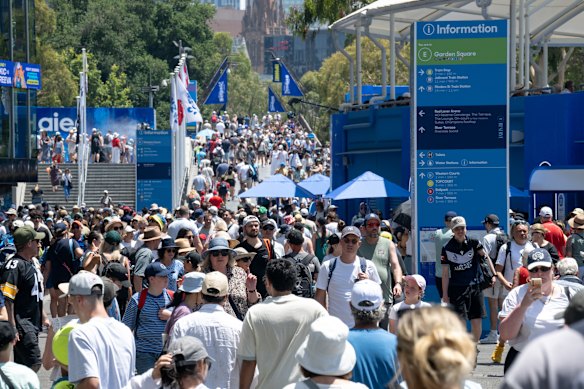
The precinct, which has been redeveloped with a $1 billion state funding injection since 2010, is best known as the home of the Australian Open, and is packed with tennis fans throughout January.
Melbourne Park chief executive John Harnden has been tasked with planning how to make the most of the space the other 11 months of the year. While Tennis Australia has long pushed for a more permanent footprint, Harnden – a panellist at Melbourne Assembly, of which Melbourne Park is a major partner – said he did not want the precinct to be “a one-trick pony”, and all venues had been designed to accommodate a range of uses and fans.
But the precinct has its own challenges. While it might have the modern edge on the MCG, and be only a stone’s throw away, the rail infrastructure between them have left it isolated, with minimal natural foot traffic. It also does not share the same historic or cultural weight of the ’G, that brings tourists to its gates for tours and photo opportunities almost every day of the year.
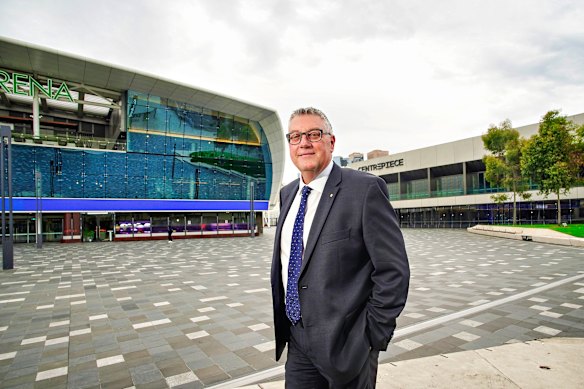
As Harnden pointed out, it is, for the most part, a nighttime venue. Full to bursting on evenings when major events are in town, it is notably empty on an average weekday – an odd sight in an era of a growing population and squeezed inner-city space.
According to Melbourne sports magnate Eddie McGuire, the answer to both sports precincts’ future relevance lies right between their noses.
‘A complete festival’
Of McGuire’s many ideas for the city’s future, building a sports and entertainment precinct over the rail tracks between the MCG and Melbourne Park is among his most enduring. He said it would lead to more foot traffic through Melbourne Park, and allow its modern facilities to be put to use during major events hosted at the MCG, such as the AFL grand final.
“We’ve got all of this magnificent infrastructure that the government has built … Centrepoint is just one of the best places, Rod Laver, Margaret Court, John Cain, all there. Collingwood’s ground is across the road. Punt Road’s there,” he said. “It costs you a fortune every time you put a marquee up [outside the MCG] … portable toilets. This is all there [at Melbourne Park]. Beautiful, air-conditioned, plumbed, magnificent.”
McGuire said covering the rail tracks would enable major events to expand their fan offerings outside the grounds, with big screens, stages, pop-up pubs and restaurants – a concept recently proven by the NFL’s takeover of Yarra Park to mirror popular tailgating parties outside games in the US. It would also limit the need to rely on temporary facilities in the parkland, which has frustrated some local residents.
“For major football games, cricket games, rugby league games, NFL games … we could get 100,000 in the ground and 200,000 around it, and turn it into a complete festival,” he said.
“You can then buy tickets to come into the precinct, but the outer precinct you can make free for kids and have jumping castles and AusKick over at Gosch’s Paddock, and turn the whole place into something great … You’ve got to remember why you’re doing it, and that’s why you’re doing it. It’s not just for the bloke with the super box, it’s for the kid who’s coming in, and maybe even for the kid who can’t get in.”
McGuire said he understood the idea would be explored as part of the MCG redevelopment business case. He said the main question still to be answered was how much it would cost and who would fund it, adding private equity could play a role. Harnden has also thrown his support behind the idea.
“From Melbourne Park’s perspective, stronger connections with the MCG would make it easier for people to experience everything this extraordinary precinct has to offer. We would welcome the opportunity to help shape any future proposal so it works well for visitors, events and the precinct as a whole,” he said.
Victorian Tourism Industry Council chief executive Lisa Patroni said she also viewed it as a natural next step.
“As competition between global destinations intensifies, we must continue to think ambitiously about the infrastructure, experiences and connections that will position Melbourne as a leading global destination for generations to come,” she said.
“Connecting two of Melbourne’s iconic sporting destinations [the MCG and Melbourne Park] presents an exciting opportunity to shape the future of Melbourne as Australia’s premier events and sporting capital … [and] would unlock new opportunities to experience, stay, explore and spend more time in our city. It represents the next evolution of a truly world-class events precinct and strengthens Melbourne’s ability to attract and host major sporting, cultural and business events well into the future.”
The state government did not respond to a request for comment.
McGuire said that once the rail area was covered, the precinct could be further expanded to connect other key areas of the city.
“I’ve always felt that the difference between Melbourne and particularly Sydney is [that] Sydney is a whole series of villages around this magnificent harbour. Melbourne has always had football grounds, racecourses, everything that was open to the public … so it’s just about connecting all that up,” he said.
Melbourne Assembly will be held from October 19 to October 21. More information is available on the Melbourne Assembly website.
KioskNews shows a cleaned-up reading view extracted from the publisher’s page — the original always lives on their site, not ours.