War starts when deterrence stops working
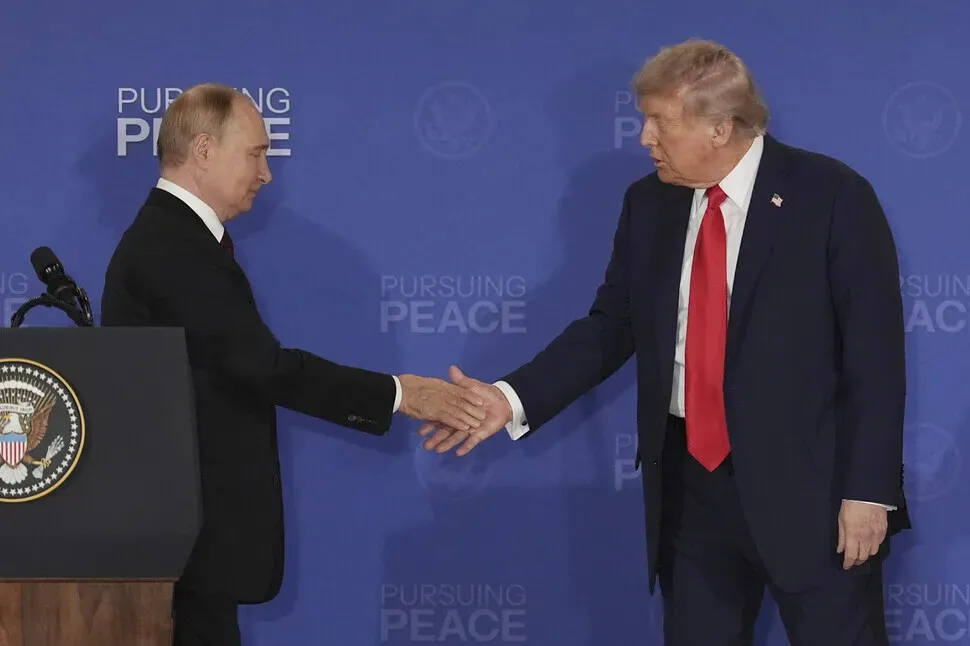
Russian President Vladimir Putin and US President Donald Trump shake hands during a joint press conference in Alaska on Aug. 15, 2025. (AP/Yonhap)
On June 28, 1914, the heir to the Austro-Hungarian throne was assassinated in Sarajevo. Just five weeks later, the world was at war.
No one at the time expected a conflagration that would leave 40 million people dead or wounded. Edward Grey, the British foreign secretary at the beginning of the war, later recalled the period in his 1925 memoir in meteorological terms: “In the early months of 1914 the international sky seemed clearer than it had been.”
Historians later explained the war as the result of a buildup of structural forces: tensions and mutual distrust between Britain, the established hegemon, and Germany, the rising challenger; the ascendancy of protectionism and the retreat of globalization; surging nationalism; territorial expansionism and competition for colonies; and an arms race. Add in the arrogance, miscalculations and foolishness of the leaders of the major powers, and systemic failure was inevitable.
Curiously enough, today’s world bears more than a passing resemblance to the prewar periods in 1914 and 1939 (when World War II began). Substitute the US and China for Britain and Germany, and similar patterns emerge across trade, military affairs and security. To make matters worse, leaders of major powers once again harbor vain ambitions of restoring defunct empires.
How local conflicts spark wider conflagrations
When great power rivalry is intense, even a small clash can lead to catastrophe. Regional wars are particularly dangerous when allowed to fester without being restrained by pressure from the international community.
Before World War I came the First Moroccan Crisis between Germany and France over Morocco’s status in 1905-06, Austria-Hungary’s annexation of Bosnia in 1908, the Second Moroccan Crisis in 1911 and the Balkan Wars of 1912-13.
Before World War II were Japan’s invasion of Manchuria in 1931 and Italy’s invasion of Ethiopia in 1935, along with Germany’s remilitarization of the Rhineland in 1936, annexation of Austria in 1938, and occupation of Czechoslovakia in 1939. Every unchecked precedent paved the way for the next act of aggression.
That’s why today’s wars are so dangerous. Russia’s invasion of Ukraine has continued for four and a half years. The Israel-Hamas war, which began three years ago, basically continues as a low-intensity conflict under a nominal ceasefire, while the US’ campaign against Iran has already passed the six-month mark.
The common denominator of those conflicts is that they all represent attempts by great powers or regional powers to expand their spheres of influence. When international law stands in the way, it is shoved aside.
The aggressors are even seeking to neutralize the International Criminal Court, which has become an integral part of the postwar system of international norms, to preempt attempted prosecution of war crimes. The US recently imposed sanctions on the court’s president and senior trial lawyer.
On the road to 1914 and 1939?
Troublingly, prominent historians and experts are now noting the similarities — or more precisely, the “historical parallels” — between today and the periods immediately preceding the two world wars.
A leading historian comparing the present moment to the eve of World War I is Odd Arne Westad, a professor at Yale University. In his book “The Coming Storm: Power, Conflict, and Warnings from History,” which was published this year, he identifies several characteristics of the late 19th and early 20th centuries: a prolonged peace among the great powers, the decline of British hegemony, multipolar competition, and economic globalization. War ensued, he argues, when those conditions began changing at roughly the same time.
Westad sees parallels between Germany then and China today: each overtook Britain or the US in manufacturing, each depended heavily on resources from overseas, and each regarded the hegemonic power’s tariffs and export controls as attempts to contain its economy.
There are parallels between the dominant powers as well. Britain was gripped by fear of imperial decline, while its citizens faced fewer jobs and more competition from immigrants and its leaders squandered blood and treasure in the unnecessary Boer War.
Westad writes that the US, much like Britain, has “squandered its global position through unnecessary wars, uncertain strategic priorities, and domestic social and economic decline,” resulting in a world increasingly reminiscent of the imperial wars, shifting alliances, revanchist powers and rampant expansionism of the late 19th century. Britain’s shift away from the free trade order it had championed toward tariffs in the early 20th century also bears an obvious resemblance to the US today.
A prominent figure emphasizing the parallels with the 1930s is Ray Dalio, founder of the hedge fund Bridgewater Associates.
Dalio identifies four broad similarities, the first being the monetary and credit order. As in the aftermath of the Great Depression, the budgets of the US and other major economies are strained by huge national debts.
The second similarity is the conflict over wealth and the rise of populism. After 1929, squabbles over distribution erupted in nearly every country, helping bring populist, authoritarian and nationalist leaders to power. Similar polarization is occurring today.
Third is the return of protectionism. The US Smoot-Hawley Tariff Act of 1930 lit the fuse of an international tariff war.
Fourth is the disintegration of the rules-based order. Just as the League of Nations began to collapse after Germany and Japan withdrew in 1933, international organizations can no longer constrain great powers as the world reverts to the law of the jungle, where “might makes right.”
Dalio believes that the monetary order, the domestic political order (in some countries), and the geopolitical world order are breaking down simultaneously, warning that “we are in a transition stage from the pre-fighting stage to the fighting stage,” roughly analogous to 1913-14 and 1938-39.
Is this the post-Cold War era or the eve of World War III?
Some broach the possibility of World War III. While no one knows whether that will actually happen, the prudent approach is to prepare for the worst.
When Adolf Hitler became German chancellor in 1933, few could foresee that was the first step toward World War II. Yet Hitler had always dreamed of territorial expansion and methodically prepared for it through the rearmament of Germany.
Had Britain and France recognized earlier what kind of man he was, they might have responded differently. Even in 1938, British and French leaders remained complacent, pursuing appeasement and neglecting preparations for war until Germany made its move.
To people of the time, the future was murky. But when the early and mid-1930s is viewed as the eve of the war, those critical developments come into focus.
The same is true today. Whether we regard the present as the post-Cold War era or the eve of World War III completely changes how we see the world. If we take a showdown between the US and China for granted, the puzzle pieces — higher tariffs and protectionism, economic warfare, military buildups and territorial expansionism — fit together into a picture that roughly resembles the periods preceding the two world wars.
But even when structural contradictions reach the breaking point, it is ultimately a leader who must choose to pull the trigger. Margaret MacMillan, a professor at the University of Oxford, faulted the era’s dithering and daft leaders in “The War That Ended Peace: How Europe Abandoned Peace for the First World War.”
“It was Europe’s and the world’s tragedy in retrospect that none of the key players in 1914 were great and imaginative leaders who had the courage to stand out against the pressures building up for war,” MacMillan wrote. “Forces, ideas, prejudices, institutions, conflicts, all are surely important. Yet that still leaves the individuals, not in the end that many of them, who had to say yes, go ahead and unleash war, or no, stop.”
Unfortunately, there is little reason to believe the leaders of today’s major powers have better judgment than those in 1914 or 1939. Kaiser Wilhelm II expected that a short but vigorous war would reshape the Balkans in Germany’s favor and strengthen his own political position at home. That’s probably comparable to what Russian President Vladimir Putin and US President Donald Trump envisioned before launching their respective attacks on Ukraine and Iran.
War remains a leader’s choice
The most dangerous link in the chain is Putin. He is reminiscent of the leaders of the Austro-Hungarian Empire who pulled the trigger on World War I: the last gamble of a declining empire compounded by an autocrat’s hunger for power.
That is why CIA Director John Ratcliffe’s surprise visit to Moscow on Aug. 25 is so disturbing. The Wall Street Journal reported that one purpose of his visit was to warn Russia against testing NATO, such as by attacking the three Baltic states.
The key is for the US to maintain credible deterrence, leaving leaders of other great powers with no room for miscalculation.
In an essay for Foreign Affairs, Westad argues that once Europe’s great powers began mobilizing against one another in July 1914, the war was made almost inevitable by Germany’s foolhardy belief that Britain might decline to aid its friends and allies.
The same was true before World War II. Hitler miscalculated that Britain would not come to Poland’s aid. Thus, both world wars began when deterrence was undermined by unreliable security pledges.
That is what makes Trump’s impulsive, improvisational leadership so dangerous. His transactional diplomacy toward allies and adversaries alike erodes the credibility of deterrence. The moment the commitment to defend an ally is seen as being up for negotiation, adversaries may assume that the US will not come.
As Grey wrote in his memoir, the skies in 1914 looked clear. But that was a failure of observation.
Should we read the present as a time of turbulence in the post-Cold War era, or as the eve of World War III? Some things only become visible in the proper framing — and only the watchful can make the necessary preparations.
KioskNews shows a cleaned-up reading view extracted from the publisher’s page — the original always lives on their site, not ours.