Michigan rabbis lay out demands for El-Sayed and state Democrats to earn their votes
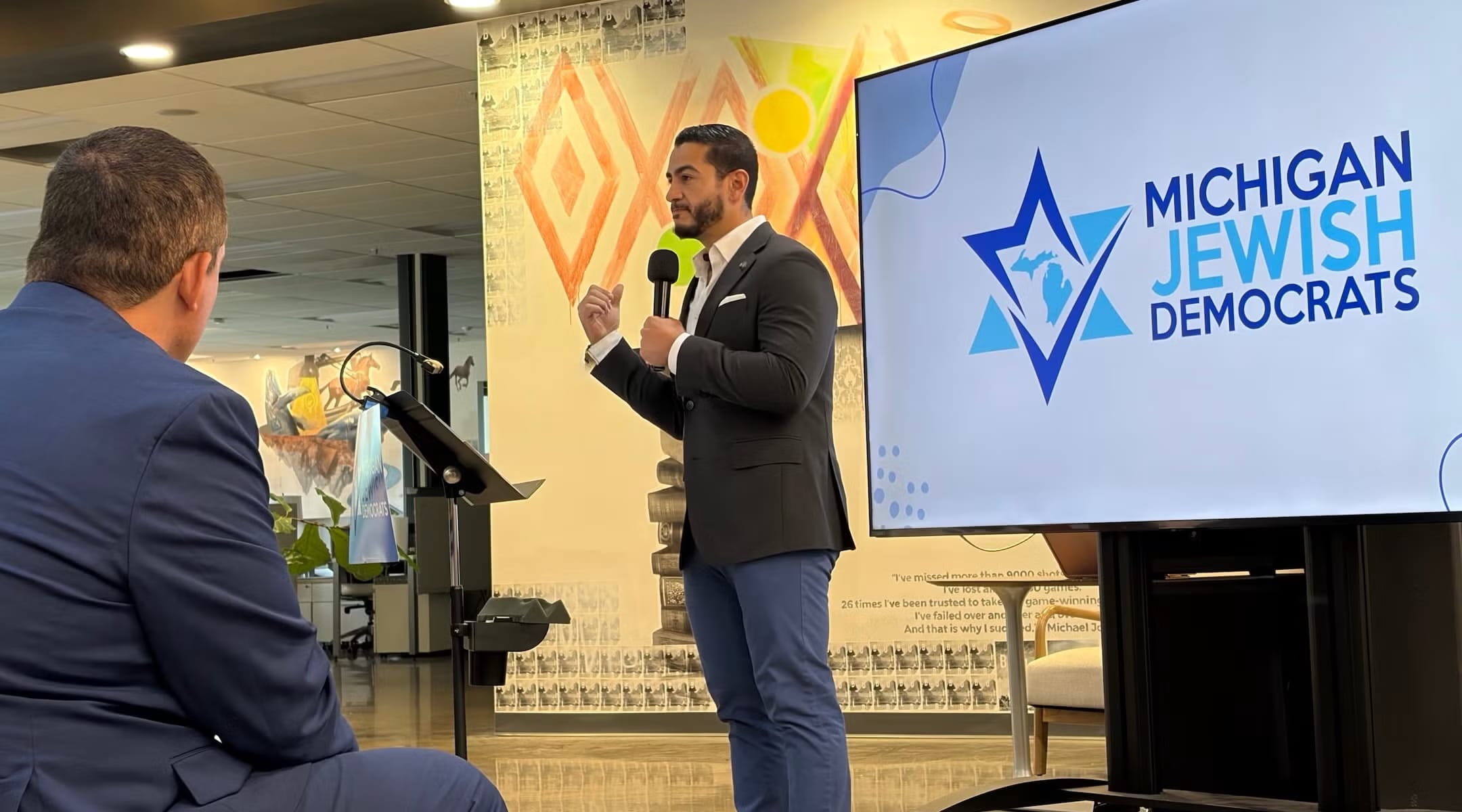
Liberal Michigan rabbis and other Jewish leaders are calling on the Democratic Party to agree to a list of “nonnegotiable” principles about Jewish safety and Israel as the party’s US Senate candidate in the state, Abdul El-Sayed, seeks to make inroads with Jewish voters.
The campaign, backed by a progressive Zionist group, comes as a different subset of Michigan Jewish leaders are urging their community to reject El-Sayed outright and instead vote for his Republican opponent, former US Rep. Mike Rogers.
“I think he has the potential to be an amazing, visionary leader in the state of Michigan and in this country,” Rabbi Josh Whinston, who heads the Reform Temple Beth Emeth in Ann Arbor and has met privately with El-Sayed, said Monday about the Democratic candidate during a press conference. “But his vision needs to be more inclusive.”
Whinston was one of more than a dozen Jewish clergy who signed “Nonnegotiable Michigan,” the open letter. It does not directly address El-Sayed by name but outlines five principles its signers say “leaders who want our votes” must demonstrate.

The letter lists five “nonnegotiables”:
“Jewish safety — including for Zionist Jews — in Michigan and across America”;
“Our right to define our own Jewish identities”;
“Jewish sovereignty in Israel”;
“Welcoming our full participation in American political life”; and
“An affirmative vision for a better future in the Middle East.”
The “Nonnegotiable” campaign is backed by Zioness Action Fund, a registered 501(c)4 associated with the advocacy group Zioness, which bills itself as “Unabashedly progressive. Unapologetically Zionist.” Past Zioness actions have put pressure on progressive spaces to become more welcoming of Zionism as the progressive movement has sharply turned against Israel.
The initial signatories number 16, most of whom are Reform and Conservative rabbis and cantors serving congregations in the state. The initiative was spearheaded by Whinston and Rabbi Aaron Starr, of the Conservative Congregation Shaarey Zedek in Southfield, a Detroit suburb. Starr is also president of the Michigan Board of Rabbis.
“We realized we were all having this same experience of our members coming to us and saying, ‘Rabbi, what should I do?’” Starr told the Jewish Telegraphic Agency about the letter’s origins.
At the press conference, Starr compared the relationship between Jews and political parties to a marriage. “I would advise against a couple getting married if they can’t ensure each other’s safety and can’t honor each other’s identity,” he said.
It remains relatively rare for Jewish spiritual leaders to directly involve themselves in electoral politics, though a large coalition of thousands of rabbis signed onto a letter opposing “rising anti-Zionism” shortly before the election last year of New York City Mayor Zohran Mamdani, a harsh critic of Israel.
The latest letter comes as Michigan’s Jewish community of around 100,000 has been put in the national spotlight in a crucial election for deciding control of the Senate. In late August, El-Sayed, a strident Israel critic who has questioned its future as a Jewish state, apologized to Jewish Democrats for his past comments about the Temple Israel attack in West Bloomfield Township earlier this year. El-Sayed had said of the attacker, who lost family in an Israeli strike in Lebanon, “Hurt people hurt people,” triggering backlash from the Jewish community.
The candidate has also been meeting with Jewish voters and leaders, and recently told JTA that “safety” is the top concern he hears from them. His campaign intends to hire a Jewish liaison, sources have told JTA.
El-Sayed has not budged on other issues of concern to Jewish voters, including his reticence to back a two-state solution that would specifically recognize Jewish sovereignty — though he has said he would be open to the possibility if Israelis and Palestinians jointly agreed on it.
Letter was in the works since before El-Sayed's apology, petition's leader says
The petition’s leaders told JTA their letter had been in the works since before El-Sayed’s apology, and said he needs to do more. “It took on another level of meaning after his quote-unquote ‘apology,’ which was really only a partial apology,” Starr said.
Following one of El-Sayed’s apologies, Michigan Attorney General Dana Nessel, who is Jewish, urged the same room of Jewish Democrats ”to place the needs of the world above even our own self-interest and, yes, even our own survival.” Invoking Queen Esther and “Jewish values,” Nessel’s remarks have since been criticized by Jews across the spectrum and spurred renewed debate over the role of Jewish interests in the broader political conversation.
In contrast to Nessel, and to the rival letter urging a Rogers vote, the “Nonnegotiable” campaign does not endorse a candidate. Instead, it argues that Democratic leaders should make clear to Jews that they agree with what the letter defines as central Jewish concerns.
“Every constituency must occasionally remind its party that support is earned, not owed,” the letter states. “This is a good faith effort to make our needs unmistakably clear, and to invite any candidate seeking public office — now or in the future — to engage, listen, learn, and grow.”
Spokespeople for the El-Sayed campaign and for the Michigan Democratic Party did not immediately return JTA requests for comment.
Starr said the values articulated in the letter go beyond El-Sayed: Jews, he told JTA, also have “an eye to 2028.”
KioskNews shows a cleaned-up reading view extracted from the publisher’s page — the original always lives on their site, not ours.