Concrete aims or just symbolism? Trump, Xi and Putin talk nuclear risk but controls stall
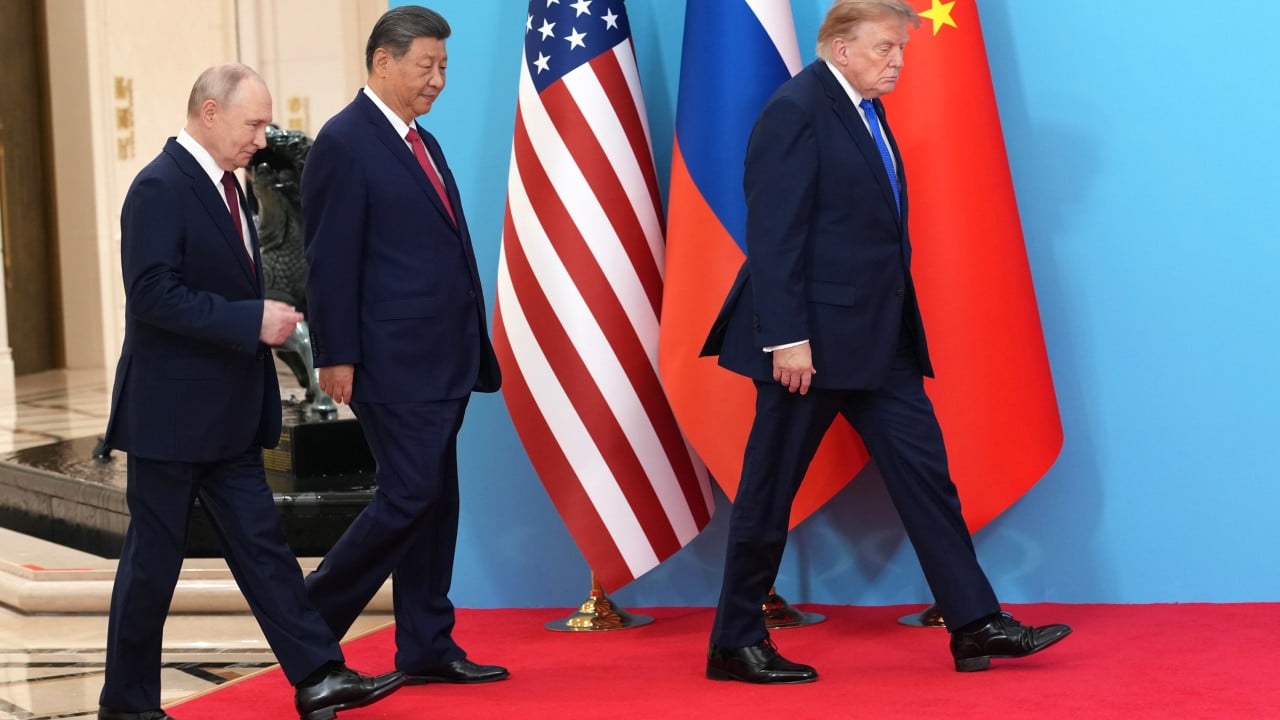
The joint pledge to reduce nuclear risk by the United States, China and Russia during their unprecedented three-way summit this week sends a positive signal on stability, analysts say, although they warn that there is little room for optimism without concrete measures.
Nuclear arms control among the world’s three major nuclear powers – long sought by US President Donald Trump – failed to make it into the joint declaration after his talks with Chinese President Xi Jinping and Russian President Vladimir Putin in Shenzhen on Thursday.
The three countries notably pledged to engage in a dialogue on nuclear risk reduction and non-proliferation, yet it remains unclear whether the leaders substantively discussed either issue during the talks.
02:48
Xi, Trump and Putin meet for historic trilateral summit at Shenzhen Apec meeting
“The contrast between President Trump’s stated ambition to negotiate a new arms control treaty and the declaration’s lack of substance could hardly be starker,” said Zhao Tong, senior fellow at the Carnegie Endowment for International Peace, adding that the declaration “fell far short of expectations”.
Beijing has repeatedly refused to join trilateral nuclear arms control negotiations, citing the disparity in arsenal sizes. According to estimates by the Stockholm International Peace Research Institute (SIPRI), Russia and the US hold total inventories of about 5,420 and 5,042 warheads respectively, compared with China’s 620.
While stating that the three powers were “uniquely positioned” to discuss nuclear reduction, Trump acknowledged the difficulty.
“It’s quite frankly a very hard thing to do because once you have the nuclear weapons, it’s very hard to not have them. It’s very hard to give them up as the leader of a country,” he said in his opening remarks during the trilateral summit.
The last bilateral nuclear arms control treaty between Washington and Moscow, New Start, expired in February. It had capped each country at 1,550 deployed strategic nuclear warheads and a combined 700 deployed intercontinental ballistic missiles, submarine-launched ballistic missiles and heavy bombers.
In Shenzhen on Thursday, the three leaders also reaffirmed the Cold War-era Reagan-Gorbachev statement that “a nuclear war cannot be won and must never be fought” – a pledge last jointly endorsed by the leaders of five recognised nuclear-weapon states in 2022.
Reaffirming that statement did no harm, Zhao said, but it did little to address the intensifying nuclear arms competition. He noted that the declaration identified no shared interests – let alone concrete measures – in curbing nuclear arsenal expansion or pursuing arms-control cooperation.
Analysts also said it remained to be seen how the proposed framework on nuclear risk reduction and non-proliferation would unfold after the summit.
Zhao said nuclear risk reduction was only meaningful if it addressed the underlying drivers of growing risks, including AI integration into military systems and all three powers’ embrace of rapid nuclear launch capabilities.
Although Xi and former US president Joe Biden agreed in 2024 on the need to maintain human control over nuclear command-and-control decisions rather than ceding them to artificial intelligence (AI), a step some analysts viewed as low-hanging fruit, that commitment was omitted from the trilateral talks.
On non-proliferation, the leaders offered no concrete commitments to curb North Korea’s nuclear expansion or prevent other countries – including Iran – from acquiring nuclear weapons, Zhao added.
“The only glimmer of hope lies in the prospect of a future dialogue, but the devil is in the details,” he said.
“Will it amount to another symbolic leaders’ meeting or evolve into a series of sustained, substantive talks aimed at concrete results?
“Even the level at which such a dialogue would take place remains unspecified. The brevity and vagueness of the nuclear language give little reason for optimism.”
Hu Bo, director of the Centre for Maritime Strategy Studies at Peking University, said it was nevertheless a positive step for the three leaders to begin discussing nuclear issues.
“However, it is neither a surprise nor a breakthrough, as non-proliferation has always been a shared interest among the three powers,” Hu said.
“They have simply talked about it less over the past couple of years due to major-power rivalry, so reaffirming it now still carries significant weight.”
While Trump sought to eliminate Iran’s nuclear capabilities, Hu said the new peace declaration was not likely to have an immediate effect on the nuclear issue in Iran or the ongoing conflict, which must ultimately be resolved by Tehran and Washington.
“When it comes to reducing nuclear risks, this mainly refers to preventing nuclear accidents, including those involving infrastructure – which I believe will lean more towards civilian facilities,” he said.
“Making progress on the military side remains very difficult, given the lack of transparency and the impossibility of sharing sensitive information.”
01:47
North Korea launches second 5,000-tonne nuclear destroyer in 75 days
Other analysts echoed the view that while the statement lacked binding commitments, keeping diplomatic channels open had strategic value.
“This statement is far from meaningful arms control. But it’s still a reasonable down payment on stability,” wrote Erin D. Dumbacher, Stanton nuclear security senior fellow and director of the Defence and National Security Programme at the Council on Foreign Relations (CFR).
While Trump was concerned about Iran, Putin and Xi would “have US allies in mind”, she said.
“They don’t want Germany, Japan, Poland or South Korea to consider building their own nuclear arsenal if US commitments to defend them fall away,” Dumbacher wrote in an article published on the CFR website on Thursday.
KioskNews shows a cleaned-up reading view extracted from the publisher’s page — the original always lives on their site, not ours.