Binoculars over the border: The Chinese town visited by Kim Jong-un
Dandong: It’s early morning in the Chinese border city of Dandong, and truck drivers are pulling over for a brief rest in their cabs a few hundred metres from a four-lane bridge that has just opened to North Korea.
On an ordinary day, dozens of trucks will bank up here, carrying a mix of cargo including trees, fresh fruit, cement, clothes, plastics, machinery and furniture – all headed across the border once it clears Chinese customs.
But on Saturday, traffic ground to a halt as North Korean leader Kim Jong-un crossed the bridge himself, lauding its “historic mission” to unite the two countries in a surprise visit to Dandong.
“Everyone went crazy,” says Mr Zhang, a truck driver who crosses the border at least once a week.
“Dandong is a small city; we’ve never had such a high-ranking official visit.”
Kim’s rumoured arrival was the talk of the town, as extensive roadblocks cordoned off the bridge district and hotels along the riverfront mysteriously booked out. The evening before, Chinese Navy divers could be seen at the water’s edge, oxygen tanks still strapped to their backs, possibly having just cleared the river in a security sweep.
The New Yalu River Bridge is not particularly new. The three-kilometre, two-way link sat unused for 12 years until this month, delayed by North Korea’s lagging efforts to finish building customs facilities on its side of the border.
It connects Dandong, in China’s northeast Liaoning province, and the North Korean city of Sinuiju, replacing the single-lane Friendship Bridge as the main trade thoroughfare between the two countries.
Bridges are often as symbolic as they are functional. In the city centre, Dandong has preserved as a patriotic site the US-bombed bridge that Chinese troops used to march into the Korean War in 1950 to support the North. Kim paid homage to this “friendship forged in blood” at Dandong’s war museum during his visit.
The new bridge, in part, continues this legacy, functioning as a key conduit for the economic lifeline China provides to the North, helping sustain the Kim regime in the face of US-led international sanctions designed to cripple its nuclear weapons program.
Kim’s visit is a signal that Pyongyang wants to strengthen ties with Beijing, which had cooled in recent years, while also forging a new alliance with Russia and sending troops to fight in its war in Ukraine.
“North Korea is most comfortable playing two patrons off each other, basically to achieve its own autonomy,” says Justin Hastings, a professor of international relations at the University of Sydney.
In theory, the bridge paves the way for increased trade between the two allies by accommodating heavier trucks and two-way traffic. North Korea is already dependent on China for almost all of its foreign trade, most of it transiting through Dandong.
Whether it ramps up will be determined by politics, not infrastructure alone, says Christopher Green, a Korea studies expert at Leiden University in the Netherlands. Kim, he notes, did not attend last month’s opening of North Korea’s first road bridge to Russia.
“He has gone over the bridge to show his belief in the strength of China-North Korean relations,” Green says, “and given his imprimatur to bilateral trade.”
The Dandong trip was Kim’s first visit to China in more than year. It follows Chinese leader Xi Jinping’s state visit to North Korea in June, his first in seven years, widely interpreted as a move to counterbalance Kim’s pivot to Moscow.
For now, Zhang, the truck driver, is sceptical that his business will see a sudden pick-up in cargo volume.
“As long as US sanctions remain, [the bridge] won’t make much difference. North Korea can’t develop even if it wants to,” he says.
Window to another world
Dandong is a city with its nose pressed against the looking glass.
About the same time that Kim was touring a bus factory in Dandong, accompanied by China’s top political adviser Wang Huning, tourists on the easternmost stretch of the Great Wall of China, 20 kilometres away, were peering across the border at his citizens.
Here the Yalu River narrows to just a trickle, and the Wall provides a vantage point to see beyond the North’s boundary, which Pyongyang has fortified since the pandemic with concrete, electric fences and watchtowers to lock in potential defectors.
On top of a tall building, children were stripping corn of husks in the afternoon sun before things took a mischievous turn and they began chasing each other around the rooftop.
This is one of the “model” villages that the regime has built as a showcase to the world. The apartment towers are new, replacing homes damaged by floods in 2024. But they are incongruous with their austere surroundings, arising almost out of nowhere and surrounded by underdeveloped farmland, where workers are carrying sacks of crops on their backs.
The few roads are deserted, although a motorbike or two can be seen zipping around.
It’s a stark contrast with the Kim’s family’s luxurious existence at their seaside villa in Wonsan, where satellite images recently captured his 80-metre mega-yacht with its 50-metre pool and waterslides.
“There’s no trickle-down,” says Green. “It’s all about patronage networks and maintaining the coffers of the government elite and investing in the things that help to preserve the regime, such as nuclear weapons and missiles, which are clearly not helping the economy develop.”
Meanwhile, along the waterfront promenade in central Dandong, the Chinese city quite literally stares directly across the Yalu River at its neighbours. It mines public curiosity about the hermit kingdom for tourism dollars.
Giant pay-for-use binoculars offer a close-up view of the facade North Korea has built on the opposite shore in Sinuiju, less than a kilometre away. Even some river-facing hotels offer guests in-room binoculars.
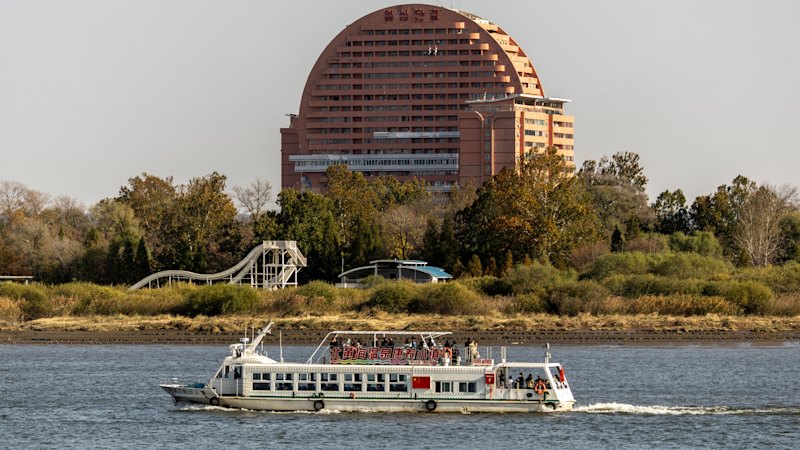
Chinese vendors sell North Korean banknotes and cigarettes as souvenirs and river cruises run on the hour. They loop past local landmarks, including the massive sun-shaped orange apartment tower, where laundry hangs from a few balconies. There’s a waterslide park nearby, but it’s too cold to gauge whether it’s functional.
For some Chinese locals and tourists, Dandong holds up a mirror to their lives, inviting a favourable juxtaposition with their comrades whose leaders have never released their grip on totalitarian socialism.
“We have more freedom than North Korea,” says Mr Liu, aged in his 50s, giving only his surname.
He takes a dip in the Yalu River most days, sometimes paddling right to the North Korean shore.
“You can stand up in the water on the other side,” he says, but you cannot venture onto North Korea’s bank.
Occasionally, he will spot a construction worker and wave to them, but otherwise the buildings on the other side appear largely vacant.
At night, the contrast is stark. On Saturday evening, the Dandong side was buzzing with tourists and street sellers, with people spilling out of neon-lit restaurants and shops, while Sinuiju appeared dark and subdued, but for a few faint lights glowing in the windows of some buildings.
Banking on booming trade
At least one business in Dandong is banking on the new bridge making it smoother to do business with North Korea.
Around the corner from Dandong’s customs checkpoint, a new trading centre showroom is already stocked with goods — clothes, blankets, hats, women’s wigs, wooden doors, tyres and alcohol.
“North Korean business people come regularly. They’re coming again in a couple of days to buy medicines. Demand is huge,” says a worker, who does not give his name.
They order in bulk and pay in cash, he adds.
This kind of trade does not violate international sanctions, which in 2017 made it illegal for UN member states to sell military equipment, heavy machinery and luxury items such as cars and jewellery to the Kim regime.
But hiring North Korean workers in restaurants and factories does, with their wages confiscated by Pyongyang. It is a well-documented practice in China despite Beijing maintaining it complies with the sanctions.
In the city’s backblocks, the fluorescent lights inside a garment factory reveal a North Korean banner posted across a wall.
“Let us uphold the spirit of revolutionary comradeship!,” it says in red Korean script.
A decade ago, Dandong’s government claimed there were 10,000 North Korean workers employed in its factories, and boasted they were “well disciplined and easy to manage” and unlikely to ever strike.
Today, calls to five different contact numbers for the garment factory failed to produce an answer as to why Korean slogans were being deployed to inspire its workers.
Luorui Xiang contributed research.
Get a note directly from our foreign correspondents on what’s making headlines around the world. Sign up for our weekly What in the World newsletter.
KioskNews shows a cleaned-up reading view extracted from the publisher’s page — the original always lives on their site, not ours.