[Column] No, tactical nukes aren’t practical for real-world use
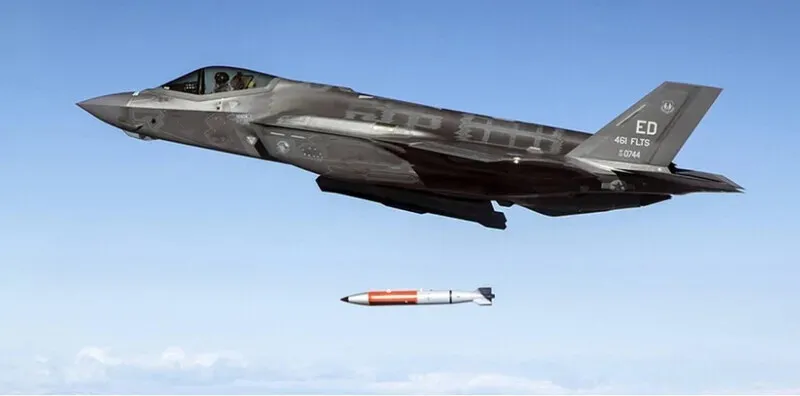
A US F-35 fighter jet drops a dummy B61-12 bomb, which can be used as a tactical nuke, during training. (via Los Alamos National Laboratory)

By Kwon Hyuk-chul, unification and foreign affairs editor
“Despite the threat posed by North Korea’s nuclear program, President Lee Jae Myung will stubbornly oppose US plans to provide tactical nuclear weapons to its allies,” People Power Party spokesperson Cho Yong-sool said in a statement on Aug. 8.
The statement mentioned that the US Department of Defense is looking to expand the role of shorter-range tactical nuclear weapons, along with the fact that Lee has previously opposed allowing the US to deploy tactical nuclear weapons to the Korean Peninsula.
“If even the US is considering a new strategy for increasing the efficacy of its nuclear umbrella, we should be keeping all options on the table and reviewing them dispassionately from the perspective of the national interest,” Cho argued.
Cho’s statement amounts to an appeal to take another look at letting the US deploy tactical nuclear weapons in Korea, as it used to do.
It goes without saying that a US decision to deploy such weapons in Korea would be based on its global strategy, and not on the wishes of the Korean government.
Indeed, the US’ removal of tactical nuclear weapons from Korea was itself part of a revised global strategy.
On Sept. 28, 1991, US President George H. Bush announced the removal and destruction of tactical nuclear weapons deployed around the world.
Given US concerns that some of the nuclear weapons scattered across the 15 Soviet republics might fall into the hands of “rogue states” after the dissolution of the Soviet Union, the US took this preemptive step as a way of encouraging the Soviets to do the same. All tactical nuclear weapons deployed to US military bases since the 1950s were removed at that time.
In a private speech delivered recently, Elbridge Colby, the US undersecretary of defense for policy, reportedly spoke of growing interest in small tactical nuclear weapons and advocated the need for the US to possess reasonable nuclear options.
That has kindled hopes among some — including, evidently, Cho — that another iteration of the US’ nuclear strategy will lead to the redeployment of tactical nuclear weapons in Korea.
But given the US’ approach to fielding tactical nuclear weapons and the strategic advantages and disadvantages of such weapons, the chances of the US actually fielding tactical nuclear weapons in Korea again are little better than the proverbial camel passing through the eye of the needle.
In 1991, there were around 100 tactical nuclear warheads stationed with US Forces Korea, which included not only bombs for airborne delivery but also 40 nuclear shells permanently assigned to artillery units.
The US current military doctrine assumes that tactical nuclear weapons would be dropped by aircraft. The B61-12, a tactical nuclear weapon deployed at bases in Germany and other parts of Europe, can be delivered by such aircraft as the B-2 strategic bomber and the F-35 fighter.
This bomb is designed to have a variable yield, including such options as 0.3 kilotons, 1.5 kilotons, 10 kilotons and 50 kilotons. A single kiloton is the explosive power of a thousand tons of TNT.
If the US were to deploy tactical nuclear weapons on USFK bases, the primary target would be North Korea. But there would also be a backlash from China and Russia.
By leaving tactical nuclear weapons on the mainland and in such overseas territories as Guam, the US gains greater flexibility for responding to developments not only on the Korean Peninsula but in a range of regions. After all, it would only take a couple of hours for US strategic bombers bearing tactical nuclear weapons to reach the Korean Peninsula from bases in Guam.
Given the US’ emphasis on strategic flexibility, there’s little to be gained from having tactical nuclear weapons permanently deployed on USFK bases.
In the debate over tactical nuclear weapons, we must be wary about the fallacious assumption that while strategic nuclear weapons are too destructive to be used (and are thus reserved for deterrence), tactical nuclear weapons, being less destructive, are fit for use in actual warfare.
Tactical nuclear weapons are generally classified as those with a yield of between 20 and 100 kilotons.
The original distinction between strategic and tactical nuclear weapons derived from geographical considerations in the Cold War, with the US and Soviet Union both being continent-spanning countries with considerable distances between major cities. The Pacific Ocean also served as an ample buffer between the two sides.
The US-based distinction between strategic and tactical weapons isn’t really applicable to the Korean Peninsula, which is much smaller and crammed with densely populated metropolises.
Seoul, given its proximity to the armistice line, would be exposed to radioactive fallout if tactical nuclear weapons were used against North Korea.
According to a simulation run by the Defense Threat Reduction Agency, an agency within the US Department of Defense, the detonation of a 20-kiloton nuclear bomb in the central Yongsan area of Seoul would inflict around 2.75 million casualties altogether, including 1.13 million deaths.
For Koreans, in other words, the distinction between strategic and tactical nuclear weapons is largely meaningless.
According to US standards, the atomic bombs dropped on Hiroshima (15 kilotons) and Nagasaki (21 kilotons) in August 1945 were both tactical warheads. By that December, around 140,000 people had died in Hiroshima and 74,000 in Nagasaki.
KioskNews shows a cleaned-up reading view extracted from the publisher’s page — the original always lives on their site, not ours.