Balraj Khanna: Lines of Flight review – plenty of dazzle, but where is the darkness?
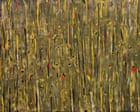
The work of Balraj Khanna will be familiar to many residents of Birmingham, whether they know it or not. Displayed on the safety curtain at the Hippodrome, his monumental painting Astral Dance has prepared countless theatregoers for the evening’s performance since it was completed in 2001. Khanna produced a dreamlike vision of biomorphic forms – pulsing blobs, splayed fingers, blooming whorls – set against variegated orange hues. Its delightful colours and benign shapes conjure a palpable sense of magic and wonder, while also containing little that might disturb the audience’s mind beyond the curtain’s raising.
This show is likewise one of flash and spectacle. The introductory text makes a point of the fact that, having been born in Punjab in 1939, Khanna witnessed the 1947 partition of India as a young boy. But if that generational trauma influenced his work as an artist, then it is apparent only in a turning away from horror towards the consolations of fantasy. He moved to London in 1962, just in time for the invention of sex (in Philip Larkin’s account), but the social revolutions of the era are no more obvious. Instead, his practice as an artist (and a picaresque novelist) summons more innocent memories: the astonishments of street entertainment and the glamorous artifice of theatre.
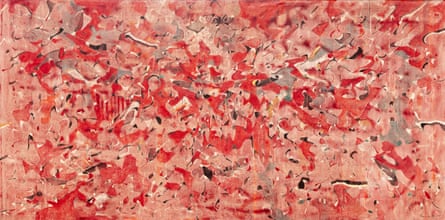
One tantalising early work hints at darkness behind the dazzle. In a mulch-green landscape, a body struggles to unwrap itself from a winding shroud. Composed during the artist’s rehabilitation from a motorcycle accident, the puzzlingly titled Ladies With Qualification is so direct in its expression of suffering that you wonder whether this otherwise effervescent artist abandoned figuration because he found it too revealing. The surrounding abstractions struggle to match its charge, shoehorning blustery squiggles into strict grids that can impose only the most superficial measure of control. This is an issue that will dog the work.
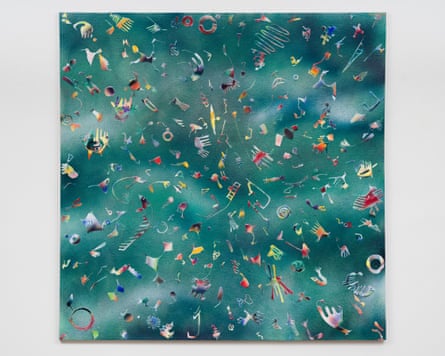
A standout is A Grasshopper’s Eye View, the title of which was suggested by the enduringly great Indian painter FN Souza, an early supporter of Khanna. Colourfully striped, spotted and dotted globules float through a field of verdant colour structured by regular vertical struts and subtle horizontal balances that allow the eye to wander at leisure around the picture without fear of getting lost in the confusion. The title is apt: a grasshopper might not be able to see how the wider world is organised, but can be confident enough in the prevailing rules (of gravity, of the distribution of forces) to jump from one stalk to the next.
This balance is difficult to maintain. Unravelled, which presents a tangle of white lines against a night-blue background, might seem to meet Paul Klee’s maxim that making a drawing is like “taking a line for a walk”. The problem is that this walk should ideally take the artist into strange and unexpected places. Khanna’s line, by comparison, meanders around the canvas, turning back politely when it veers too close to the edges. His line feels a little too well behaved to drag its owner down into the depths of the unconscious, as artists including Klee (a clear influence) hoped it might do.
It is nonetheless entertaining to see an artist try on so many styles: an abrupt diversion into hard-edge minimalism; a rhapsody in pink scattered with footprints (perhaps in homage to Jackson Pollock’s Blue Poles); a gloss finish anticipating the vogue for spray paint (it seems Khanna achieved the effect by blowing paint through a straw). But two significant paintings from 1970 show an artist getting a grip on the compositional dynamics – the systems of push and pull – that would govern the fabulous world of his paintings. In Splash and Festival this takes the form of an invisible force pulling forms resembling glistening scales and fading petals into a central vortex. They promise much.
On the second floor, Khanna settles into a style. Characterised by forms resembling amoebas, tropical fish and bioluminescent invertebrates floating through candy-coloured galaxies, the style is cosmic in its ambitions and bombastic in scale. The late painting Big Bang is typical: a vaguely celestial landscape in which the attempts of Klee, Miró or Kandinsky to pull archetypal forms out of the primordial soup have been replaced by shapes like children’s toys drifting through a Day-Glo ether. Like magic tricks, these paintings attract your gaze but do not hold it for long. My lingering feeling was that this was no longer a failure: the artist preferred, for reasons of temperament, to excite the eye rather than trouble the mind.
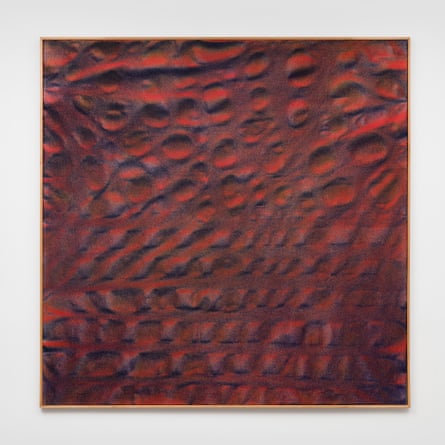
Nothing wrong with this, of course: paintings can do all kinds of things. Yet three remarkable works are so at odds with the general bravado that no one seems sure they were finished (the artist died in 2024, and the wall text calls them “almost studies”). Sunset in Sinai is a grainy landscape of depressions and folds that might equally be the surface of Mars or the fabric of spacetime; Dunes, in gorgeous bright pastel tones, is embedded with trails of string (a characteristic technique) that pull the colour off a series of gentle ripples; Ocean is a marvellously delicate interplay of scintillating pinks and greens. These strangely melancholy close studies of the natural world strike me as far more transcendent than the aggressively cosmic scenes by which they are surrounded. Because they are so much less eager to impress, I found myself wanting to spend time with them. They made me wish that Khanna had more often resisted the urge to entertain.
-
Balraj Khanna: Lines of Flight is at Ikon, Birmingham, until 21 February
KioskNews shows a cleaned-up reading view extracted from the publisher’s page — the original always lives on their site, not ours.