Marc-Olivier Fortin: The Parti Québécois will be pulled left and right. Can it survive?
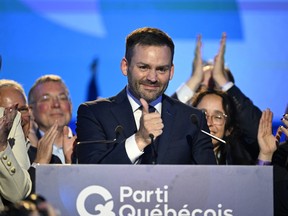
Physicists have long struggled to predict the movement of three objects exerting gravitational force on one another. It is popularly known as the three-body problem. Monday night, Quebec may have created its own three-party problem.
Sign In or Create an Account
While the Parti Québécois was able to form government, it fell just five seats short of a majority. For reasons yet to be determined, the PQ electorate did not come out at full force. While polling averages had them at 29 per cent with a big lead among francophone voters, the party underperformed and could barely reach 28 per cent in support. It was held to a minority.
The Quebec Liberal Party won 40 seats up from 21 in 2022 and was able to regain ground in historically liberal strongholds of the province including a foothold in Quebec City. The incumbent Coalition Avenir Québec was wiped off the map with zero seats. But those two parties are not the story of the night.

Columnist Jesse Kline keeps you up to date with what’s happening in Israel and the effects of antisemitism on life here in Canada. Friday mornings.
By signing up you consent to receive the above newsletter from Postmedia Network Inc.
A welcome email is on its way. If you don't see it, please check your junk folder.
The next issue of Channel Israel will soon be in your inbox.
We encountered an issue signing you up. Please try again
Quebec Solidaire and the Conservatives are. And being in a minority, the leader of the PQ, Paul St-Pierre Plamondon, will have to work with one of the two.
QS survived the doom and gloom scenarios and lost only three seats, electing nine MNAs, resisting the PQ assault in eastern Montreal. QS is a left-wing party that is also separatist, making it a natural ally to the PQ. However, they are much further to the left of the PQ, advocating for rent control, public grocery stores and higher taxes. They also take a much more pro-immigration position than the PQ, causing a lot of friction between the two parties.
Quebec Solidaire was able to elect candidates only in core urban ridings, winning 12 per cent of the vote province wide. Their platform makes it difficult for them in other parts of the province. PSPP has spent the last four years broadening his coalition beyond sovereigntists which, was traditionally seen as left of centre. While working with QS to hold a referendum might be a temptation for the PQ, the election results would advise otherwise.
In complete contrast to QS, the Conservatives caused the big surprise of the night. Many doubted that the party had the organizational strength to translate its strong polling numbers into seats. They won 19, the first Conservative seats in Quebec in nearly a century. Winning in key francophone regions, taking almost 21 per cent of the vote and finishing second in multiple ridings, the Conservatives have been detrimental to the PQ majority.
Éric Duhaime, its leader, wants to cut spending by $47 billion over five years,cut taxes, and offer private-sector-led solutions to government problems. Monday night, the Conservatives won in multiple regions scoring in areas even the federal Conservatives have not yet been successful. Duhaime is determined to break with the Quebec model, of statism and move the province to the right.
On the separation question, the Conservatives are aiming to occupy the political space left vacant by the CAQ: that of a third voice, neither separatist, nor federalist. A voice that sees itself as more autonomist and fights for greater provincial powers such as immigration. But always within the Canadian framework.
While the PQ has moved closer to the Conservatives, on some policy questions, such as on cutting public spending, the two remain fundamentally divided on Quebec sovereignty.
Every major decision made by the PQ government will be shaped by two competing gravitational forces. The PQ will soon find itself not fighting opponents but preventing them from pulling it apart. QS will pull to the left. The CPQ will pull to the right. The PQ won power on Monday night. Whether it can remain stable under those diametrically opposed forces is another question entirely.
As difficult as the path forward is now for PSPP and the referendum, do not write him off yet. He has proven to be an effective force, holding true to his principles. He has led the PQ from three MNAs in 2022 to 59 today. The PQ cannot remain trapped in that three-party dynamic forever. At some point, it will have to make a move and try to absorb one of the two.
Taking a closer look at the results tonight, there is no doubt the majority slipped away from him in Conservative party held areas. Those were francophone ridings that, only a few months ago, looked destined to vote PQ.
The PQ will need to win them back if they want to succeed in forming a majority government and hold a referendum. As I mentioned in a column over the weekend, the Conservatives will face a tough challenge in a minority situation. They had better remain faithful to the principles that got them there, and avoid the fate of the undisciplined Action démocratique du Québec. Because if they do, not only will the PQ will fail to take them over, but once the PQ loses its chance to form government again and the possibility of a third referendum dissipates, the Conservatives will have the opportunity of becoming what the CAQ should have been. A real autonomist vehicle, but with a clear right-of-centre ideology favouring lower taxes and lower government spending.
In this new three-body system, the PQ may find itself trapped between two competing political forces. Quebec Solidaire will push it left. The Conservatives will push it right. And if that dynamic endures, the real winner of Monday night’s election may not be the PQ at all. It may be the Conservative movement that is only now beginning to find its place in Quebec politics.
Marc-Olivier Fortin is the former national vice-president of the Conservative Party of Canada (2016-2018) and campaign manager for the CPC in Quebec (2021). He is now a regular commentator at RDI and on COGECO radio and works for Transfert, a firm specialized in social acceptability in mining, energy and heavy industry sectors.
Join the Conversation
This website uses cookies to personalize your content (including ads), and allows us to analyze our traffic. Read more about cookies here. By continuing to use our site, you agree to our Terms of Use and Privacy Policy.
KioskNews shows a cleaned-up reading view extracted from the publisher’s page — the original always lives on their site, not ours.