Southern and central Australia face summer of heightened bushfire risk and heatwaves
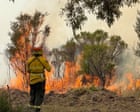
Large parts of southern and central Australia face elevated fire risk this summer, authorities say, while heatwaves and extreme temperatures are likely nationwide.
Most of Victoria, eastern Tasmania and large parts of South Australia, Western Australia, New South Wales and the Northern Territory face heightened bushfire risk – driven by high fuel loads, low soil moisture and forecast hot and dry conditions – according to the seasonal outlook from the Australian and New Zealand Council for Fire and Emergency Services (AFAC), released on Friday.
The AFAC chief executive, Rob Webb, said nearly every state had areas of above average risk heading into the hottest part of the year. He urged people to make sure they had a plan and to talk to family and neighbours.
“Know what you’re going to do and know where you’ll get your information – don’t wait till the fire’s there,” he said.
In Victoria, the dire outlook followed back-to-back years of devastating fires and record-breaking heat. Recent rains had spurred abundant grass growth in places, which could dry rapidly, creating the potential for grassfires as the weather warms up, AFAC said.
Last summer, more than 440,000 hectares of land burned across Victoria – an area larger than the Black Saturday fires of 2009. That followed major fires in the Grampians national park in 2024-25.
The state’s emergency management commissioner, Tim Wiebusch, warned that bushfires wouldn’t be the only risk Victorians would have to deal with.
“We’ve also seen in recent times the storm risk here in Victoria. We’ve seen flash flooding, we’ve seen low levels of riverine flooding, but we’ve also seen earthquakes, and we’ve seen the risk of thunderstorm asthma,” he said.
“All Victorians need to prepare for a mixed bag of emergencies over our high-risk weather season as we come through the summer months.”
In Tasmania, residents on Flinders Island were already contending with an out-of-control blaze, after a warm and dry year, and rainfall well below average.
“Tasmania has been particularly dry,” Webb said. “The fuel is there to burn, it’s just a matter of whether we get the weather conditions, the windy conditions, that allow fires to become established.”
Climate councillor Dr Andrew Watkins said a complex combination of factors – including the strong El Niño, a positive Indian Ocean Dipole, and influences from Antarctica – were combining with long-term warming to create tinderbox conditions in parts of the country.
Global heating, fuelled by the burning of fossil fuels, was already having an influence on fires across the world, said Watkins, adjunct professor at Monash University’s School of Earth, Atmosphere and Environment.
“South-eastern Australia is one of the most bushfire-prone places in the entire world,” he said.
“Nowhere on that map is low risk. Everyone needs to prepare, and unfortunately climate change is going to mean that’s the norm for the future.”
Hotter than usual days and nights were likely nationwide between December and February, which could lead to extreme temperatures and heatwaves, according to the Bureau of Meteorology. North-western Australia and eastern Tasmania were forecast to be drier than usual in summer, while above average rainfall was expected for Queensland and north-eastern New South Wales. Oceans around Australia were mostly much warmer than usual, with the temperature expected to rise over coming months.
In its summer outlook, the Great Barrier Reef Marine Park Authority was forecasting a high risk of widespread coral bleaching, with marine heatwaves up to 2C warmer than average expected.
The Australian Marine Conservation Society has called for an emergency response plan for the reef, which could include temporary protections for critical reefs to restrict certain activities, like removing coral.
“Everyone is very worried,” Dr Lissa Schindler, AMCS campaign manager, said. “The Great Barrier Reef is heading into another dangerous summer, with El Niño threatening to intensify marine heatwaves across the whole World Heritage Area.
“The warning lights are flashing red. We need to be throwing everything that we can at this, to give the reef a fighting chance.”
Year-end fundraiser
$0 of $2,000,000 goal
A moment full of possibility – and risk
We hope you appreciated this article. Before you close this tab, can we ask you to support the Guardian at this crucial time for democracy in the US? With Black Friday approaching, our most impactful monthly support option is just $7.50 a month for six months.
In the last two years alone, Donald Trump has eroded many of the pillars of US democracy – slashing funds for universities, undermining science, shutting down arts institutions, and attacking the free press as an “enemy of the American people” and “a threat to our national security”. While he and his allies have enriched themselves and spread lies, federal forces have harassed and imprisoned innocent people and violated the constitutional rights of many Americans.
Now, in a sweeping change election, the American people have spoken: Donald Trump, Pete Hegseth, RFK Jr, Elon Musk and the tech oligarchs may finally be held to account. A majority of American voters have demanded an end to the costly and immoral wars, the flagrant profiteering, and the corrosive attacks on communities and democratic institutions.
It’s a moment full of possibility, with more stories than we can possibly cover. New leaders are emerging from Texas and Michigan to Iowa and South Carolina – and heading to Washington to fight for affordability, against wealth inequality, and for human survival in the face of AI and the climate crisis.
These new leaders will be facing a cornered Trump and his hardline chief of staff, Stephen Miller, who have nothing left to lose. The next few years are critical for the future of the country. Journalism that covers the epic clash between these forces has a vital role to play right now.
Investigative journalism provides a fact-based paper trail for an emboldened Congress to follow. Members of Congress – and the American public – often rely on our in-depth reporting to inform the tough questions, to connect the dots and to pursue accountability for wrongdoing.
At the Guardian, our newsroom is devoted to uncovering the truth and conveying it to as many people as possible. We’re not alone in this mission, but this kind of journalism faces unprecedented hurdles: big tech threatening our financial stability and stealing our work for AI, billionaire owners telling journalists what to publish, and a hostile executive branch intent on suppressing our reporting.
The Guardian is free to dig deep without fear because we’re funded by our readers. Our readers hold us to account, and we hold the powerful to account.
However, this only works when enough of our readers contribute. Against the advice of most industry analysts, we’ve refused to put up a paywall – we believe good journalism should be freely available to all people, regardless of ability to pay. If you’re counting on our reporting, and you can’t afford to pay, please stop reading this message and go back to our articles.
If you can afford to contribute, please know that your support is not only helping yourself – from voters in Kansas to immigrants in Minnesota and families in Gaza, your generosity is bringing factual news to people around the globe.
Today is among our most important fundraising days of the year. To sustain our unique financial model, our goal is to raise $2,000,000 before the new Congress is seated on 3 January. More than 19,000 people have contributed already. All gifts are gratefully received, but for the next several days only, our most impactful monthly support option is $7.50 a month for the first six months. If you can afford 37 seconds, please join our ranks – and show your support for the rekindling of democracy in the US and around the world.
KioskNews shows a cleaned-up reading view extracted from the publisher’s page — the original always lives on their site, not ours.