Caryl Churchill’s magnificent Cloud 9 reaches for the skies – the National Theatre has done it proud

Caryl Churchill’s time-hopping 1979 drama is not revived as often as it might be, perhaps because it is so magnificently madcap. Bouncing from a first act satirising Victorian life in colonial Africa to a second act exploring sexual liberation in 1970s London, it could easily roll off-kilter in the wrong hands. There is also its complicated framework. Cloud 9 is a play in two distinct parts which follows some of the characters a century on, although they only age 25 years in that time and are played by different actors through ironic cross-casting.
Thankfully this crisp, handsome and note-perfect revival lands in exactly the right hands with director Dominic Cooke, clear as crystal despite the complications, sizzling with satire but showing itself to be a deadly serious, and still highly topical, play about identity beneath its playful sending up of everything from empire and Britishness to the confinements of marriage.
The first act takes in the moral hypocrisies of arch patriarch Clive (Sam Troughton, excellent). He comes with a constellation of exquisite caricatures including Betty (Stuart Thompson), his smilingly subjugated wife; their son Edward (Ellen Robertson, glinting with mischief), whom Clive berates for playing with dolls; and their daughter Victoria, such an apogee of obliging femininity that she is represented by a ventriloquist’s dummy. Throw in a closet homosexual explorer (Tom Mothersdale, fantastically hammy), Betty’s dowager mother (Charlotte Ritchie, deadpan, resembling a bishop in gigantic black hooped dress) and a secret lesbian governess and a singularly liberated woman (Rebecca Humphries plays both masterfully), and it takes on shades of a queer romp à la Oh, Mary! – but funnier and without exploding into farce or pantomime.
Miriam Buether’s set design dazzles too, giving Churchill’s meta-theatricality an elegance in the first half where the colonial homestead is framed by red curtains and surrounded by African forest. There is a fun touch to the second act when some members of the audience are moved on to the stage. The boundaries between us and them, life and art, are left in pieces, the proscenium arch in ruins with its scraps scattered across the stage.
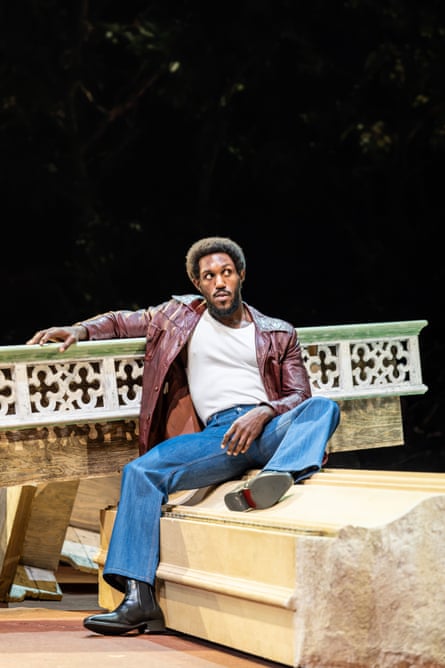
Cooke further fiddles around with casting as Clive’s Black house-servant, Joshua (written to be played by a white actor), is here portrayed by a Black actor, Eloka Ivo (“My skin is black but my soul is white,” he announces) and it works powerfully in presenting him as Frantz Fanon’s Black psyche colonised by whiteness. Ivo brings a dangerously contained anger, and it becomes meaningful in Churchill’s symbolic revolution, when the Chekhovian gun Joshua has been carrying is put to use.
The second act switches registers from satire to earnestness, and is clearly set against the Second Wave feminism from the time Churchill was writing, the characters in flares or hippyish dress. Betty (Robertson) is now divorced and delivers her monologue on a life of suppressed desire very movingly; Edward (Thompson) is openly gay and Victoria (Ritchie) trying out throupledom with liberated lesbian Lin (Humphries). It explores how to live beyond the confines of conventional marriage, straight sexuality and maybe patriarchy itself. The act is punctuated by the persistent needs of Lin’s gobby child (also Troughton, played with flamboyant annoyance) and it is endearing but feels baggier and more dated.
The play still has great cumulative emotional power, alongside asking philosophical questions of all the people we contain within us which history will or will not allow out. And Churchill is not just examining racial dynamics or same sex desire but intersectional gender theories of fluidity and performance that had not fully spread beyond academic circles by 1979. This is what lies at the heart of the play: how girls and boys learn to become men and women, how some rebel against gender conditioning, and how history straitjackets some lives, which leads to shame and doubleness.
-
At the Lyttelton theatre, National Theatre, London, until 13 January
KioskNews shows a cleaned-up reading view extracted from the publisher’s page — the original always lives on their site, not ours.