‘I spent five years with criminals’: dissident Cuban artist embraces new life in US after prison release

When Luis Manuel Otero Alcántara was pushed into the back of a police car on 11 July 2021, during the biggest protests Cuba had seen in nearly three decades, he expected to be in custody for “one, maybe two days”. Instead five years would pass before he was free, and only then after he’d agreed to exile.
“I remember that Sunday,” he says as he opens a beer in El Espacio 23, an art gallery in the Allapattah neighbourhood of Miami. “I was at my girlfriend’s. Friends started writing to tell me there were demonstrations in the streets. It felt like the day we all longed for had arrived – the end of the dictatorship – and I went out into the street.”
He walked for an hour to Old Havana, but was suddenly picked up by Cuba’s revolutionary police. First he was taken to a former seminary in Havana’s suburbs, the much-feared state security interrogation centre of Villa Marista; then, after two days, to Cuba’s maximum security prison, in Guanajay.
There he became the best known of the more than 1,000 political prisoners believed to be incarcerated in Cuba.
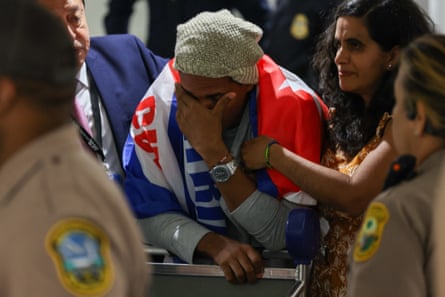
He also became the most corrosive to the reputation of Cuba’s government. In contrast to José Daniel Ferrer, the 56-year-old hard-fighting and political former prisoner who was released in October 2025, Otero Alcántara is an artist: unruly certainly, but young, mischievous, mixed race, self-taught and from a poor background.
For many Cubans on the island, the treatment he received encapsulated a sense that the state had come down too hard on young people following 11 July. There’s no doubt that in the run-up to the protests, Otero Alcántara had been troublesome to Cuba’s embattled government. In 2018 he had co-founded the San Isidro collective in a poor part of Old Havana, protesting against a new law, decree 349, that required all artistic endeavours to be pre-approved by the state.
His performance pieces were pointed. He mocked a new $500-a-night hotel that none of his neighbours could afford by asking what had happened to the statue of Julio Antonio Mella, student leader and Marxist, which had previously stood outside. Or he hung out under a balcony in a hard hat after one collapsed, killing three young girls.
These pieces cut through. He believes the authorities would have tolerated such work if he’d agreed to show it in galleries. “I refused, because no one who mattered to me would see it,” he says. “Instead, I tried to speak directly to people on the street, and that wasn’t acceptable.”

The San Isidro collective was cut off by police and surveilled, its occupants harassed. Otero Alcántara says those within drew confidence from each other as the pressure, and the public interest, increased.
“There were so many points of view in San Isidro,” he says now. “There was a babalao [a high priest of Santeria, Cuba’s syncretic religion], a Muslim, a gay person – all the layers that make up a society. San Isidro united them, and from there it generated a ripple effect.”
The reality of prison, he says, was horrific. “The first month I spent with people taken on 11 July. But then they were released, and I spent five years with criminals, often murderers – people who aren’t normal, people who are sadistic, people who are cruel, people who kill women, kill children.
“You come to terms with the fact that you’re in an extremely violent place, and begin to understand the different ways. That normalisation is where confinement is the worst. I think it’s one of the worst experiences a human being can have.”
Told he would never be free to walk the streets of Cuba, he accepted exile in the US, and arrived in Miami on 18 July in good physical shape, having disappeared for the week after his prison term ended. It turned out he had been taken to a beachside state security safe house, where he was allowed to see family and drink Chinese whiskey with his guards.
Once in the US, he appeared in Washington to receive the 2026 Democracy Award from the National Endowment for Democracy, an institution that’s a bugaboo for supporters of the Cuban government. More bizarrely, former president George W Bush, who has also taken up art, painted his portrait for a forthcoming book about political prisoners and dissidents.
His exit from Cuba did not play well with sections of the exile community in Miami, some of whom accused him of having sold out. “Who drinks beer and toasts with their captors right before being exiled? This looks like a staged performance by G2 (Cuban state intelligence),” said Alexander Otaola, a popular Cuban American commentator.
“There was a lot of pre-judgment,” says Michael Bustamante, chair of Cuban and Cuban American studies at the University of Miami.
Otero Alcántara only added to the fire during a round of interviews with exile media. During one, with the 87-year-old former political prisoner Ángel de Fana, he said that, no longer living in Cuba, he would miss the “taste of a woman on the island” (“la sabrosura”).
The remark caused laughter among some in Havana, but less so in Miami. “His form of speaking is very off the cuff,” says Bustamante. “It’s very Cuban-everyman, and relatable, but for guardians of certain traditions it’s seen as a departure. And it’s hard not to see a subtext about race.”
Otero Alcántara blames the criticism on the prevalence of social media, something that has exploded in the five years he was in prison. “There’s this phenomenon where a lot of influencers are actually making a living off likes, and views, so they get caught up in an algorithm that keeps the conversation going, without even assuming any civic responsibility toward Cuba.”
He does, however, agree he received better treatment than some others, that the authorities were in some ways frightened of him. “There were moments when, especially when state security wanted to get me out, they eased up a bit, because I went on more than six hunger strikes in prison, and they knew they could cause me to have a mental breakdown, so they started to give in.”
“I could come here and say, ‘Oh, in prison they beat me senseless, they broke my head,’ but that wouldn’t be honest,” he adds. “I can’t give a speech for the cameras just to keep influencers happy.”
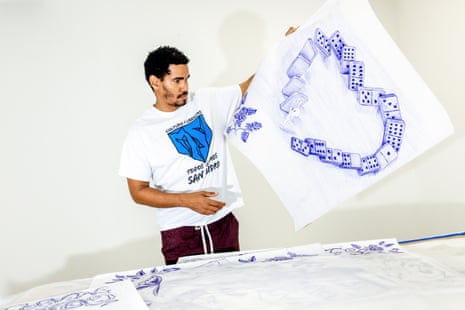
On the floor of EL Espacio 23 is a pile of paintings he made in jail, which he was allowed to bring with him (another black mark in some eyes). A triptych shows the bars of the jail with various things in front: a tree or a cross. “It’s about what you think about in jail,” he says.
The gallery, which belongs to the Cuban American billionaire and Democrat Jorge M Pérez, is something of a sanctuary: it offers month-long residencies to young artists from around the world so he is among friends.
Meanwhile, back in Cuba, the authorities have a new problem on their hands. Anna Sofía Benítez, 21, better known as Anna Bensi, was sentenced last week along with her mother to two years of “restriction of liberty”, which means having to report regularly to police and inform them of any travel plans.
An enthusiastic Christian, Benítez had been using social media to rail against the Cuban government and the collapsing conditions in Cuba. She was charged with “acts against personal and family privacy” after filming a police officer serving her a summons, and this subsequent sentence means she could be jailed for any further infraction. The sentence has been heavily criticised by religious leaders, and on Wednesday Mike Hammer, the US chargé d’affaires in Havana, visited the family, further stirring up the situation.
Young Cubans are watching her closely, as they still are Otero Alcántara. He said he wants to move to New York, where he can slot into an artistic crowd outside the Miami exile bubble – perhaps a smart move given the issues facing young Cubans in Florida, many of whom are now actively hiding from ICE.
In the US today it’s hard to see how he won’t get himself into further trouble. He says he would have been a Cuban revolutionary if he’d been born 50 years earlier. “But I’m almost certain I would have gone to prison when the revolution triumphed. Like many who realised the revolution had become a dictatorship, I would have rebelled against it.”
Given Cuba’s turbulent history, has there been any period where he wouldn’t have ended up in prison? “In the future,” he says.
KioskNews shows a cleaned-up reading view extracted from the publisher’s page — the original always lives on their site, not ours.