Marc-Olivier Fortin: The Parti Québécois cannot win a majority without putting separatism first
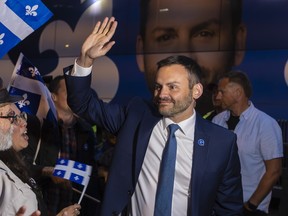
For four years, Parti Québécois Leader Paul St-Pierre Plamondon (PSPP) sharpened the spear of Quebec sovereignty. He told Quebecers the province was ready for a defining national moment. But when the election finally arrived, he left the spear in the tent.
Sign In or Create an Account
After winning only three seats and not even 15 per cent of the vote in the 2022 Quebec election, many thought that PSPP was only a transitional PQ leader. However, not only did he stay on, but he worked consistently to put independence at the forefront of his agenda. That steady work paid off. At its peak, the party led the polls, reaching 38 per cent support, according to aggregator qc125.com in last December, 16 points ahead of their closest opponent.
But, ahead of Tuesday’s election debate, that lead is now slipping through his fingers. What looked like a certain majority government a few months ago has become a much more uncertain position.

Columnist Jesse Kline keeps you up to date with what’s happening in Israel and the effects of antisemitism on life here in Canada. Friday mornings.
By signing up you consent to receive the above newsletter from Postmedia Network Inc.
A welcome email is on its way. If you don't see it, please check your junk folder.
The next issue of Channel Israel will soon be in your inbox.
We encountered an issue signing you up. Please try again
In the lead-up to the election, PSPP has favored a big tent approach. While PQ leaders in the 21st century have been ideologically more left of centre, PSPP has been focusing his agenda on putting Quebec independence first and foremost, similar to what Lucien Bouchard and Jacques Parizeau did in the 1990s. For that, he knew he had to build a vast coalition of nationalists and bring more right-of-centre voters into the party’s coalition. In the years before the election, he has adopted policies that align with this line of thinking. From advocating for stricter immigration to denouncing wokeism, PSPP has pushed the party beyond the centre-left comfort zone it has occupied the last quarter century.
A staunch separatist, he has never shied away from defending his proposal to hold a referendum on Quebec independence in the first term of a PQ government. He was avoiding a critical mistake multiple PQ leaders have made in the past in moving away from their core raison d’être. PSPP’s immediate predecessor Jean-François Lisée pledged not to hold a referendum if elected. He won only 10 seats in 2018 and was forced to resign afterwards. In the 2012 election, former premier Pauline Marois pledged to hold a referendum only in a second term. All polls suggested that she was on track for a majority government, but on election day, she was held to a minority.
Bernard Landry followed a similar path in 2002. Elected on a sovereigntist mandate in 1998 with Bouchard, the PQ government spent years pursuing “winning conditions” rather than holding a third referendum many supporters expected. Landry, who took over the leadership before the end of the PQ’s term, proposed a 1,000-day timetable. He never came close to reaching it, losing power in 2003. Taken together, when PQ leaders allow sovereignty to become an afterthought, when it is their founding purpose, the base and core supporters tend to stay home.
And now, history appears to be rhyming once again.
PSPP spent four years convincing Quebecers that the province was ready for a rendezvous with history. However, right before the election campaign began, he argued that Quebec should wait until U.S. President Donald Trump leaves office before deciding its future. What he told Quebecers is that he does not believe in his own project enough to risk an election on it.
One can understand the temptation. On the campaign trail, voters are worried about Trump and the trade war. PSPP likely concluded that talking less about sovereignty when voters are looking for reassurance and stability would strengthen his chances of forming government. But great national projects have never been built on caution alone.
The very idea of independence rests on the belief that a people can determine its own future despite whatever happens in the world. If a movement keeps waiting on the perfect conditions, these conditions will never arrive. There is never going to be a perfect timing. Voters can make the case that if the PQ is not willing to hold a referendum until Trump is gone, then they won’t vote for the PQ until Trump is gone. Nations cannot schedule history around U.S. elections.
Now that Trump has become a key issue of this election, and Coalition Avenir Québec leader and premier Christine Fréchette is driving a narrative that Quebecers need stability to face the trade dispute. PSPP has effectively played into Fréchette’s hands. Instead of doubling down early in the campaign and convincing voters that sovereignty was the way forward, he said in his own words that Fréchette’s approach is right and we need stability.
While the PQ leader is now complaining that Trump sucks up all the space in the campaign, he is the one who changed his referendum timeline because of the U.S. president. The irony is difficult to miss.
Facing declining support in the polls and on the sovereignty question itself, PSPP chose caution over conviction. PSPP’s personal numbers have been affected. In the last Pallas Data poll, his unfavorable rating has reached an all-time high of 55 per cent. Only 15 per cent of people have a neutral opinion of the PQ leader, giving him limited room to expand support. He is now sitting at 29 per cent compared to 23 per cent for the CAQ and 22 per cent for the Liberals in the the QC125 average. Despite an edge of nine points over the CAQ among francophone voters, it is not enough for the to win the majority government it once coveted.
Since becoming PQ leader, PSPP built his brand every day on being transparent and ideologically consistent. It was refreshing to see in a political landscape full of carefully managed scripted politicians. Unfortunately for him, at the first real test he faced, he undermined the very brand that brought him so high in the polls. For four years, PSPP told Quebecers history was knocking at the door. And when the moment finally arrived, he did not answer.
National Post
Marc-Olivier Fortin is the former national Vice-President of the Conservative Party of Canada (2016-2018) and campaign manager for the CPC in Quebec (2021). He is now a regular commentator at RDI and on COGECO radio and works for Transfert, a firm specialized in social acceptability in mining, energy and heavy industry sectors.
Join the Conversation
This website uses cookies to personalize your content (including ads), and allows us to analyze our traffic. Read more about cookies here. By continuing to use our site, you agree to our Terms of Use and Privacy Policy.
KioskNews shows a cleaned-up reading view extracted from the publisher’s page — the original always lives on their site, not ours.