Who can speak for Europe in peace talks with Russia?
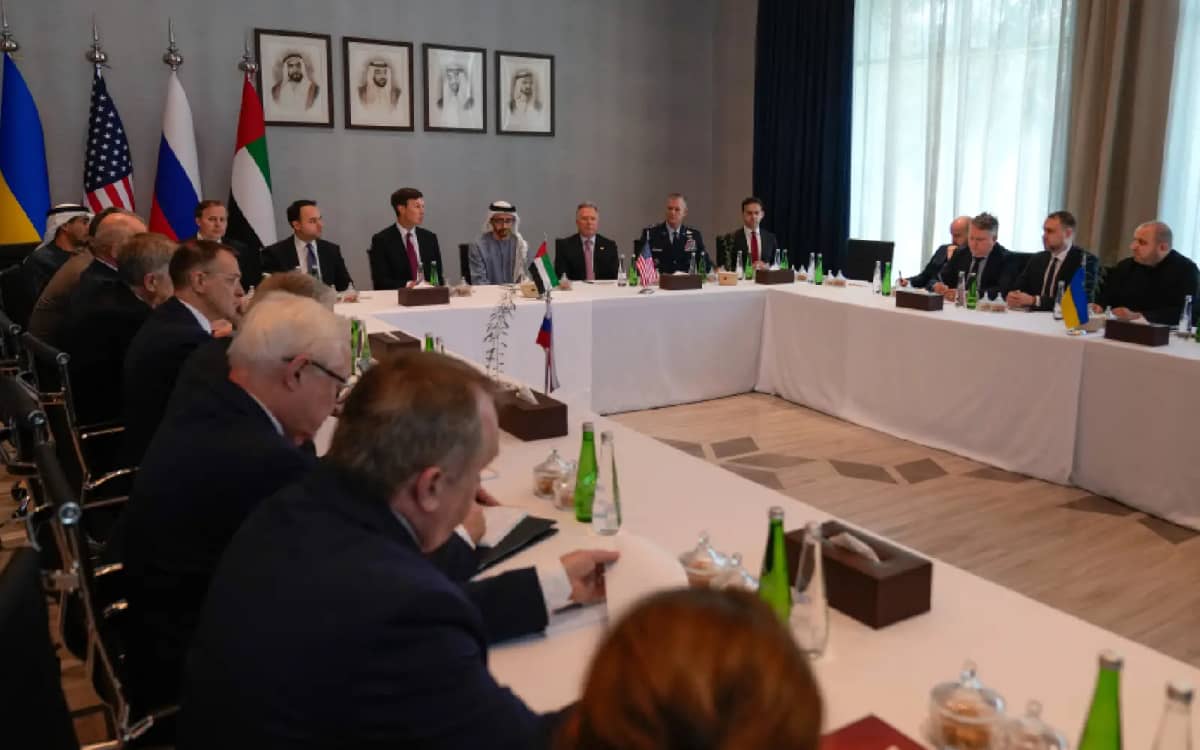

Europe’s leaders are coming to terms with a notion that they hitherto considered heretical. They must talk to Russia. Otherwise, Europe will either have to pay for a peace negotiated without its consent or it will run out of money.
But this realisation raises a question history has ascribed to Henry Kissinger: When world leaders want to call Europe, who answers the phone? The European Union has proven institutionally incapable of providing even a moderately serious answer.
The only way Europe can take a seat at the table on Ukraine is for the EU to step aside and let the governments of the UK, France, and Germany pick a representative—an E3 envoy.
The EU’s inability to find one person to represent it in such negotiations reflects a structural failure, not a shortage of skilled personnel. Given Europe’s confederate model of decision-making, it could not be otherwise.
In the absence of a federal government, no one can negotiate a mutually unsatisfying resolution of a mutually catastrophic conflict on behalf of a highly asymmetrical agglomeration of member states.
Ukraine peace talks are not a trade deal, a Brexit agreement, or an austerity package to be imposed upon a bankrupt member state whose banks have been shut down by the European Central Bank. This is war.
The European Commission knows how to impose its will upon foreign countries or whole economic blocs (like South America’s Mercosur grouping) that have an urgent need to access a half-billion rich consumers.
Equally, as in the cases of Brexit or the eurozone’s insolvent member states, EU functionaries have honed their skills at grinding down internal resistance. A point-blank refusal to negotiate and an ironclad insistence on ticking the boxes on a Brussels-sourced questionnaire were all it took.
When the European Commission’s Michel Barnier entered the room to “negotiate” the Brexit deal, or when the troika representatives “negotiated” Greece’s or Ireland’s next loan tranche, the first thing they would say is: “I have no mandate to negotiate. I am here to establish what progress has been made.”
Progress was a euphemism for the other side’s capitulation. All the council of the EU had to do was approve the questionnaire.
The European Council seems to understand that this approach cannot guide Europe’s talks with Russia, which is why it swiftly rejected the suggestion by Kaja Kallas, the EU’s high representative for foreign affairs and security policy, that she should talk to Russia on Europe’s behalf.
Kallas, who as Estonia’s prime minister had casually remarked that Russia should be broken up, was selected for the post to send a strong signal of the EU’s commitment not to negotiate with Russia. That commitment is obviously incompatible with the EU’s decision to talk to Russia.
The EU’s North–South and East–West faultlines are another source of its diplomatic weakness. Leaders of Mediterranean countries, at a relatively safe distance from the frontlines and secure in the knowledge that they will not be contributing much to any peace deal, will try to lever any negotiations in their interests (which do not necessarily coincide with their people’s interests).
Political elites in northeastern countries (the Baltics, Poland, Finland), for their part, have long discovered that fervently advocating escalation is the way to punch above their weight in Brussels.
Before any EU delegation sits down with the Russians, it will face one veto or another from within its own camp by parties whose relative influence within the EU is threatened.
This paralysis is why I advocate a solution at odds with my anti-colonial, democratic instincts. Realistically, either an E3 envoy selected by the UK, Germany, and France represents Europe, or Europe has no representation whatsoever.
There are good reasons to delegate the choice to these three countries. The UK and France are the only European military powers of note, while Germany has paid the highest price in support of Ukraine, both in direct funding and losses due to the cutoff of Russian energy supplies.
There is also a precedent. In 2003, this E3 group’s foreign ministers went to Tehran together, outside EU and Nato frameworks, and opened the nuclear talks with Iran. The format exists; only the will is lacking.
Strong candidates for an E3 envoy must combine diplomatic skills with a record of saying no to naked power. They must be broadly respected across left and right, East and West, and in the Global South. They must be neither Russophobes nor Russophiles. And they must be in nobody’s pocket: not the military-industrial complex, not the fossil-fuel industry, and certainly not the US.
I am sure there are many candidates like that. For example, Dominique de Villepin stood at the UN Security Council to speak against the Iraq war and was proven right.
As an independently minded foreign minister, he participated in the E3 delegation that went to Tehran in 2003, proving he knows how the format works in practice.
Barnier, too, could be considered. He is a Gaullist, not a Russophile, and an Atlanticism-sceptic, not anti-American. And he is respected in Washington, Moscow, Beijing, and the Global South precisely because no one owns him.
There are certainly others. The point is not the name but the profile. Europe needs someone the Kremlin cannot dismiss, the US cannot command, and the Baltic hardliners cannot veto.

Yanis Varoufakis, a former finance minister of Greece, is leader of the MeRA25 party, professor of economics at the University of Athens, and a senior research fellow at Fudan University.
The views expressed are those of the writer and do not necessarily reflect those of FMT.
KioskNews shows a cleaned-up reading view extracted from the publisher’s page — the original always lives on their site, not ours.