The bridge that carried Klang's childhood is making room for its future
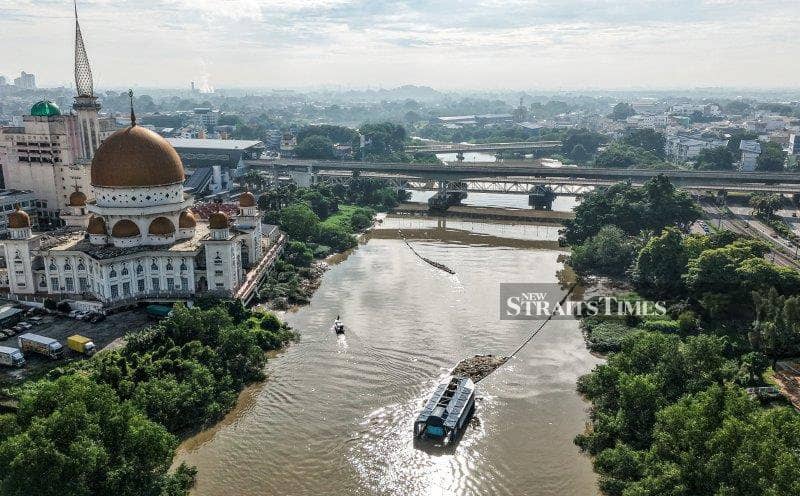
ANYONE looking for the palace that gave Jambatan Kota its name will have to turn to old photographs and records, even as people continue to cross the bridge beside its former site every day.
Istana Bukit Kota once stood within the vicinity of Kota Raja Mahadi. However, structural deterioration has led to its demolition and the Klang Municipal Council headquarters was constructed to replace it in late 1963.
[[nid:1588085]]
Its name, however, remains attached to a crossing over Sungai Klang that generations of families have made part of their lives.
For some, it was the way to school. For others, it meant shopping trips with a parent or a bicycle ride home.
Returning years later, we may remember less about the journey than the person who once made it with us.
The bridge gives us somewhere to bring those memories and someone younger to share them with. Where the palace must now be imagined, Jambatan Kota can still be walked across.
That's part of what the Klang Royal City Council (MBDK) is preserving: the chance for a changing town to remain recognisable to its people and for their children to know something of the place that shaped them.
"These places are part of Klang's own identity," says Faisal Surani, curator of Galeri Warisan MBDK and better known as Cikgu Faisal.
"If we change these things, what else will be left?"
HISTORY WORTH CARRYING FORWARD
[[nid:1588084]]
MBDK brings its own long history to that work.
As Faisal points out, its roots reach back 136 years to the Klang Sanitary Board established in 1890, following the town through colonial administration, wars and independence.
He describes the separate administrative bodies that governed Klang, Port Swettenham, Kapar and Meru, which were brought together over time.
Municipal status followed in 1977 and city status took effect on Nov 23, 2023. Sultan Sharafuddin Idris Shah formally proclaimed MBDK on Feb 5, 2024.
The royal city council's present name is the latest chapter in that history. Its predecessors served generations who built businesses, raised families and watched the town extend beyond the streets they'd known as children.
The council records two significant firsts in 2021: appointing a curator for history, heritage and royal institutions, and establishing Arkib Negara Malaysia's first such cooperation agreement with a local authority.
[[nid:1588083]]
Galeri Warisan MBDK gives that administrative history a public home, helping residents understand how the council's development is bound to their town's.
Jambatan Kota makes that relationship tangible. Beside a former palace site that became a seat of municipal administration stands a crossing that helped people get home.
Caring for its records and structure preserves a history that residents can recognise and walk through.
LEARNING TO CROSS
[[nid:1588082]]
Faisal traces the need for Jambatan Kota to the wartime destruction of the Belfield Bridge. Pontoon crossings and a suspension bridge followed, but a growing town needed a dependable route across its river.
Construction of a permanent bridge began in June 1957, just months before independence, at a cost of about RM7 million.
British firm Dorman Long (Bridge and Engineering) Ltd built it, with piling undertaken by Gammon (Malaya) Ltd.
Its two levels accommodated different journeys. Cars, buses and lorries travelled above, while pedestrians, bicycles and trishaws crossed below.
The bridge linked Klang's northern and southern banks and supported movement to and from the port.
[[nid:1588081]]
It nearly carried a different name. Initially intended to be called Alam Shah Bridge, it was renamed at Sultan Hisamuddin Alam Shah's request shortly before its opening, acknowledging the nearby palace.
The sultan opened it on June 24, 1959. In Faisal's earlier published account, the ruler's yellow Rolls-Royce was the first vehicle across.
After the ceremony came decades of journeys to school, work and the market. Faisal remembers walking to shops and cycling across, when bicycles were far more numerous and there was space below to park them.
As traffic grew, a newer bridge assumed the main road function. The old bridge's upper deck was closed to motorised traffic in 1992, but the lower level continued serving people on foot and two wheels.
For those who depend on it, preservation remains a practical concern as well as a matter of affection.
KEEPING THE OLD BRIDGE STANDING
[[nid:1588080]]
MBDK has undertaken repeated repairs and strengthening works on Jambatan Kota.
Faisal recalls the expenditures of RM750,000 in 1995 and RM160,000 in 2008. A RM700,000 refurbishment in 2024 included paving, repainting, wiring and lighting up the structure.
Raja Muda of Selangor Tengku Amir Shah launched the bridge's lighting on Aug 28 that year.
"Once it has been restored and looks beautiful, how do we look after it?" asks Faisal.
Maintenance presents particular challenges, he explains, adding that appropriate materials and specialist consultations can be expensive and difficult to secure.
Repairs must also respect the original construction and protect the people using the crossing.
[[nid:1588079]]
Heritage buildings consultant Anuar Haron stresses that the bridge's character must guide those decisions.
"What's important is that it conserves and maintains its identity," he says, adding that preservation begins with examining the surviving materials, their condition and how the structure was assembled.
Testing helps determine which repairs are compatible with it. Even cleaning can damage historic surfaces if done indiscriminately.
New installations require consideration of their effect on the original old materials and the landmark's appearance.
Anuar's point gives substance to the affection people feel for the bridge. If future generations are to encounter something their grandparents would recognise, the details that make it recognisable have to survive the work intended to save it.
He advocates formal heritage protection, a Conservation Management Plan and a structured maintenance programme.
These would establish what must be retained and guide future repairs, activities and development around the crossing.
Formal recognition remains unfinished. The council's June 2021 Warta Warisan recorded an agreement to gazette Jambatan Kota Lama on Dec 2, 2019, but noted that no gazette number had been issued.
Faisal shares that the pandemic had interrupted the process and changes to the structure may require fresh assessment.
Meanwhile, Anuar envisages an outdoor classroom where engineering, architecture and conservation students could study the bridge's structure and materials.
Its builders' knowledge could continue teaching long after they're gone.
THE TOWN WE RECOGNISE
[[nid:1588078]]
Conserving Klang, says Faisal, also means collecting the information that explains its landmarks.
MBDK is gathering photographs, written materials and oral accounts, helping keep scattered memories within reach of future researchers and residents.
A photograph restores a vanished building to its setting; someone's recollection puts people back into the scene. These records explain what the surviving structure cannot tell us alone.
"They are what show that this is Klang," says Faisal of the town's historic places.
His understanding of its royal identity extends to the people who share it. He speaks of different communities and ways of life existing together within the royal town.
Its character is found in their neighbourhoods and daily interactions, as well as its palaces and royal institutions.
That's why losing an old landmark can feel so personal. A part of the setting in which we learned who we were has gone.
[[nid:1588077]]
For younger residents, the loss can happen before they even know what was there.
As Faisal approaches retirement, he worries about who will carry on a work built on a lifetime of research.
Recording and sharing that knowledge makes it possible for the next generation to continue, rather than begin again with an unexplained name or an unidentified photograph.
"Without Sungai Klang, there'd be no Klang and no Kuala Lumpur either," he says, explaining its importance as an early route for movement and trade. Before roads assumed that role, the river was the highway.
His work on Jejak Warisan Sungai Klang begins at Taman Pengkalan Batu beside the bridge, following a course towards Connaught before turning downstream to connect historical locations.
About 14 heritage points have been identified. The route is being refined, with landing access and tides among the considerations; but a regular guided heritage service has yet to be established.
In March, MBDK announced plans for 18 thematic heritage routes over five years, including the river, port, traditional settlements and food.
Site improvements and information boards will support their phased introduction. Jambatan Kota already features in its Kota Raja Mahadi heritage trail.
BRINGING PEOPLE TOGETHER
[[nid:1588076]]
Shaiful Azli Muhamad Surol, founder of VolunHeritage, knows the crossing from his schooldays, when he walked it to and from school, when trishaws were still part of the scene.
Today, he's helping others find their own connection to it.
When he approached MBDK about his programmes in 2024, the council suggested the bridge and Pengkalan Batu as locations. It has also helped promote the activities through its official channels.
Regular Saturday programmes began in January with about 20 traders and creative practitioners, taking account of people already crossing to the nearby night market.
[[nid:1588075]]
He insists: "There must be community involvement. We can't do this alone."
He wants communities along the river to participate, with opportunities to share their skills and earn an income.
First, though, people need a reason to spend time at a landmark they may have known for decades without exploring.
"Some are already in their 50s or 60s and have never set foot on Jambatan Kota," says Shaiful.
[[nid:1588074]]
That process of discovery is familiar to cartoonist Muhammad Fikri Azman, who joined the programmes at Shaiful's invitation in November 2024. What began as a place to sell his work soon became a subject for it.
"Before this, I didn't know about Jambatan Kota. After joining the events, I learnt about it and turned it into comics," he shares.
People around the bridge provide material for stories featuring his character, Mat Semangka. His drawings and merchandise give visitors another way to encounter the crossing and the everyday life around it.
[[nid:1588073]]
A cup of coffee offers a different invitation to linger. Nuruddin Rusli, who also runs a shop in Pasar Jawa, likes the setting's old-fashioned character.
His customers have begun seeking him out at the bridge.
"Sometimes customers ask, 'Din, aren't you selling coffee at the bridge?'"
Such encounters give substance to Shaiful's plans: artists finding inspiration, traders building a following and residents finding reasons to return.
He knows those relationships take time to grow.
"We go for impact. But impact takes time."
Anuar sees further possibilities in bringing Klang's Malay, Chinese and Indian communities together through traditional markets, performances and demonstrations of local crafts.
[[nid:1588072]]
Through the people sharing their skills, visitors could discover something of the town that built and used this crossing.
For Shaiful, the school journey he remembers has become an opportunity to help someone else make a memory here.
MBDK's support gives that effort a place to grow, alongside its work to preserve the structure itself.
This is where the council's preservation work reaches into family life. Keeping Jambatan Kota standing allows people to return to a place they knew with their parents, then bring their own children to it. The stories have somewhere to belong.
[[nid:1588071]]
We cannot make those earlier journeys happen again exactly as they were. But we can stand beside someone younger and explain where we went, who came with us and how different everything looked then.
Istana Bukit Kota now has to be imagined from photographs. At Jambatan Kota, a grandparent can still take a child by the hand and walk a familiar route together, explaining where they went and who once came with them.
Through MBDK's care, the crossing can continue to connect those lives with the ones that follow, giving the next generation more to inherit than a photograph.
PRECIOUS MEMORIES
NICHOLAS ONG, 69
[[nid:1588070]]
Jambatan Kota wasn't just a bridge to me. It was my playground, my landmark, my whole world.
I grew up just a stone's throw away from it, so the sound of the river, the rumble of four-wheel vehicles on the top deck, and the clatter of bicycles, trishaws and pedestrians on the lower deck were part of my everyday life.
Even the rattling sound of the train, which became my early morning call, was part of it. That was my alarm clock.
I remember walking and jumping so carefree across the lower deck to get to the other side.
Twice a week to the pasar pagi, and on Saturday night to the pasar malam with my late mum.
She'd hold my hand tight, afraid I'd run off, but I just wanted to see everything. The smell of food, the shouting of hawkers, mothers carrying groceries and hopping onto trishaws.
Occasionally, I got to cross over for movies with my late father. Those were the best days. I'd walk a little faster, a little taller, just to keep up with his steps. Holding his hand, crossing that bridge, felt like going on a big adventure.
Jambatan Kota was the heart that connected North and South Klang. Everyone passed over it. If you lived near it, you knew everyone, and everyone knew you.
Today, I'm no longer that carefree boy jumping across the lower deck. But whenever I see that old bridge, I still hear the train and the times my parents walked and guided me along it.
As I grew older, my bicycle became my companion of adventures.
Jambatan Kota isn't just steel and concrete. It's my best childhood memory.
ALEX LIM, 65
[[nid:1588069]]
My memories of Jambatan Kota are filled with laughter, mischief and the simple pleasures of growing up in Klang.
In the evenings, thousands of crows would gather in the big rain trees, turning the sky beneath them into a noisy black canopy.
We had to watch our steps when walking underneath, as the birds seemed to have an uncanny knack for dropping their "calling cards" on unsuspecting passers-by.
Riding pillion on a bicycle came with its own little adventures. The moment we spotted a policeman approaching on his bicycle, I'd quickly jump off, as though making myself disappear.
If our bicycle had no lights, we'd quietly push it along the lower deck of the bridge, hoping to escape notice.
Jambatan Kota was our main route to Emporium Makan and everything beyond. Every crossing brought a sense of anticipation: a meal waiting, friends to meet and perhaps a little adventure along the way.
At the northern end, beneath the bridge, trishaws or beca occupied their familiar spots. Their riders wait patiently for passengers.
Above them, life carried on in its familiar rhythm: bicycles passing, footsteps echoing and people chatting as they went about their day.
Jambatan Kota was more than a bridge.
It was woven into the everyday rhythm of our childhood, and even the crows, the policemen, and the waiting beca riders have become part of the memories we look back on fondly.
REGINA STANISLAUS, 69
[[nid:1588068]]
I have fond memories of 1971, when I was 13. I'd walk with my 16-year-old girlfriend from Jalan Melawis at around 10.30pm to have ice kacang at Emporium Makan.
It was a different time, when we felt perfectly safe being out so late.
On Fridays and Saturdays, we'd sometimes only make our way home between midnight and 1am.
The old bridge was always bustling, with people cycling and walking across it.
There was a wonderful sense of freedom and youthful fun. We'd talk endlessly along the way, about practically anything and everything. Those conversations were therapeutic and liberating.
We didn't have television back then, so these simple outings and long conversations were among the greatest pleasures of our time.
AHMAD KAMAL MD ATAN, 79
[[nid:1588067]]
My family and I lived in Klang from the early 1970s until the latter part of the 1980s, and Jambatan Kota was a familiar sight in our everyday lives.
It was a bridge we crossed often, whether going about our daily errands or making our way to other parts of town.
One image that remains vivid in my memory is the sheer number of black crows along the river.
They seemed almost inseparable from the bridge, gathering in the trees along the riverbanks, where they perched and nested in large numbers.
Their presence eventually became a nuisance, prompting the authorities to shoot the birds to control their population.
A happier memory is our family's regular weekend trips to Pasar Jawa on the northern side of the river. It was a favourite stop for locally grown vegetables, halal chicken and other kitchen essentials.
These visits became something of a family ritual, and crossing Jambatan Kota was simply part of the routine.
Now, when I think of Jambatan Kota, it's these everyday journeys, familiar sights and family routines that return to me. They're small memories, perhaps, but they remain part of my memories of Klang.
NITHIYALAKSHME, 55
[[nid:1588066]]
I was born in Klang, and to me, Jambatan Kota was more than just a bridge.
In the 1970s, it was the only way to get to the other side of town.
There were no alternative roads or shortcuts; if you wanted to cross, you had to take Jambatan Kota.
Below the bridge was a pedestrian walkway that we used to cross to Pasar Jawa.
There was also Emporium Makan, then Klang's most famous shopping mall. A trip there felt like going to the big city.
One of the biggest thrills was riding in a beca. The friendly pak cik riders would wait patiently for passengers, and sitting in one, feeling the breeze as the beca trundled across the bridge towards Jalan Taiping, was pure joy. Every ride felt like a little adventure.
Lorries were parked along the roadside for hire, making house moves a simple affair. You just walked over, spoke to a driver and arranged everything there and then.
Beneath the bridge, people gathered to relax, chat and laugh. There was no sense of urgency; nobody seemed to be in a hurry.
Those were carefree days. Jambatan Kota was not merely steel and concrete; it was where the everyday life of Klang unfolded.
ALLISON WONG, 55
[[nid:1588065]]
Jambatan Kota has a dual-level structure, with the upper deck used by heavier vehicles and the lower deck serving pedestrians and smaller vehicles such as bicycles and motorcycles crossing the Klang River.
Whenever we stayed back for school activities, we'd walk across the bridge into Klang town for lunch at the hawker stalls beneath Emporium Makan. Those were the days of simple pleasures, tucking into local favourites such as air tebu, ice kacang, noodles and an assortment of delicious street food.
elena@nst.com.my
intanm@nst.com.my
KioskNews shows a cleaned-up reading view extracted from the publisher’s page — the original always lives on their site, not ours.