Palestine has become electoral issue in UK for first time, says solidarity campaign chief

Palestine has become a domestic electoral issue in Britain for the first time, according to the incoming head of the country’s largest Palestinian solidarity organisation.
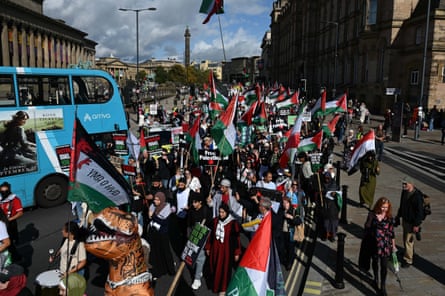
Aimee Shalan, who will take over as director of the Palestine Solidarity Campaign (PSC) in November, joins the organisation as demonstrations against Israel’s war in Gaza have snowballed into what organisers describe as one of the most sustained protest movements in modern British history.
She said public anger over Israel’s treatment of Palestinians and Britain’s response was increasingly being expressed not just through demonstrations but at elections, in workplaces and trade unions and through consumer campaigns.
Speaking before a PSC protest at the Labour party conference, Shalan said: “We’re seeing for the first time in British history Palestine become a domestic issue, electorally, at the national level and at the local level.”
The shift was visible at the 2024 general election and 2026 local elections, where pro-Palestinian candidates made major breakthroughs.
Shalan pointed to the foreign secretary Ed Miliband’s announcement of sanctions against settlements in the occupied Palestinian territories as a notable success for their movement.
Miliband said at the Labour conference on Monday: “I want to say to the millions of people in this country and indeed elsewhere who have been moved and outraged by the plight of the Palestinian people: we hear you, you were right.” He described the sanctions as a definitive change in how Labour would approach the situation in the Middle East.
Shalan said: “That shift is a testament to the mass movement. Both internationally, but specifically also here in Britain, with hundreds of thousands of people marching, campaigning, lobbying.
“He [Miliband] says he hears the British public, but his announcement falls far short of the clear and immediate actions millions of people have been calling for: full sanctions on the state of Israel, including a two-way arms embargo, an end to material support for Israel’s military operations and an end to British political and diplomatic support for an apartheid state.”
Shalan welcomed the shift within the Labour government but said the sanctions announcement would be “very little solace for Palestinians whose lives have been brutally destroyed through Israel’s relentless oppression and genocide”.
She pointed to the 70,000 Palestinians killed in Israel’s war in Gaza and the more than 1,300, including at least 300 children, killed since a ceasefire was signed last year.
The PSC says its individual membership has more than doubled from 7,800 at the beginning of 2023 to nearly 17,000, with subscribers to its newsletters rising from 70,000 to about 300,000.
Along with partner groups, it has organised 36 national demonstrations since October 2023, some drawing hundreds of thousands of people. Organisers say the demonstrations represent one of the largest and most sustained protest movements in British history.
Shalan said: “It’s been uplifting to see the level of support and the connections that people are making between their own lives, and other liberation and social justice struggles, and the Palestinian cause.”
But the demonstrations have been contested. Some politicians and campaign groups have raised concerns about antisemitism surrounding pro-Palestinian protests, with critics describing them as “hate marches”.
Shalan rejected that characterisation as a smear against the movement, saying: “Those marches have been a really wonderful coming together of communities of all sorts of different faiths, of all sorts of different backgrounds, young and old, of all sorts of different ethnicities.”

Shalan also rejected calls for the PSC to be designated an extremist organisation, arguing that attempts to criminalise parts of the Palestine solidarity movement were increasingly at odds with public opinion.
after newsletter promotion
“You can try and criminalise, but all it will do is anger the public more,” she said. “That’s why we’re seeing people going out on the streets and risking being arrested because they refuse to be hobbled by this effort to criminalise both Palestinians and those that stand in support.
“Those who are responsible for trying to criminalise support for Palestinians and their rights, and supporters trying to end a horrific genocide, should hang their heads in shame.”
Supporters attending national demonstrations are directed toward a network of more than 100 local branches, which organise campaigns in communities, workplaces and universities and lobby councils and MPs.
The PSC says 34 councils in England and Wales have committed to supporting the divestment of their pension funds from companies that campaigners accuse of complicity in Israel’s actions.
The PSC’s influence has also grown within the trade union movement. The Trades Union Congress is backing the Palestinian-led boycott, divestment and sanctions (BDS) movement, supporting workplace campaigns and divestment from companies it says are complicit in abuses against Palestinians.
Shalan defended BDS after Miliband said he “wholeheartedly” opposed the campaign. “BDS is a set of tactics that provide a peaceful way for people to campaign for human rights, for justice, for accountability,” she said.
Shalan, who is British Palestinian, has spent nearly three decades campaigning for Palestinian rights. She is the director of Makan, a Palestinian-led educational organisation, and has served as chief executive of Medical Aid for Palestinians and as director of Friends of Birzeit University, which has changed its name to Friends of Palestinian Universities. She holds a doctorate on the politics of Palestinian literature.
The group’s Pledge for Palestine campaign was signed by more than 2,200 candidates before this year’s local elections and it plans to repeat this at the next general election.
“There’s a very short time before the next election and we need to have a very robust movement that ensures that we don’t sleepwalk into what appears to be a really deeply authoritarian future,” Shalan said.
She compared the Palestine solidarity movement to the international campaign against apartheid South Africa, while stressing that the histories were not identical.
“People can’t unsee what they’ve seen,” she said. “People are finding ways to be mobilised in different spheres. And support for Palestinian freedom and justice will only continue to grow”
KioskNews shows a cleaned-up reading view extracted from the publisher’s page — the original always lives on their site, not ours.