Law Society complaint questions U of Toronto law professor’s Indigenous ancestry
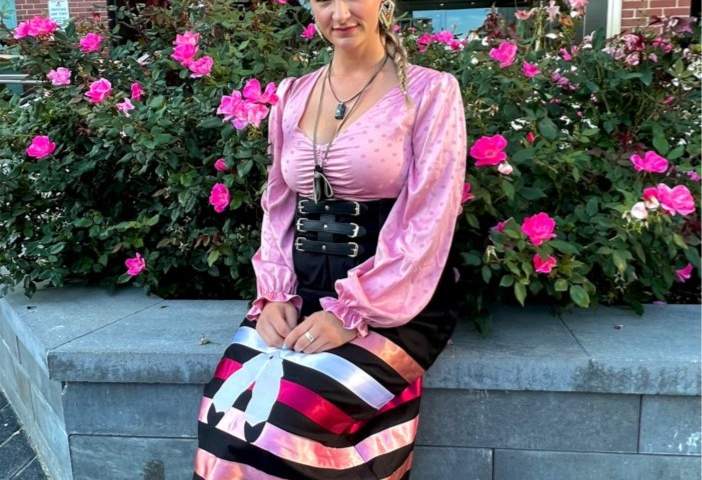
A complaint filed Oct. 14 with the Law Society of Ontario requests that disciplinary action be taken against a Toronto lawyer who has built a notable career as an Anishinaabe woman specializing in Indigenous law, alleging she has no evidence that she is Indigenous at all.

The complaint is against Promise Holmes Skinner, who identifies as Anishiaabe-Scandinavian.
Holmes Skinner has a private law practice and teaches Indigenous law at the prestigious University of Toronto. She served as a senior manager at Toronto’s Aboriginal Legal Services before opening her own law firm.
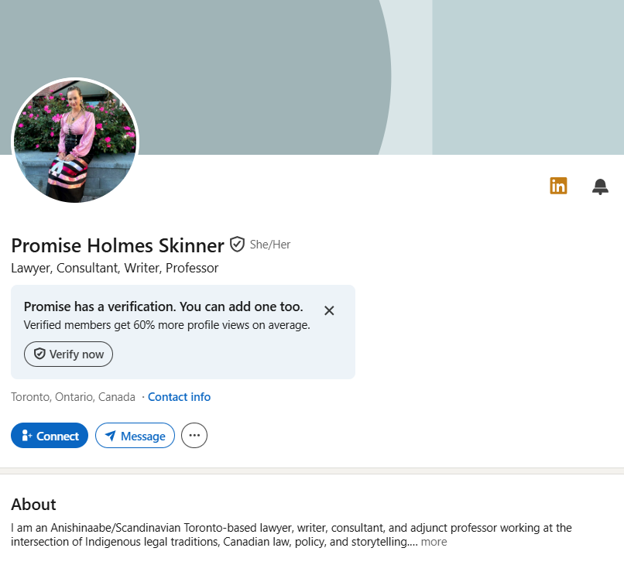
Her LinkedIn profile cites working ‘in Indigenous traditions’ as an “Anishinaabe-Scandinavian lawyer.”
The complaint alleges she has “no First Nations, Inuit bloodline to speak of.”
Story continues below advertisement
Holmes Skinner declined an interview request, but said in a statement to Global News that while she has no documentary proof of Indigenous ancestry, she has a “cherished understanding that my grandmother was Anishinaabe” from Cape Croker First Nation in Ontario. “However,” she added, “without documentary evidence to verify that, I have learned culture in other ways.”

Get breaking National news
Get breaking Canada news delivered to your inbox as it happens so you won't miss a trending story.
Holmes Skinner says she has been “transparent about not being a rights-bearing individual” and that she has not taken any benefits or positions reserved for those individuals.
She says her family is from Cape Croker First Nation, but she does not claim to be from there herself.
She also said her “legal education and practice are about contributing skills, not taking space I am not invited to take.”
Her lawyer Andrea Gonsalves challenges “that Indigenous identity can validly exist only through proven blood connections to a rights-bearing community.”
Kim Tallbear, one of the world’s leading academic experts on people who questionably claim to be Indigenous, takes issue with that.
“If she can’t verify her grandmother is Anishinaabe, don’t be speaking as an Anishinaabe person,” says Tallbear, a citizen of the Sisseton–Wahpeton Oyate.
“You can be speaking as a friend or an ally to the people that you have made relationships with. We have all kinds of non-Indigenous people that do that, and they don’t claim to be us.”
Story continues below advertisement
The complaint was filed by Crystal Semaganis, who heads a grassroots group that tracks and exposes suspected cases of Indigenous identity fraud.
The complaint asks the Law Society of Ontario to apologize for allegedly allowing a member to take roles intended for First Nations, Inuit and Metis lawyers and to “formulate and implement a First Nations, Inuit and Metis Authentication Policy… to go beyond simple declarations of self-identification.”
It also requests disciplinary action against Holmes Skinner.
Semaganis has testified before the House of Commons Standing Committee on Government Operations and Estimates regarding non-Indigenous people claiming to be Indigenous to access lucrative procurement contracts under Ottawa’s Procurement Strategy for Indigenous Business.
Semaganis is being sued by a family of women over allegations she made that they’ve faked an Indigenous identity, a matter that remains before a Yukon court.
Many universities have implemented policies to verify indigeneity after several high-profile academics’ ancestry claims were challenged.
When asked in September how they verified Holmes Skinner’s indigeneity, the University of Toronto refused to say, citing privacy. Then it removed a page outlining its verification process from its website.
On Oct. 20, the university announced the launch of its Indigenous substantiation process. It requires genealogical evidence and membership with a rights-bearing nation.
Story continues below advertisement
The university tells Global News it “does not apply retroactively, it will be initiated for current faculty members who identify as Indigenous when they engage with new opportunities, such as promotions, research funding competitions and awards.”
The Law Society of Ontario spokesperson Amy Lewis says when a complaint is made, they “consider the potential risk to the public, the public’s confidence in the legal professions and the Law Society, and the administration of justice.”
They won’t comment on complaints or investigations until they’re complete.
Gonsalves says they cannot comment on the complaint itself but “anyone can put anything in a complaint” and “the fact of making the complaint doesn’t say anything about its merit.”
KioskNews shows a cleaned-up reading view extracted from the publisher’s page — the original always lives on their site, not ours.