Bryn is 16 and has never eaten a meal. His mother’s terrified the newly-cut NDIS won’t ‘step up to keep him alive’

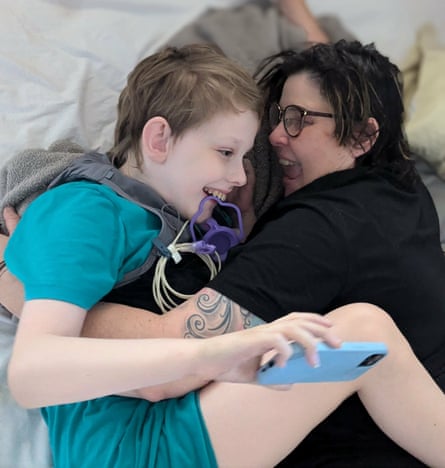
Bryn Skyes is 16 years old. He loves playing in the water on hot Ipswich days, going through the car wash with his mum and zooming down slides with his siblings.
He has also never eaten food. Bryn’s disability and gastrointestinal problems mean that he has been tube-fed since infancy.
For most of his life, the costs of Bryn’s food and feeding system have been covered by the Queensland children’s hospital, but as the process of transitioning him out of paediatric care begins, his mother, Shelley McRae, is worried changes to the NDIS mean she’ll be left to find an extra $50,000 a year to keep him alive.
After months of debate, confusion over what the changes mean, and anguish for families afraid of having their plans cut – or being moved off the scheme entirely – parliament on Wednesday passed a bill to curtail the scheme.
The changes will give the health and NDIS minister, Mark Butler, the power to reduce funding categories for individuals by up to 99%. Among the 63 last-minute amendments was a tweak to allow vulnerable participants whose budget is affected by the new ministerial power to apply for more funding through a plan variation. For now, McRae is unclear how the process will work – and how the changes will affect Bryn.
Disability organisations and some senators have condemned the bill, and families like McRae’s are terrified they’ll be left behind.
“Without that nutrition and the pumps, he would die. He would starve to death because his gut doesn’t work properly,” McRae says.
It would take about two years for Bryn to secure specialist care in an adult hospital. Instead, McRae applied in January to have Bryn’s NDIS plan expanded to cover his food. She has not heard back.
She says she has been told verbally that the NDIS had a limit of approximately $24 a day for nutrition – which would not cover Bryn’s costs.
She is worried the changes will specify a maximum amount of funding for food and feeding and that there will be no sure way to appeal. The amendment allowing for plan variations, is little comfort, she says.
“It does not explain how that process will look,” she says. “Obviously it is better than no pathway at all, but as usual there is no clarity.
“Typically, a variation is a minor change to a plan … The current process can take 12 months and is very difficult.”
As McRae says even getting simple answers can mean a long wait. After years of trialling different feeding formulas and poor weight gain, the hospital identified the only formula Bryn could tolerate while maintaining a healthy weight. It is available on the PBS, but only for children up to 10 years old.
His hospital team is meeting this week to transition him to adult care, though his food will not be covered.
A spokesperson for the National Disability Insurance Agency would not comment on current feeding support limits, or if changes to the bill could cap that support, but acknowledged the “extremely challenging circumstances” many people managing disabilities and chronic illness found themselves in.
“The NDIS was designed to complement, not replace, other mainstream services such as the health system or the Pharmaceutical Benefits Scheme (PBS),” the spokesperson said.
“Nutrition supports are one type of disability-related health support we may fund, if it is related to the functional impact of a participant’s disability. Evidence and reports must be provided to the Agency to ensure the support meets the NDIS funding criteria.”
after newsletter promotion
Costs projected to more than double in 10 years
Without the cuts to the scheme, the government estimates the $52bn-a-year NDIS will more than double in cost to $117bn a year in a decade’s time.
The government will also reduce the number of participants by 2028 – with more than 240,000 people expected to be cut from the scheme in the four years after the new eligibility rules are introduced.
Mind Australia surveyed 156 participants with psychosocial disability, their carers and staff, and found uncertainty around the proposed cuts was already causing participants stress, with almost all respondents (92.9%) concerned the reforms would lead to a decline in NDIS participants’ mental health.
The CEO of Children and Young People with Disability Australia, Skye Kakoschke-Moore, says families should not have to live with the fear that the essential support they need could disappear.
“This is already the reality for too many people on and off the NDIS, and we’re concerned it will become that much worse,” Kakoschke-Moore says.
“Giving the government, and the minister of the day, greater power to determine and reduce funding for certain supports must come with strong transparency, appropriate safeguards, and meaningful avenues for review when funding decisions do not adequately meet someone’s needs.”
The joint NDIS minister, Jenny McAllister, says the government was concerned the fast-rising costs would negatively affect broad support for the NDIS.
“I don’t think that the community broadly believes that a scheme that costs $100bn a year by the middle of next decade is a scheme that is operating sustainably,” she says.
“But that is the path that we are on, unless sensible amendments are made to the operation of the scheme to ensure that [the NDIS] works as intended.”
In the meantime, McRae is bracing, waiting anxiously to see how her family will be affected.
“This bill is only going to expand [the NDIS’] powers to punish people,” McRae says.
“The Children’s hospital can’t hang on to him; they’ve got to transition him out. And at that point we’re back to square one. We’re back to trying to convince the NDIS … somebody needs to step up to keep him alive.”
KioskNews shows a cleaned-up reading view extracted from the publisher’s page — the original always lives on their site, not ours.