A longer life, but how many years in good health?
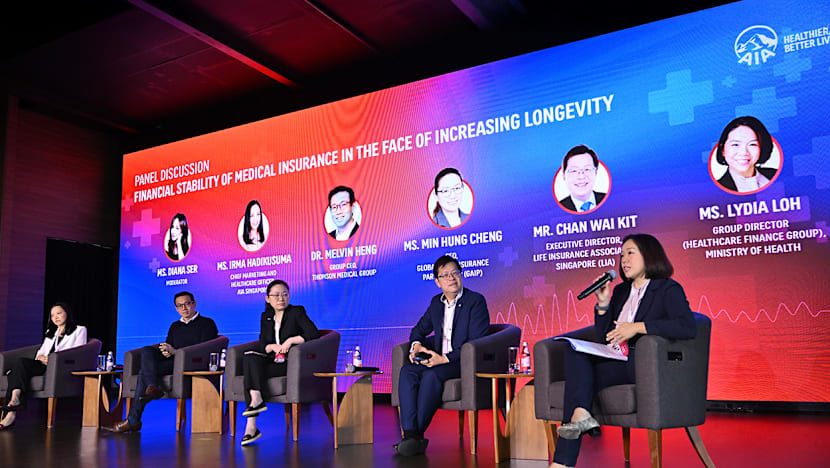
A nine-year gap separates lifespan and health span in Singapore. Experts at the AIA Healthcare Summit 2026 explored how preventive care, healthier habits and sustainable healthcare financing could help narrow it.
New: You can now listen to articles.

This audio is generated by an AI tool.

15 Sep 2026 09:46AM
What do regular exercise, strong social connections and having a sense of purpose have in common? Each can play a part in how well we age.
With Singaporeans living longer, attention is turning to how they can remain healthy for more of those years – a challenge that goes beyond individual choices and demands a whole-of-society effort to create the environment for healthier longevity in Singapore.
There is currently a gap of roughly nine years between Singapore residents’ expected lifespan and their health span, or the number of years they can expect to live in good health. This means they could spend about nine years in poor health or living with illness. The prospect is a source of anxiety for 51 per cent of Singaporeans surveyed in the AIA Longevity Study.
Closing the gap between living longer and living well was a focus of the AIA Healthcare Summit 2026, held on Aug 12 at The Ritz-Carlton, Millenia Singapore. The summit brought together over 700 government leaders, academics and healthcare professionals, as well as AIA consultants and clients, under the theme Purposeful Longevity to explore how Singapore can deliver better health outcomes and enable people to live longer, healthier and more purposeful lives.

AIA Singapore CEO Wong Sze Keed summed up the challenge in her opening address: How do we live longer with health, dignity, independence and purpose? “This conversation is not abstract,” she said. “It affects our families, workplaces, communities and the way we think about health across every stage of life.”
01:00 Min
The AIA Healthcare Summit 2026 focused on purposeful longevity and the role of public-private collaboration in supporting healthier ageing.
KEEPING HEALTHCARE AFFORDABLE AS SINGAPORE AGES
Living longer also has implications for how healthcare is funded.
Guest of honour, Ms Lai Wei Lin, Permanent Secretary (Policy and Development) at the Ministry of Health (MOH), noted the growing number and proportion of Singaporeans aged 80 and above. Just as rising longevity led us to redesign our healthcare and aged care system, she said, it also raises important questions about how coverage needs to be redesigned to provide assurance for Singaporeans, from their working years through to retirement.

“We cannot do this alone, and this is where the public-private partnerships come in,” said Ms Lai, adding that a whole-of-society approach was needed to support Singaporeans in achieving purposeful longevity.
She highlighted three areas for closer public-private collaboration: assurance for individuals across the life course, keeping coverage sustainable and investing in preventive health.
Rising healthcare costs have also raised questions about the long-term sustainability of medical insurance. Ms Lydia Loh, group director of MOH’s Healthcare Finance Group, pointed to factors driving higher premiums, including greater healthcare use as the population ages, medical inflation driven by rising manpower costs and medical advances, and inefficiencies or wastage in the healthcare system.
“The government sets conditions that are conducive for affordable healthcare by improving transparency and setting benchmarks,” she said. “But the overall responsibility lies in shared accountability by all stakeholders such as healthcare providers that make most of the decisions about treatments, costs and charges, insurers who control benefit design and contracts with providers, and individuals who make choices about their healthcare utilisation.”
While reforms, such as new policy requirements for Integrated Shield Plan riders, have been introduced to rein in over-consumption and over-servicing in the private healthcare sector, the panellists acknowledged that their effects would take time to be felt.

Ms Irma Hadikusuma, AIA Singapore’s chief marketing and healthcare officer, said consumers also need help navigating their healthcare and financing options. She suggested that financial consultants could help clients better understand their options before they fall ill – particularly as longer lifespans mean there is a greater need to address potential health needs early, while insurers can help encourage healthier behaviour through preventive health programmes such as AIA Vitality.
“A system that is sustainable is not necessarily one that spends the least on healthcare, but one that creates the most health span for every dollar we collectively spend among insurers, healthcare providers and policymakers,” she said.
LIVING HEALTHIER, LONGER AND BETTER LIVES
But sustainable healthcare is only one part of the longevity equation. Helping people live longer, healthier and more purposeful lives also means shifting the focus upstream – from treating illness when it occurs to preventive health and supporting people to remain active, independent and engaged throughout their lives.
Dr Kelvin Loh, AIA Group’s group chief healthcare officer, said poor health in old age is not inevitable. “Many risk factors of the diseases of ageing are modifiable. Exercise more, sleep better, don’t smoke, drink less and eat better – that means more plant foods,” he said. “And then there’s precision geromedicine, which can give more specific and personalised recommendations to improve one’s health span.”

Precision geromedicine is a research interest of Professor Andrea Maier, a panellist and co-founder of Chi Longevity. She said targeted interventions should begin with an assessment of a person’s physical and cognitive health to establish their gerotype, or personalised biological ageing profile.
But living well for longer is not only about physical health.
A person’s purpose and motivation also matters, she added. “Knowing why a person wants to improve their health and then tailoring the intervention to their gerotype means you’re more likely to have a good outcome compared to just telling them to take a multivitamin,” she said.
There may be no single formula for ageing well. But the discussions pointed to a broader shift in how we approach ageing – from simply managing disease to supporting the physical, financial, mental and social well-being that enables people to live fulfilling lives for longer.
Individuals have an important role to play in making healthier choices and planning ahead, but this also requires support across healthcare, financial protection, workplaces, technology and the wider environment. Insurers, healthcare providers and policymakers help shape these conditions, including how preventive care is supported and healthcare is financed.
Against this backdrop, Ms Wong called for a “more proactive, sustainable and people-centred healthcare ecosystem” – one that looks beyond paying for treatment to helping people stay healthier for longer.
Explore how AIA Singapore supports health at every stage of life.
KioskNews shows a cleaned-up reading view extracted from the publisher’s page — the original always lives on their site, not ours.