[OPINION] The HIV epidemic we saw coming — and can still stop
Not long ago, I was having dinner with a former health secretary from an earlier Philippine administration.
Our conversation turned to the extraordinary rise of HIV. I asked when the epidemic really began to accelerate, and why the Philippines had diverged so sharply from neighbors such as Thailand and Vietnam.
The answer surprised me. The instinctive explanation was essentially that young people today were having too much unprotected sex.
That is partly true. But it does not explain the Philippine anomaly.
Young people have sex in Thailand and Vietnam. HIV stigma and inconsistent condom use are hardly uniquely Filipino.
Yet estimated new HIV infections in the Philippines increased from around 4,400 in 2010 to 29,600 in 2024 — a 550% increase. Around 252,800 Filipinos were estimated to be living with HIV in 2025.
Vietnam moved in the opposite direction: new infections fell nearly 60%, from around 14,000 in 2010 to fewer than 6,300 in 2024. Thailand has reduced new infections by about 66% since 2010.
So the question is not simply why individuals acquire HIV. It is why the Philippine epidemic diverged so dramatically from those of comparable neighbors.
We saw it coming.
The critical window
The critical Philippine period was arguably 2010 to 2014.
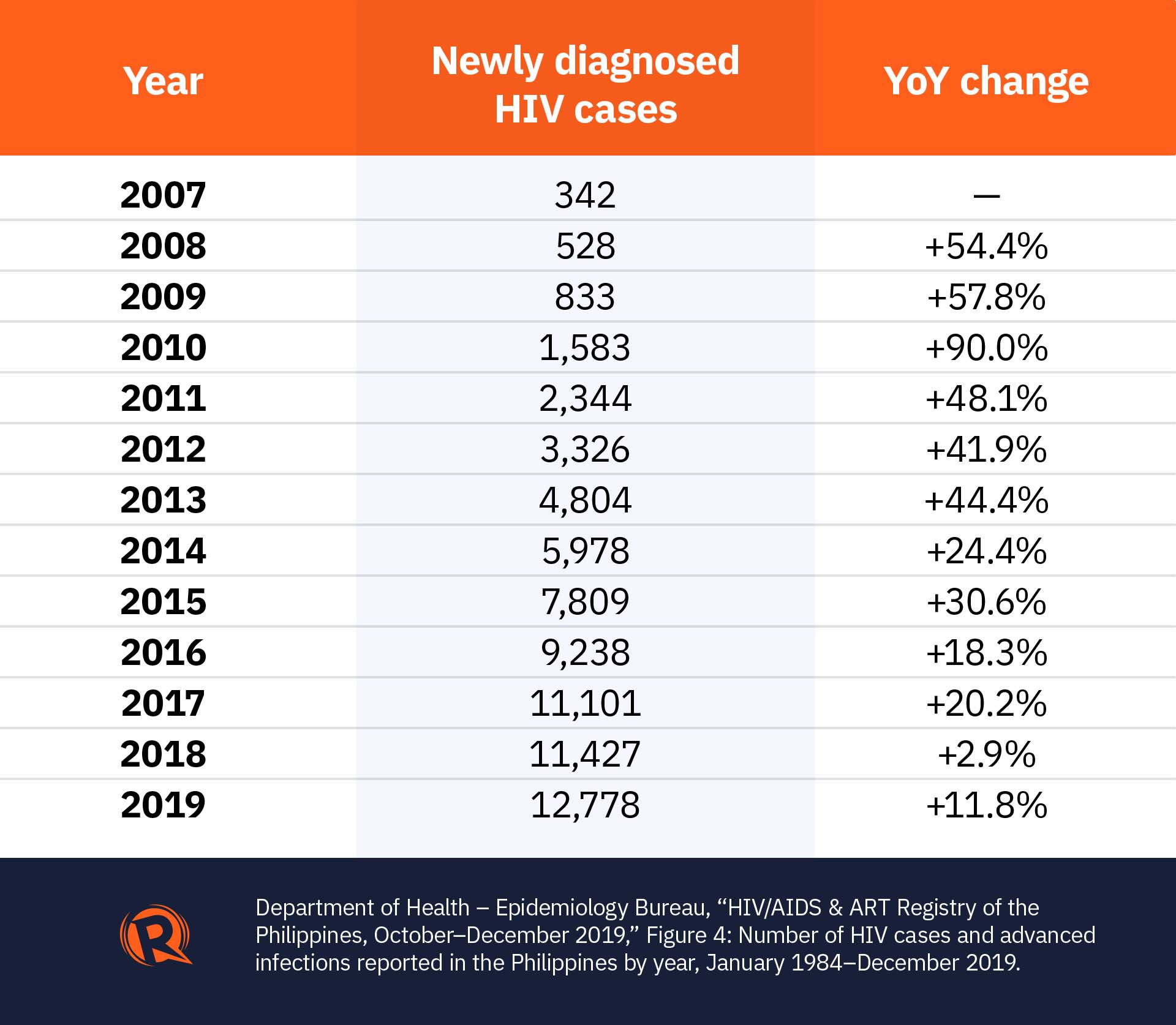
In 2010, the HIV registry recorded 1,591 newly diagnosed cases. That became 2,349 in 2011, 3,338 in 2012 and 4,814 in 2013. Annual diagnoses more than tripled in only three years.
And this was not simply more testing uncovering a stable epidemic. Among men who have sex with men, HIV prevalence in sentinel sites rose from 0.30% in 2007 to 1.05% in 2009, 2.12% in 2011 and 3.50% in 2013.
By 2011, prevalence was already reported at around 6% among MSM in Quezon City and 5% in Cebu, even while national prevalence remained very low.
Government therefore had a clear warning. But it still faced a much smaller and more concentrated epidemic than it does today.
UNAIDS estimated around 36,000 Filipinos were living with HIV in 2014, compared with roughly a quarter-million today.
Yet in 2013, the UN Secretary-General’s Special Envoy for AIDS warned that the country was spending only about US$8–10 million annually on HIV prevention, against an estimated requirement of at least US$40 million.
By 2014, only around 24% of people living with HIV were receiving antiretroviral therapy.
That is why this period matters. The epidemic was unmistakably accelerating, but before the reservoir of infection had reached today’s scale.
The missed opportunity was not one person’s failure. It was a health-system failure to translate surveillance into sufficiently aggressive execution.
Thailand made a different choice
In 2025 in Bangkok, I had the opportunity to meet Khun Mechai Viravaidya, Thailand’s famous “Mr. Condom.”
Thailand faced its own critical period decades earlier. Its response was strikingly different.
When HIV exploded there around 1990, the government did not simply tell people to behave better. It elevated HIV to a national priority. Prevention messages saturated radio and television. Condoms were aggressively distributed. The 100% Condom Programme targeted the transmission networks surveillance had identified. Mechai became one of the most visible faces of that response.
Within three years, condom use among sex workers reportedly increased from below 25% to more than 90%. HIV-prevention spending rose almost twentyfold to US$44 million by 1993. Estimated annual new infections subsequently fell from about 143,000 in 1991 to fewer than 14,000 in 2001.
Thailand did not eliminate risky behavior. It changed the environment in which transmission occurred. That distinction matters.
As HIV prevalence rises inside a sexual network, an individual does not necessarily need to become more sexually active for risk to increase. More infected partners are simply circulating within that network.
Meanwhile, undiagnosed and untreated infection allows transmission to continue.
The cycle becomes: undiagnosed infection → transmission → higher prevalence → greater exposure → more infections.
Treatment breaks that cycle. A person who achieves sustained viral suppression does not sexually transmit HIV. That is why simply blaming young people for unprotected sex is an inadequate public-health explanation.
Even today, Thailand is making progress in eliminating HIV. Dr. Nittaya Phanuphak, a pioneer of community-led PrEP and transgender health services, was named a 2026 WHO South-East Asia Public Health Champion — a recognition well deserved.
Mercado’s challenge
The Philippines has previously set a national goal of reaching 150,000 people with PrEP by the end of 2026. Yet only 55,284 had ever initiated PrEP by the end of 2024 — against an estimated MSM population alone of roughly 1.38 million.
Secretary Edwin Mercado merely inherited the epidemic. But he can become the health secretary under whom Philippine HIV incidence finally peaks and begins to fall.
That should be the metric: Did fewer Filipinos acquire HIV this year than last year? What is the PrEP target?
DOH should aggressively expand testing, immediate treatment, viral suppression and PrEP.
It should also question the assumption that making HIV testing free is enough.
Testing still carries costs: transportation, lost work time, inconvenience, stigma and fear.
There is already evidence that incentives can increase testing uptake.
In a randomized US emergency-department trial involving more than 8,700 patients, offering US$5 increased HIV-test acceptance by about 10 percentage points, while US$10 increased it by about 15 points compared with no financial incentive.
In Kenya, a randomized study found that offering US$5 or US$10 to caregivers to bring children of unknown HIV status for testing increased testing from 34% without an incentive to 55% and 61%, respectively.
The Philippines should test the same principle rather than debate it abstractly.
Offer modest incentives — perhaps transport credits, mobile load, pharmacy or food vouchers — to selected populations with low screening uptake.
Then measure the results.
The Philippines had surveillance. It had plans. It had the warning. The failure was translating warning into execution quickly enough.
Thailand’s experience offers a simple lesson:
When an epidemic moves quickly, public health must move faster.
Mercado’s DOH cannot change what happened in 2010. But it can determine what the Philippine HIV graph looks like in 2030.
Make this the period when HIV incidence finally peaks — and begins to fall. – Rappler.com
Dr. Jaemin Park is an adjunct professor at the University of the Philippines College of Public Health and works across Southeast Asia on healthcare financing, medical innovation, and public sector reform.
KioskNews shows a cleaned-up reading view extracted from the publisher’s page — the original always lives on their site, not ours.