Amy Hamm: ‘I don’t want to be me,’ Galloway testifies to his ruined writing career
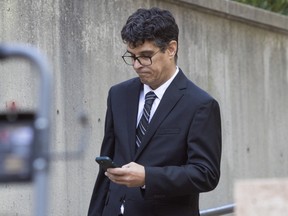
Steven Galloway’s accuser, known only as A.B. in his defamation trial, sought more than $3 million in damages from the University of British Columbia (UBC) in the wake of her unproven sexual assault allegations.
Sign In or Create an Account
On day four of the trial, and day three of his testimony, Galloway’s lawyer, Daniel Burnett, introduced a February 2017 email, containing a draft statement of claim, between A.B.’s former lawyer, Joanna Birenbaum (who stopped representing A.B. before this trial), and UBC lawyer Hubert Lai. The statement of claim included six requests for $500,000 in various damages, in addition to punitive damages.
Burnett presented several emails to Galloway, which were first shown to him during 2017 employment arbitration with UBC. The emails revealed that, in addition to seeking millions in damages, A.B. had requested and received $30,000 in university bursary funds — after Galloway says she was no longer a UBC student. Galloway told the court that he believes this was fraudulent. He testified that the amount “eclipses the entire bursary program for the creative writing program… (and) after UBC accused me of all manner of crime, to see this was flabbergasting,” he said.

Columnist Jesse Kline keeps you up to date with what’s happening in Israel and the effects of antisemitism on life here in Canada. Friday mornings.
By signing up you consent to receive the above newsletter from Postmedia Network Inc.
A welcome email is on its way. If you don't see it, please check your junk folder.
The next issue of Channel Israel will soon be in your inbox.
We encountered an issue signing you up. Please try again
A.B.’s lawyer, Arden Beddoes, objected to the email evidence; he claimed it was not relevant to defamation, and pointed out that Galloway had not made pleadings regarding A.B. having financial motivations. Burnett then argued that the emails were relevant insofar as they revealed “the myriad ways in which A.B. exerted influences over those in positions of power” to harm Galloway’s reputation. Further, he said, he intends to use the email evidence for a legal argument of malice and aggravated damages.
Justice Neela Sharma overruled the objection and explained that she was not yet in a position to say if the emails were relevant, but will consider the issue during arguments for damages.
Galloway, who had an affair with A.B. from 2011 to 2013, was fired from his job as a UBC creative writing professor and program chair in June 2016. A.B.’s claim of sexual assault resulted in a years-long public mobbing of Galloway by several figures, including former friends and colleagues. This is despite the fact that retired judge Mary Ellen Boyd, hired by UBC to independently investigate the allegations against him in 2015, found that all of the claims were unsubstantiated and did not take place, on a balance of probabilities. He was, however, found to have breached the university’s sexual harassment policy.
The best-selling novelist filed his defamation lawsuit against A.B. and several other defendants in 2018. Only four defendants remain, after several settled before trial.
Much of Galloway’s testimony Thursday focused on his inability to write since the allegations.
“I just can’t do it anymore. I wish I could. I loved doing it; it was the greatest part of my life — it was the only thing that made me me,” he told the court.
Moments later, he was in tears, and placed his head down on the witness box, faced turned from the gallery as if to hide. Justice Sharma then suggested a break. Galloway got up from the witness stand and walked into the corner behind the judge’s bench, leaned his head against the wall and silently cried for a brief period. He then approached his wife in the gallery and the two left the courtroom for several minutes.
Galloway also testified about his prior literary and financial success as a Canadian novelist. The court reviewed his earnings before and after his career was destroyed by the unsubstantiated rape allegations. Galloway explained that he made upwards of $1.5 million from his novel, The Cellist of Sarajevo, but that his royalties “cratered” in the aftermath of A.B.’s allegations. He has not written since and, after stints in landscaping, pool maintenance and online ad writing, now earns commission as a sub-contractor selling boats.
Galloway told the court that he was negotiating a publishing contract for a three-novel series around the time that A.B.’s allegations went public. He explained that he, for a time, believed that the result of Boyd’s independent investigation may exonerate him in the public’s eye and allow him to “more or less go back to normal.” However, the book deal fell apart after UBC terminated his employment. He testified that, even if the publisher hadn’t cancelled his contract, he still would have been unable to write or go on book tours.
“I couldn’t have done it. I could barely leave the house, let alone go on a book tour,” he said.
Galloway spoke of having a dour outlook on his future ability to earn a living.
“I had some sense of financial stability … life was fun. … Now, life is really small,” he said, as his face twisted. “Whatever it holds, I’m not particularly excited by it.”
Galloway told the court that he expects to “scrape together a living” until retirement age and that he will probably end up as “that old guy bagging groceries.”
“I don’t particularly like the person I am going to be now,” he said. “I don’t want to be me.”
Galloway also described how he has been on some combination of anti-depressant and anti-anxiety medications since A.B.’s allegations went public in 2015. He testified that he had only once, before 2015, had a panic attack, but that they became a regular occurrence afterwards. He also told the court that he had never seen a therapist or psychiatrist before this time in his life. Finally, he described that he no longer enjoys socializing or having a large friend group. “I don’t want to connect with people,” he said.
Burnett also took Galloway through several published articles and tweets that were written about him, as well as a public art exhibit that A.B. created about a “rape narrative” which, Galloway testified, clearly identified him as a rapist. Galloway noted that, to this day, the public can still go online and purchase a book with the gallery artwork, signed by A.B.
They also discussed the viral hashtag, #UBCaccountable, which referred to a November 2016 letter calling for due process for Galloway. The letter was signed by many well-known writers, including Margaret Atwood. However, as Galloway testified, many of the signatories faced online abuse and, he said, even lost friendships or jobs. Galloway told the court he “felt incredibly guilty” about the abuse faced by those who signed the letter.
Many removed their names over the backlash, and Galloway described how the hashtag, rather than being about due process, essentially became a viral repository of online posts calling him a rapist.
Galloway appeared downcast during much of his testimony, frequently placing his head in his hands, taking pauses, and sighing.
Part of the day was also spent discussing partially redacted documents that were entered into the record prior to trial, and which sometimes caused confusion during proceedings. “I’m unaware of any authority given to anyone in this case to allow them to redact things for introduction into this trial,” said Justice Sharma.
She may go on to make a document production order to have all the redacted documents re-entered to the court, without missing information.
The trial resumes Friday.
National Post
This website uses cookies to personalize your content (including ads), and allows us to analyze our traffic. Read more about cookies here. By continuing to use our site, you agree to our Terms of Use and Privacy Policy.
KioskNews shows a cleaned-up reading view extracted from the publisher’s page — the original always lives on their site, not ours.