Carson Jerema: Mark Carney’s path from here is surprisingly obvious
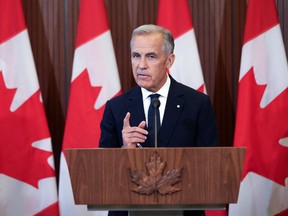
If you need to blame Prime Minister Mark Carney for anything, be it for overpromising on his ability to get anything resembling an acceptable “deal” with U.S. President Donald Trump on trade, but his decision to walk away from negotiations Friday, based on what we know, was the right thing to do.
Sign In or Create an Account
Leaked details of the tentative agreement that was reached earlier this week were bad enough. Apparently, according to media reports, Canada was conceding to permanent unilateral tariffs from the Americans on steel and autos, albeit at lower rates, while this country was expected to lift all tariffs, and make several non-trade concessions. These included scuppering digital legislation, a promise to complete the F-35 purchase and altering Canada’s supply management regime. Whatever one thinks of those policies, whether they are good or bad, they should be the purview of Ottawa, not Washington.
The fact that Canada was expected to make all these concessions while American tariffs remained in place is ludicrous. Not to mention that this little side deal already contravenes the existing Canada U.S. Mexico Agreement, which is somehow supposed to be renegotiated at some point.

The National Post newsletter that doesn’t hold back, giving readers the unvarnished truth on media, politics and culture.
By signing up, you consent to receive the above newsletter from Postmedia Network Inc.
A welcome email is on its way. If you don't see it, please check your junk folder.
The next issue of Right? will soon be in your inbox.
We encountered an issue signing you up. Please try again
Now we know that the deal on the table was evidently worse or became worse, than even all that. The Americans, according to Carney on Saturday morning, wanted to not only keep some tariffs on the auto sector, they wanted to exclude medium and heavy duty trucks from the deal altogether. Most galling of all, again, assuming the prime minister’s characterization of events is accurate, is that the U.S. wanted to restrict Canada’s ability to sign trade deals with other countries.
In other words, the plan was to turn Canada into a Western version of Belarus, where it is nominally independent but controlled from a foreign capital. Incidentally, what the Americans seem to want Canada to give up is not much different from what would have to be conceded if we joined the European Union, where Ottawa would also be prevented from signing independent trade deals and expected to align its regulatory regime with other members.
So walking away from negotiations, even if it leads to a protracted trade war, was the right thing to do. It may have been the most important moment for Canadian sovereignty in generations, and much credit to the prime minister for having the nerve to stand up.
That said, the fact the Liberals benefit politically from conflict with Trump is notable, but eventually Carney will have to account for any prolonged economic pain that might result from this.
The larger challenge now is reversing decisions taken in Canada over decades that have made it uniquely vulnerable to the treatment it is currently facing from Trump. Living next to the most powerful and richest nation in history, which was somehow uniquely benign, and, until now, largely friendly, allowed successive politicians the luxury to delude themselves into thinking Canada was morally superior. The U.S. spends money on the military and is the home of ravenous capitalism, while Canada is a nation of health care, peacekeepers and multiculturalism.
This country’s entire national mythos since the 1960s has only been possible because the Americans had not been a genuine military threat since at least the Civil War, and possibly not since the War of 1812.
Additionally, given how wealthy the U.S. is, there has never been much pressure on Canada to ensure it is a business friendly country. No matter what happens, the massive market to the south allows us to have a minimum standard of living almost by osmosis. When twinned with the fact that Canada’s inherent French-English divide absorbs unending federal resources, you have the makings of an unserious country unconcerned with national defence and generating wealth and opportunity for citizens.
So, instead of permitting competition and foreign investment, Canada protects cartels, often for regional political reasons, in banking, airlines, telecommunications and agriculture.
Instead of leaning into Canada’s comparative advantage in critical minerals and oil and gas, those industries are strangled with endless taxation and regulation that can only be described as predatory.
The auto manufacturing and dairy industries are never given the opportunity to mature so they can compete internationally. Instead, they are propped up and protected with subsidies and quotas. It is unsurprising that these are the sectors that create the most tension in trade talks.
If this wasn’t the reality of Canada, if Ottawa leaned more into its role as guarantor of national security and defence, and less into micromanaging all aspects of the economy, these periodic American shifts into protectionism would be a challenge, but hardly existential. Canada is a on the backfoot, but it was never inevitable that this would be where we landed.
It is up to Carney to ensure this isn’t where Canada stays.
National Post
Join the Conversation
This website uses cookies to personalize your content (including ads), and allows us to analyze our traffic. Read more about cookies here. By continuing to use our site, you agree to our Terms of Use and Privacy Policy.
KioskNews shows a cleaned-up reading view extracted from the publisher’s page — the original always lives on their site, not ours.