HPE Spaceborne Computer 4 to launch AI straight to the Moon aboard Astrolab’s FLIP rover
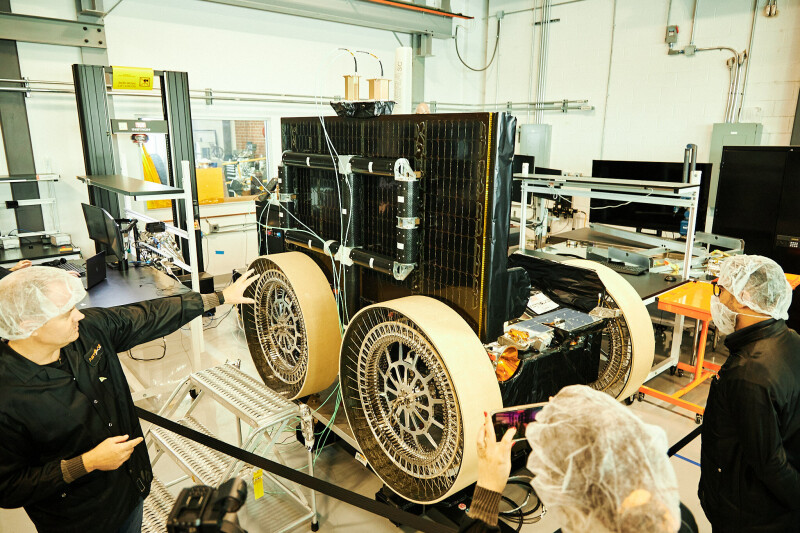
Forget space datacenters. Before the end of the year, Hewlett Packard Enterprise (HPE) will have AI running on the Moon.
This isn’t some exec’s loony fantasy either. HPE has been building orbital compute platforms for the International Space Station (ISS) for years. Now, it’s sending its fourth-gen Spaceborne Computer to the Moon aboard Astrolab’s Flex Lunar Innovation Platform (FLIP) lunar rover.
Part of NASA’s Commercial Lunar Payload Services (CLPS) program, the rover is set to be deployed near the Moon’s south pole by the Voyager Technologies Griffin-1 lander later this year.
REG AD
Assuming a safe landing on the surface, FLIP will serve as a test bed for a range of emerging technologies including HPE’s latest space-faring compute platform.
REG AD
Specifically, Spaceborne Computer 4, which for the sake of brevity we’ll just call SBC4, will carry out a number of AI and HPC-centric experiments during the rover’s year long mission on the lunar pole.
What we know about SBC4 so far
The actual silicon powering SBC4 is still a bit of a mystery. We’re told the reason for the secrecy largely comes down to the high-risk nature of the mission. If the hardware fails, HPE’s compute partner doesn’t want their name tied to it.
No guts but for the glory, we suppose, though Kioxia doesn't seem too worried.
What we do know is that it is equipped with a low-power central processing unit, a graphics processor, and will be equipped with a pair of mirrored Kioxia SSDs totaling 1 TB of capacity. That said, while it'll be among the most powerful computers on the Moon, it's still a pretty small system. The FLIP rover doesn't have an unlimited power or thermal budget. The rover's radiators can only dissipate so much heat.
Measuring in at around 5x10 inches and about an inch thick, while not a particularly big system, it's still large enough to house any number of existing compute platforms. For all we know, it could be powered by Nvidia’s GB10, AMD’s Xilinx Versal AI, or the guts of an old smartphone. We won't know until the thing powers up.
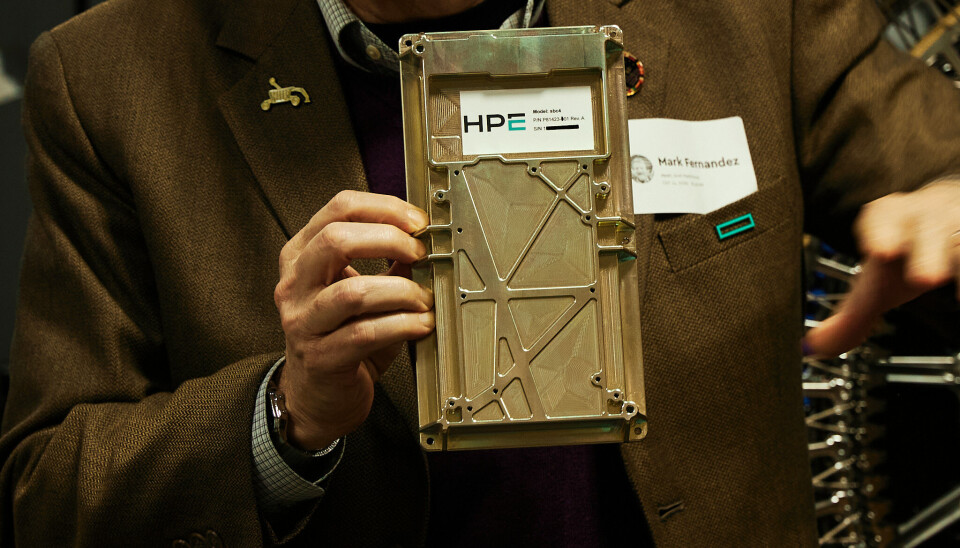
Less of a mystery is what SBC4 will be running and where. NASA plans to run a series of tuned LLM tests on the system, including a retrieval augmented generation (RAG) system to assist with searching and interpreting onboard documents. Additionally, the system will be tasked with running machine learning algorithms against camera and LiDAR data.
However, without knowing how large these LLMs are, it’s hard to infer the nature of the underlying hardware. We’re told to expect more details about the chips powering SBC4 once it’s up and running.
REG AD
Alongside AI, SBC4 will also run several high performance computing (HPC) benchmarks designed to push the system to its limits. These benchmarks include high performance Linpack (HPL) and high performance conjugate gradient (HPCG), which means HPE and Astrolab will soon hold the distinction of the first Top500 submission made from a celestial body.
Not only do HPE’s systems power some of the fastest supercomputers on Earth, but they could soon hold the number one spot on the Moon — not that that’s a particularly high bar.
Beyond bragging rights, a workload like HPL could have other benefits like helping to keep the rover from icing over during the roughly 14-day-long night cycles the rover will repeatedly endure over the course of its mission.
Hardening SBC4 for the Moon
The Rover and by extension SBC4 will have to contend with extreme vibration stresses during launch and landing, wild temperature swings, not to mention cosmic rays and solar radiation since the Moon lacks the thick atmosphere and magnetic field that shields terrestrial compute.
But, as it turns out, radiation might not be as big a problem as you’d think. According to Fernandez, SBC4 is largely assembled from off-the-shelf components, including the solid state drives.
The compute platform is using standard Kioxia BG6 M.2 drives with the main line of protection being a software RAID 1.
“It’s a silent mirror. The boot order is to try this and if something has happened to it, go here,” Mark Fernandez, HPE’s chief scientist of space tech and solutions, explained. “With our nine years' experience in the Space Station using drives, we’ve even convinced them we don’t need to do anything special for space.”
REG AD
However, this wasn’t always the thinking. As we reported at the time, early Spaceborne Computers suffered from high SSD failure rates. But as it turned out, so did the same drives deployed terrestrially. The cause of the failures wasn’t cosmic rays or energetic particles from the Sun, but rather bad capacitors, he explained. “I’ve had zero SSD failure since 2019.”
While off-the-shelf electronics are surprisingly radiation resistant — at least within FLIP’s mission parameters — HPE has invested heavily in software based redundancy and recovery.
Fernandez calls this “hardware hardening in software.” The idea being that the spare CPU cycles are used to continuously monitor and compare hardware metrics against a state table. If a parameter exceeds the specified threshold, SBC4 will take action to protect itself.
“At a high level, I say, I like to be running at full speed. I can't do that. I'll run at a slower speed. If I can't do that, I'd like to be booted, but not running anything, and then maybe the server will recover. And worst case, I'd like to be powered down rather than get destroyed,” he explained.
At the edge of the edge
FLIP is primarily intended as a proof of concept vehicle, which is to say it’s a test bed for technologies that may eventually find their way to the Moon on other missions.
The inclusion of SBC4 reflects the realities of operating at the far edge of Earth’s orbit. The latency between Earth and the Moon is nowhere near as bad as Mars's up to 44 minute round-trip communication time, but even 2.5 seconds makes real-time control from Houston, or in this case Astrolab’s mission control, which by the way is also powered by HPE's Greenlake Private Cloud stack, in Hawthorne, California a bit unwieldy.
Further complicating matters is the bandwidth afforded the rover. When Artemis 2 traveled around the Moon earlier this year, astronauts weren’t able to send back high-res photographs in real time due to the lack of bandwidth. It was only after the mission was on its way back to Earth that they were able to establish a big enough pipe to transmit the full-res images.
For this reason, SBC4 is designed to operate “at the edge of the edge,” Fernandez said.
Given the bandwidth constraints, it’s far easier to process as much of the data and telemetry gathered by the rover’s array of cameras, lidars, and environmental sensors locally.
“It’s important to ship back insight to Earth rather than all the raw data whenever possible. So having the edge compute capability to process the raw data locally, save on bandwidth back to Earth,” Astrolab CEO Jaret Matthews said.
Matthews isn’t the only one to share this perspective. Earlier this year, Nvidia CEO Jensen Huang described the challenges and opportunities of space-based computing with analysts during the company’s Q1 earnings call.
"There are many different computing problems that really want to be done in space," he said at the time. "One of the best use cases of GPUs in space is imaging. To be able to do imaging at very large, very high resolutions, extremely large scales and very, very fast, it's hard to do that by sending petabytes and petabytes of imaging data back here on Earth and doing that work, it's easier just to do it out in space."
Though others' ambitions are far greater. Google, Amazon, and SpaceX are all touting orbital datacenters powered by the Sun as the answer to terrestrial power constraints — Elon Musk wants you to believe he'll eventually be manufacturing deep-space datacenters on the Moon and lobbing them into the far reaches of the solar system using mass drivers — the economics of getting those bit barns into low Earth orbit remain unproven and so far unviable.
Despite this, executives and administrators at HPE, Astrolab, Kioxia, and NASA believe that space-based datacenters are still feasible long term.
FLIP
HPE’s Spaceborne Computer 4 will be one of several payloads aboard the FLIP rover.
FLIP will be the largest rover launched by the US since the Apollo program’s manned Moon buggy. And it is by no means small. Designed by Astrolab while measuring roughly 7 feet (2.13 meters) in length and weighing about half a ton, the rover is packed to the gills with cameras, sensors, and even a projector which will eventually be used in place of LCDs on future manned missions to the lunar surface.

For FLIP’s purposes, it’ll mostly be used to project partners' logos onto the Moon’s surface as a sorta advertising gimmick to keep the lights on back at Astrolab’s facilities in Hawthorne while it works on its FLEX rover, which Matthews characterizes as a sort of F150 or Caterpillar tractor for the Moon.
Beyond the scientific equipment, solar panels, and radiators, arguably FLIP’s most striking feature is its disproportionately large wheels. Developed by Venturi Space, along with the rover’s battery pack, these wheels are designed to function much like a pneumatic tire, just without air or rubber. Their size is also intentional. The same wheels found on FLIP are intended for use on NASA’s CLV-1 rover, which is slated to launch in 2028.
Much like FLIP offers HPE as a proving ground to test its lunar compute platform, the rover will do the same for Venturi’s wheels.
Spaceborne Computer 4 and FLIP are slated to launch aboard a SpaceX Falcon Heavy rocket later this year and will fly to the Moon’s south pole by Astrobotic’s Griffin-1 lander.
Griffin is classified as a medium class lander measuring roughly 15 feet around and 6.5 feet tall (that’s about 4.5 and 2 meters for those of you living in a nation civilized enough to use metric outside the sciences).
The lander is equipped with seven main engines responsible for everything from trans-lunar injection, trajectory correction, lunar orbit insertion, and powered descent to the surface. Four clusters of attitude control thrusters, meanwhile, will (hopefully) keep the thing pointed the right way up.
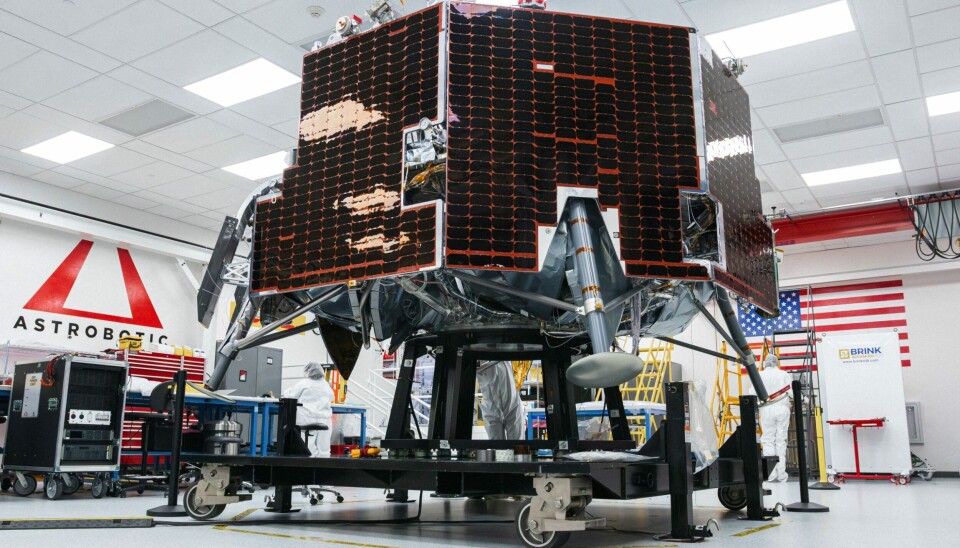
FLIP is expected to touch down near the Mons Mouton area along the edge of the South Pole before the end of the year. ®
KioskNews shows a cleaned-up reading view extracted from the publisher’s page — the original always lives on their site, not ours.