Grattan on Friday: Albanese leaves grim domestic scene as he flies to the blue Pacific
Having a “Pre-COP” meeting in Fiji and Tuvalu is one of those initiatives that seemed a good idea at the time.
No doubt it still has resonance as part of Australia’s wider diplomacy in the Pacific, in the battle to limit China’s influence. But when Anthony Albanese, still coming down from his New York high, steps onto his plane on Monday bound for Pre-COP, it could feel more chore than opportunity.
Even COP itself, in Turkey a few weeks later and also on Albanese’s itinerary, is not expected to break much ground.
Big issues have their high time, seizing public and media attention for brief or long periods. When Labor announced in 2021 that it would bid to host COP (The United Nations’ annual climate meeting), climate change was still front and centre. But now – as we (with Pacific countries) are co-hosts with Turkey – global warming has slipped down the public’s agenda.
This doesn’t mean that objectively, climate change is any less important. It means other issues have supplanted it on the public’s and the media’s radar.
In terms of excitement and imagination, AI is the “big new thing”. The appearance of OpenAI’s representative at a parliamentary inquiry on Tuesday, questioned about the recent breach of a government site by a rogue agent and the new technology’s risks and potential, will likely be of more interest to many Australians than what the PM is doing at Pre-COP, but neither will dominate their daily concerns.
In ordinary people’s day to day thinking, cost of living dominates, never more than this week when the Reserve Bank hiked rates for he fourth time this year, to the highest level since 2011.
Albanese might fend off questions about domestic politics while he’s away – as he tried to do when asked in New York about neglected Aboriginal children in Western Australia – but the home scene will remain on his mind.
The government is heading into a difficult final three months of the year.
With the latest rate rise, the argument over “blame” has intensified this week.
Treasurer Jim Chalmers on Monday got out in front of the Reserve Bank’s announcement by laying as much responsibility as he could on the Iran war. The opposition insists the pressure on inflation and rates is mostly from government spending.
Read more: Jim Chalmers blames likely interest rate rise on Middle East war
The bank on Tuesday complicated the picture. In its statement explaining the rate rise, it highlighted overseas factors. But at her lengthy news conference, RBA Governor Michele Bullock had a killer assessment in her opening statement.
“Inflation is too high and has been driven by domestic capacity pressures,” Bullock said. “The inflation impulse from the Middle East conflict is in addition to this.”
Domestic spending and investment have been stronger than expected, despite weak sentiment and the softening in housing market conditions. Productivity growth remains weak and the labour market remains a little tight. And outside of Australia, the global economy has also been more resilient than many expected.
Watching this, Chalmers may have, figuratively, kicked the cat.
Not only did the emphasis in Bullock’s summary undercut his it’s-the-war line but it also drew attention to the fact that the government’s productivity agenda, a priority with Chalmers, has not yet delivered.
Obviously, a mix of factors is keeping inflation high – on Wednesday the latest annual figure rose from 3.5% to 4% – and driving up rates. But any differences in their ranking by key players will stoke the current fevered economic debate over blame.
There’s an irony in Bullock publicly (in effect) marking the government’s homework. Her regular news conferences were part of the reforms to the Reserve Bank Chalmers and the bank made in Labor’s first term.
It’s a far cry from when the bank’s top faces lived in the political shadows. The news conferences impose more accountability on the bank but, indirectly, on the government as well.
For Bullock, appointed by Chalmers, the times have been testing. Asked recently about what the bank had done to help the economy navigate its challenges, she said, “Just as an aside, I remember previous governors saying you’d be lucky to get through your term without something going badly pear-shaped. For Ian Macfarlane, that was the Asian financial crisis, for Glenn [Stevens] it was the GFC, and for Philip it [Lowe] was COVID. So I’m getting my share now.”
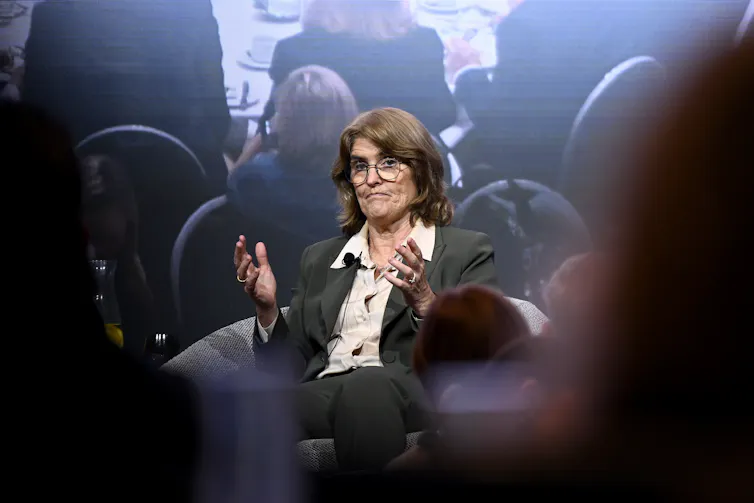
Bullock is one of several high profile women Chalmers appointed to key positions impacting his portfolio. They include Danielle Wood, chair of the Productivity Commission. From time to time Wood calls out the government on specific issues.
The willingness of Bullock and Wood, both of whom hold independent statutory posts, to tell it as they see it speaks to the quality of the appointments, although Chalmers mightn’t relish it when it happens.
As it prepares its budget update, due in December, the government is pulled in conflicting directions: to respond to calls for fresh savings, and to spend on new cost-of-living relief.
Albanese probably misspoke when he suggested this week the update would have cost-of-living help. In a recent podcast with The Conversation Chalmers played down the prospect of new measures in the update, a position backed by other government sources.
If the government really wanted a new serious reform measure to curb spending it should consider a proposal floated by independent MP Allegra Spender this week: a return to a more general use of means testing. But restricting benefits in this era of people wanting big government and financial support is considered political suicide.
Read more: By avoiding means testing, the government is giving handouts to the rich
Among the pressures the government will face in coming months could be a more difficult Senate, where the Greens hold the balance of power. If Labor can’t get a deal with the opposition on contested legislation, it has to turn to the Greens.
With Larissa Waters forced by serious ill health to stand down from the leadership, the Greens on Wednesday replaced her with David Shoebridge – a much more assertive, politically aggressive character, who gets under Labor’s skin.
Shoebridge at his first news conference as leader put Labor on notice. Condemning its “rushing to the right” Shoebridge said: “We’re not here to make the Labor Party any better. The Greens are here to replace them.”
It’s a sure bet that won’t happen, but it’s a good bet Shoebridge will turn the screws hard in negotiations.
Read more: Amid rising support for right-wing minor parties, can David Shoebridge reinvigorate the Greens?
KioskNews shows a cleaned-up reading view extracted from the publisher’s page — the original always lives on their site, not ours.