Taiwan’s Iran-style attack drone could swamp PLA air defences: analysts
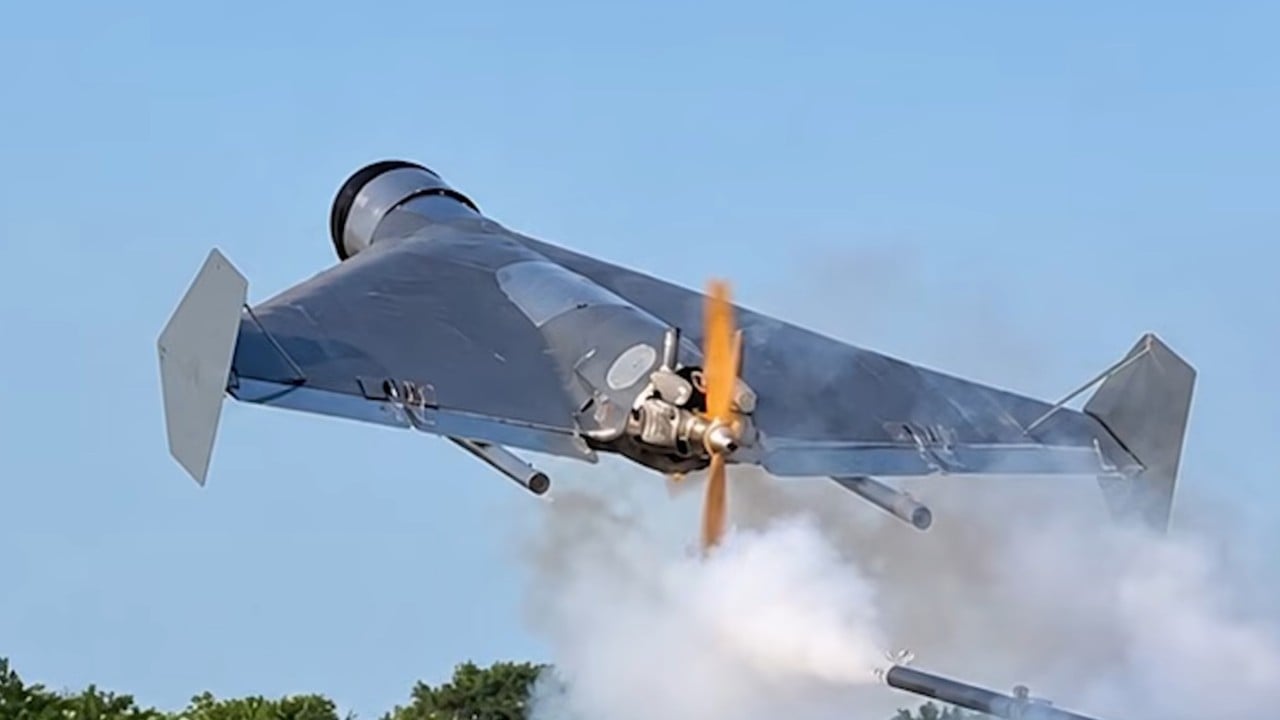
A flight-tested attack drone similar to Iran’s Shahed model that its Taiwanese maker says could reach military targets in mainland China is meant to swamp PLA air defences, analysts said.
Drawing on battlefield lessons from Ukraine and the Middle East, military experts broadly agree on the utility of such low-cost systems but differ on how it could be deployed in a conflict with Beijing should it enter service.
While some see greater value in targeting People’s Liberation Army forces in the event of a landing on Taiwan, others point to strikes against airfields and ports on the mainland.
The weapon at the centre of the debate is Thunder Tiger’s Papa Delta PD-136, which the company showcased at the Association of the United States Army defence exhibition in Washington earlier this month as it sought international defence-industry partners.
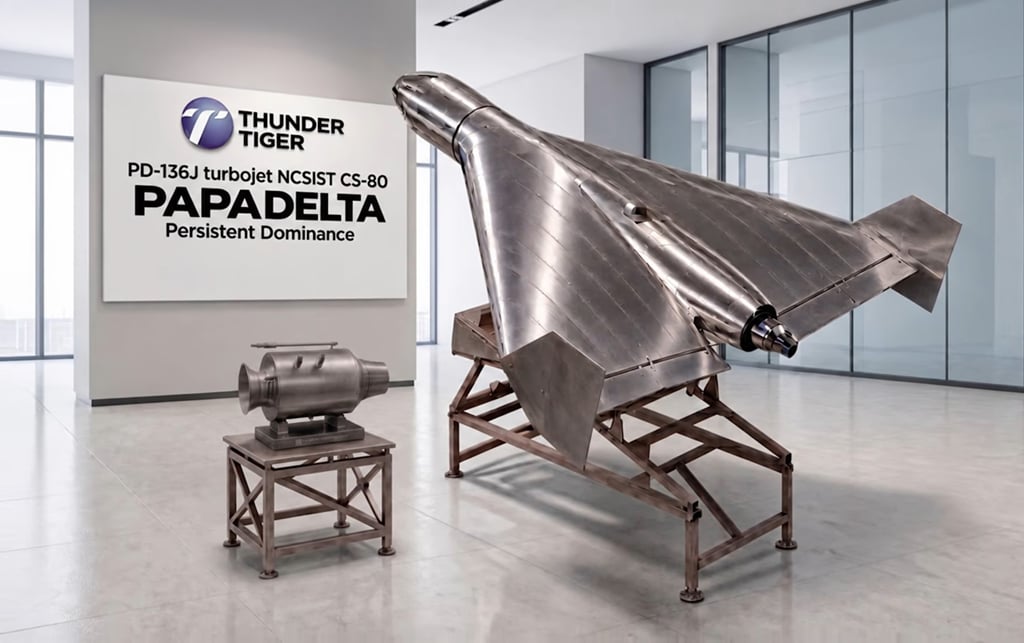
Visually, the PD-136 adopts a familiar strategic silhouette: its delta-wing airframe and rear-mounted propeller closely resemble Iran’s Shahed-136, a munition drone extensively deployed by Russia in Ukraine.
The design also mirrors the US Low-cost Uncrewed Combat Attack System (Lucas) – itself developed by reverse-engineering a Shahed-136 obtained by the United States, according to a Pentagon official cited by ABC News.
Notwithstanding the design similarities, the PD-136 would carry a smaller payload than the Shahed-136, which the Centre for Strategic and International Studies estimates at 20-50kg (about 44-110lbs).
Thunder Tiger says the attack drone is designed to carry a 10-15kg payload over a distance of more than 300km (186 miles), potentially putting areas of Fujian province on the Chinese mainland within reach, with defence outlet Army Recognition reporting a range target of about 500km.
Powered by a proprietary 250cc two-stroke engine, the PD-136 completed a catapult launch and flight test in Yunlin county in Taiwan on October 2. The advertised range has not been publicly demonstrated.
Major technical details remain undisclosed, including the drone’s guidance system, resistance to electronic warfare and operational warhead specifications. More significantly, Taiwan’s military has yet to announce an order for the PD-136.
Despite these uncertainties, Taipei’s interest in attritable strike platforms reflects lessons from recent conflicts.
“Taiwan has very likely taken lessons from the Russia-Ukraine war and the US war with Iran, both of which have shown the importance of drones,” said Timothy Heath, founder of defence consultancy Perceptum.
01:43
Shocking video shows Russian drone stalking Ukrainian vegetable vendor
However, the PD-136’s slow speed could make it vulnerable to interception when targeting mainland Chinese radars and sensors, Heath said, adding that the drone might be more useful against PLA troops and equipment after they had landed on Taiwan, where mainland Chinese forces would have less time to react.
That assessment aligns with Taiwan’s broader military priorities.
In an April briefing to lawmakers, the island’s defence ministry outlined plans to acquire more than 210,000 drones, focusing on autonomous navigation, coordinated operations and systems intended to strike enemy landing forces, armoured units and transport vehicles.
The PD-136 could support such a high-volume approach if produced cheaply. Built around a simple piston engine and a stamped-aluminium airframe, the drone is intended for low-cost mass production, though Thunder Tiger has not disclosed a unit price.
Both experts said low-cost drone attacks could force defenders to spend heavily on interception.
According to Peter Layton, a visiting fellow at the Griffith Asia Institute in Australia, massed attacks would almost certainly combine weapons like the PD-136 with other drones as well as cruise and ballistic missiles.
“The principal concept is to launch very large numbers and overwhelm the air defences,” said Layton, who is also affiliated with the Royal United Services Institute. “Most of the drones will be shot down but in so doing use up many expensive air-to-air missiles and surface-to-air missiles.”
Heath echoed that assessment, noting that low unit costs could allow Taiwan to invert the attrition ratio in a conflict with Beijing.
“The drones are far cheaper than cruise or ballistic missiles yet can be highly effective,” he said. “This could be a way for Taiwan to put the cost ratio in its favour in a war with Beijing.”
While both analysts saw advantages in launching inexpensive drones in large numbers, they differed over the best targets.
Heath said that attacking PLA forces after a landing on Taiwan would be more effective, while Layton pointed to airfields and ports on the mainland, arguing that large numbers could compensate for their “mediocre accuracy”.
However, Layton cautioned that such drones would be “ineffective against hardened targets such as buried facilities, hardened aircraft shelters or runways”.
Beijing has already trained against massed drone attacks. In January, state broadcaster CCTV showed a PLA Navy unit using shipborne missiles and other defence systems against simulated swarms of suicide drones.
Nevertheless, Layton suggested, Beijing might need additional countermeasures, including radar-controlled 30mm anti-aircraft guns and low-cost interceptor drones similar to those deployed in Ukraine.
He said the PLA would be “very effective against individual drones” but warned that, when launched in large numbers, “some will get through”.
Beijing sees Taiwan as part of China to be reunited by force if necessary. Most countries, including the United States, do not recognise Taiwan as an independent state, but Washington is opposed to any attempt to take the self-ruled island by force and is committed to supplying it with weapons.
KioskNews shows a cleaned-up reading view extracted from the publisher’s page — the original always lives on their site, not ours.