Skills, workflows and governance: What businesses need to make AI work
For decades, Singapore has made a habit of moving early when new technologies emerge. Digital services have become embedded in everyday life and, more recently, the country has laid out ambitions to deepen its use of artificial intelligence through initiatives such as National AI Strategy 2.0.
But inside the workplace, the transition may not be moving quite as quickly.
As businesses explore the next phase of agentic AI – where autonomous AI agents can reason, make decisions and carry out tasks – employees are already anticipating how their jobs could change. A Salesforce survey found that 97 per cent of workers expect to work with an AI agent.
This suggests the challenge may be less about outright resistance to AI than uncertainty over what it could mean for individual workers: how it might change their jobs, what tasks it could take on and, crucially, what skills they will need to work alongside it.
For businesses, closing this gap will require more than experimenting with the technology. They will also need to prepare their people and rethink how work gets done.
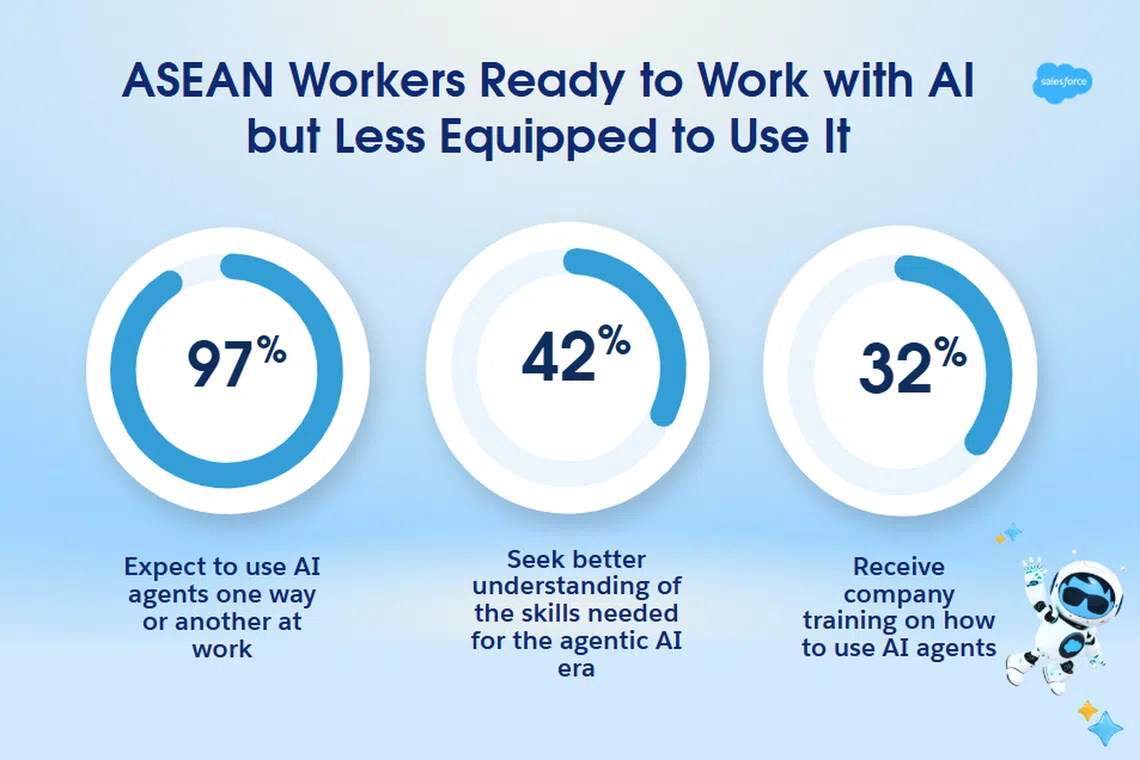
A Salesforce survey found that 97 per cent of Asean workers expect to use AI agents at work, but only 32 per cent receive company training on how to use them.
PHOTO: SALESFORCE
Why businesses need to move beyond AI pilots
There are understandable reasons for businesses to proceed cautiously with AI.
Although the technology is evolving quickly, organisations must weigh considerations ranging from data privacy and security to the accuracy and safety of AI-generated responses. A lapse in any of these areas can have consequences for customers as well as a company’s reputation.
The risk, however, is that caution turns into a prolonged cycle of small-scale pilots, without organisations taking the next step towards wider adoption.
When that happens, businesses may struggle to realise the value of AI while employees are left knowing that change is coming, but without a clear understanding of how it will affect their work.
Some workers may instead turn to AI tools and use them in their personal capacity to build familiarity. But what works for individual use does not necessarily translate neatly into the workplace, where considerations such as security, privacy and governance become much more important.
Why agentic AI is different from earlier technology shifts
AI should not be treated as just another technology cycle that businesses can wait out until there is greater certainty. There is a generational shift in the nature of work.
Previous waves of workplace technology largely helped people perform existing tasks faster or more efficiently. Agentic AI could go further by taking responsibility for certain tasks and processes itself, changing the role people play within them.
That has particular implications for Singapore. With a small domestic labour force and an ageing population, finding ways for workers to become more productive will remain important to the economy.
The question, then, is not simply whether businesses should adopt AI, but how they can do so in a way that allows their workforce to adapt alongside it.
How businesses can prepare for agentic AI
Regardless of which AI models or tools ultimately prevail, successful adoption is likely to depend on three areas progressing together: workforce skills, redesigned workflows and trust.
First, businesses need to go beyond basic AI literacy.
Knowing how to use an AI tool to summarise a document or draft an email is useful, but the bigger opportunity lies in developing workers who can combine their professional expertise with an understanding of how AI can be applied to their jobs.
Singapore’s National AI Impact Programme, for instance, aims to help companies adopt AI while equipping workers with the skills to use it. Businesses can complement such efforts by moving beyond one-off training sessions and showing employees how AI can be incorporated into their day-to-day work.
That may also mean reviewing job scopes and team structures as people begin working more closely with AI agents.
The second step is to rethink workflows.
Simply adding AI to an existing process may deliver incremental improvements, but larger gains can come from redesigning the process itself – identifying which routine tasks can be handled by AI and where human judgment, expertise and interaction remain most valuable.
Take, for example, the use of customer service in insurance, where a human service representative might use AI to help draft a response. A redesigned workflow could instead allow an AI agent to handle routine queries and complete certain steps independently, before passing more complex cases to a human agent.
Health maintenance organisation Maxicare in the Philippines has adopted such an approach for its Letter of Authorisation process, with AI agents handling parts of the customer journey and escalating cases when necessary. According to the company, this has cut service time by 97.5 per cent.
The third consideration is trust and governance.
Customers need to know that their data is protected, while employees need clarity on how AI systems are being used. Regulators, meanwhile, expect businesses to remain accountable for their systems and processes.
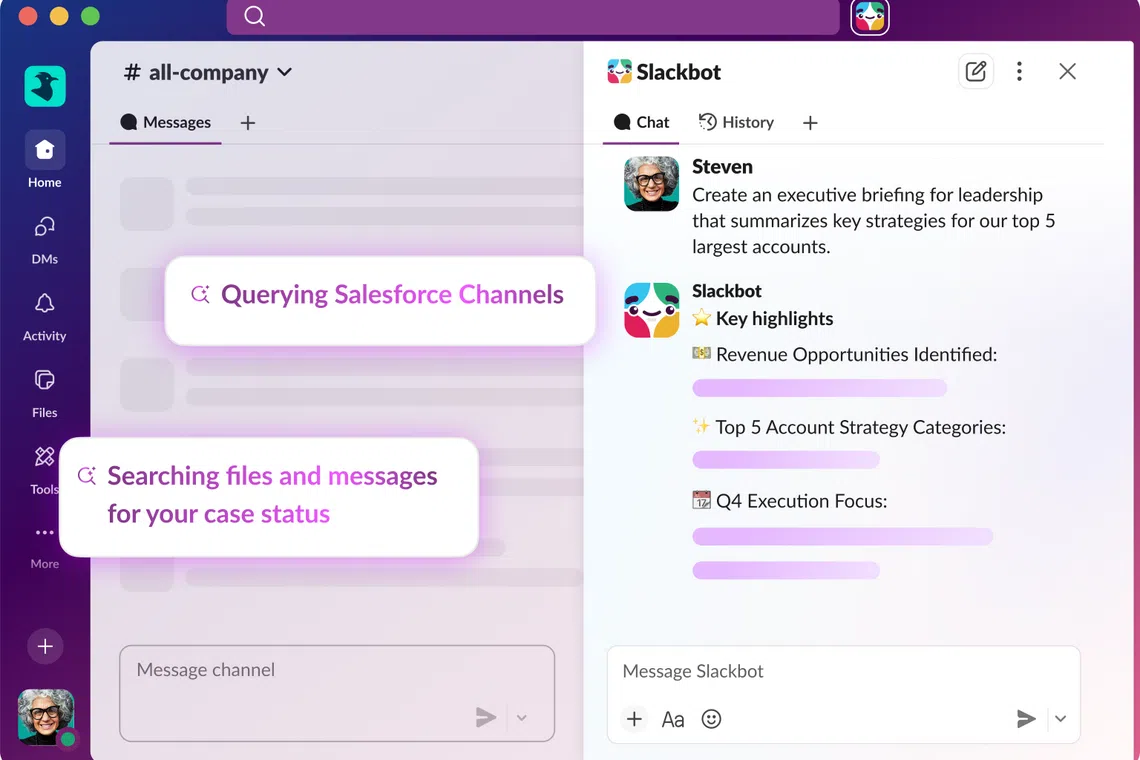
Slackbot, Salesforce’s AI agent for work, can search Salesforce data and surface answers directly in Slack, with governance managed centrally through Agentforce.
PHOTO: SALESFORCE
This becomes more complex with large language models (LLMs), whose responses are probabilistic rather than determined by a fixed set of rules. The same input may not always produce exactly the same result.
As AI becomes more widely used across organisations, governance therefore needs to scale alongside it. Businesses need ways to set controls, monitor how AI systems are being used and manage issues such as risk, security and compliance.
Salesforce’s Agentforce, for example, is designed to give organisations a centralised way to manage AI agents and the governance surrounding their use.
How business leaders can equip their people for AI
For Singapore’s business leaders, one of the clearest signals from the shift towards agentic AI is that the workforce may be more ready for change than some assume.
But expecting to work with AI is not the same as knowing how to do so effectively.
Businesses will need to give employees a clearer picture of how AI will change their work, equip them with the skills to use it and redesign processes so that people and AI can each play to their strengths.
Companies that remain stuck in experimentation risk missing not only potential productivity gains, but also the opportunity to prepare their workforce for a broader change already under way.
The next phase of AI adoption will therefore be as much about people and the way work is organised as it is about the technology itself.
Find out how you can transform your business into an agentic enterprise with Salesforce.
This article was written by Salesforce Asean senior vice-president and general manager Paul Carvouni.
KioskNews shows a cleaned-up reading view extracted from the publisher’s page — the original always lives on their site, not ours.