The Coalition is betting that people mistrust Albanese more than big tech
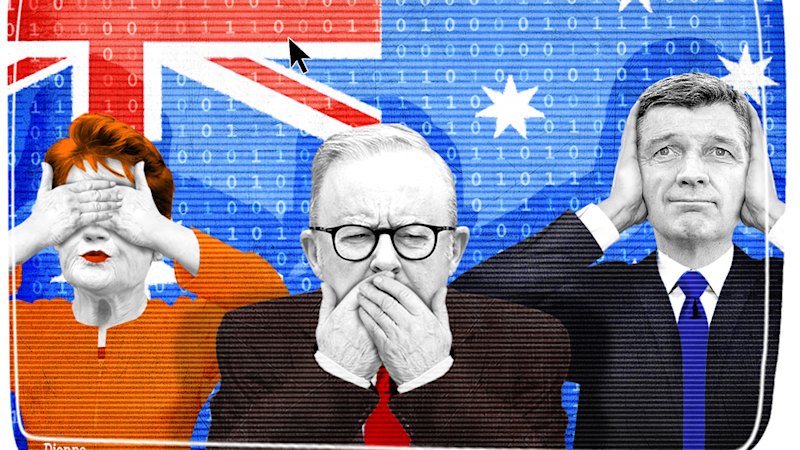
Of course we’re talking about censorship. It could be no other way when a government tries to regulate the internet. We saw it a couple of years ago when the Albanese government tried to pass laws to deal with online misinformation and disinformation. We’re seeing it this week as it tries to take on the social media companies’ algorithms.
In the former case, the government ultimately abandoned the cause. In this case, I can’t imagine any such backdown. But the debate will take a very familiar shape: the government legislating in an extremely tricky area with the stated aim of preventing harm, opposition parties accusing it of trying to remake the internet in its political image.
There are some genuine free-speech issues at play here. There are also some red herrings. That’s because the Albanese government’s bill is trying to do two quite separate things.
One, to give social media users the ability to opt out of the algorithm that feeds them suggested content. Two, to stem the torrents of what it calls “seriously harmful” online content that has people veering off into extremist misogyny or being led into having eating disorders. The objection of censorship is meaningful to the second, but it’s totally irrelevant to the first. The problem is that it’s being used to reject the whole lot. And I suspect that’s going to create a political problem down the track, especially for the Coalition, which has now officially declared it opposes the legislation.
To force social media companies to let their users switch off their algorithm doesn’t stop anyone saying or publishing anything. It doesn’t even stop social media companies producing offering to feed you content via their algorithms. It means only that you’re not compelled to be subjected to that. The relevant idea here isn’t censorship, but choice. The threat here is to the business model of the tech giants in the (unlikely) event lots of people opt out. But it is not to speech.
It’s far more fraught, though, to legislate that social media organisations must ensure a “safe online environment”, where people are “protected from seriously harmful material”. What’s “seriously harmful”? The bill has a list of horrible things: content encouraging child sex abuse, sexual violence, death and rape threats, encouraging suicide or self-harm, supporting terrorism, or promoting illicit drug use. But the real controversy is over what comes next.
The bill would allow the minister simply to declare other things to be seriously harmful, too, and it would be so. That’s the thrust of the Coalition and One Nation’s objection: it puts the declaration of harm in the hands of the government of the day, “a blank cheque for political censorship to the minister”, in Angus Taylor’s phrase. Say she wants to designate anti-immigration content seriously harmful. Or climate-change denying content. Or anti-Israeli content. This sort of thing, they say, is entirely possible under the law, and would silence political debate.
There’s half a point here. The government retorts that whatever the minister adds to the list, the senate can take away with a vote. That’s something, but it’s not as much as it seems. It puts the onus not on the government to get a majority, but on its opponents to do so. Any government will probably have a significant presence in the senate. To have a majority against it will require something close to a total alliance from all the non-government senators. In the current parliament, for instance, it would need something akin to an alignment between the Coalition, One Nation and the Greens to reverse the minister’s decision. That means that if a minister’s decision is very political – appealing to true believers on the left or the right – it will be very hard to reverse.
But it’s only half a point because this is easy enough to fix. You simply require any additions to the “seriously harmful” list to be passed through the parliament like any other amendment. That means that instead of them being at the whim of government, they’d express the will of the parliament. At least in theory, they’d capture the will of the public more broadly. I suspect nakedly partisan attempts to regulate online content wouldn’t be able to get through all that.
If I had to guess, I’d say that’s what the Albanese government will do. It’s an easy enough compromise to make, and it immediately dilutes the most powerful free speech objection. But that’s where things would get really interesting. Because if the Albanese government made that sort of change, what would the other parties do?
One Nation is easy enough to predict. It doesn’t want a single thing to change. The algorithm suits it perfectly. It lives in a world where social media influencers tell you the truth, and the ABC doesn’t. It is completely unmoved by any campaign to “fix our feeds” because it doesn’t see anything broken. For that reason, it doesn’t even need to get into intricate arguments about what is and isn’t censorship.
But the Coalition is in a bind. It clearly accepts the dangers of social media on some level. It’s easy to forget that Peter Dutton proposed the teen social media ban before Labor did. Its Shadow Minister for Communications and Digital Safety has spoken of “dreadful algorithms” which are engines of “insidious psychological manipulation”.
But its deputy leader is Matt Canavan, who has dismissed any suggestion at all that the algorithm is a problem. That’s why the Coalition has to lean so heavily on the idea of censorship. It’s not so much that the Coalition are free speech purists - after all they began this week arguing for a law to ban burning the Australian flag. It’s that on an issue like this one, censorship is the only argument that allows them to reconcile the opposing positions within. As long as you can say Labor’s solution is an attempt at thought control, you don’t need to decide whether social media algorithms are dangerous or not.
It’s banking, then, on people mistrusting the Albanese government more than it mistrusts big tech. And if the teen social media ban shows us anything, it’s that Labor quite likes that match-up. And if in the meantime it has shown a willingness to make changes, to address legitimate free-speech concerns, the Coalition might once again find itself marooned on its own divided island – unclear on what to fight for, and against whom. And, unable to decide on what it really thinks of social media, there’s a real risk it takes the fight to itself.
Waleed Aly is a broadcaster, author, academic and regular columnist. He is the author of the current Quarterly Essay, Time of Monsters: What future for liberalism?
The Opinion newsletter is a weekly wrap of views that will challenge, champion and inform your own. Sign up here.
KioskNews shows a cleaned-up reading view extracted from the publisher’s page — the original always lives on their site, not ours.