200 years of law: How Singapore’s legal system has helped shape the nation
Stripped of its legal jargon, the Rule of Law is a set of enduring principles. That no one – not even the government – is above the law.
That laws are clear, applied consistently and enforced by independent courts. And that, every person, whatever their status or means, is equal before the law and is entitled to a fair hearing.
The Rule of Law is not an abstract ideal. It is what gives every citizen confidence that he or she will be treated fairly in court. It is what gives every business the assurance that a contract will be honoured. And it is what gives every investor certainty that the rules will not change overnight.
For a small city-state with no natural resources, trust is everything.
The foundations of Singapore’s legal system
Singapore inherited its modern legal system from the British. In 1826, the Second Charter of Justice established Singapore’s modern legal and judicial system and, for the first time, a common body of law applied to everyone on the island – regardless of race, language or religion. It was a significant moment.
But for much of the colonial era, the law was wielded less for the benefit of ordinary inhabitants than to advance the interests of empire and trade.
Click here to explore early milestones that helped lay the foundations of Singapore’s legal system.
The legal systems gave merchants the legal certainty they needed to do business, and it helped grow revenue for the British colonial power – including through the licensing of opium sale for profit.
The courts were largely the preserve of the wealthy. Social services were thin, and the police had limited ability to enforce laws and maintain stability for the population.
The focus of the legal system only began to change after independence.
Building trust, stability and prosperity
When Singapore became a sovereign nation in 1965, its founding leaders – including Mr Lee Kuan Yew, who was a lawyer – recognised the Rule of Law as one of the most valuable legacies the British had left behind, even as they saw how it had to be reshaped to serve a new purpose: the pillar for Singapore’s nation-building.
Click here to explore key milestones that show how the law supported Singapore’s nation-building.
To deliver on that promise, the young nation invested in strong legal institutions – the Judiciary, the Attorney-General’s Chambers, and the Police – each tasked with applying the law firmly and fairly.
The powers of the Corrupt Practices Investigation Bureau were also enhanced through the Prevention of Corruption Act in 1960, to stamp out corruption.
Clear and predictable rules, reliably enforced, gave businesses and investors the confidence to put down roots in an untested country.
The results were dramatic. In 1965, the average income per person was around US$500 (S$633). By 2024, it had climbed to more than US$75,000.
Just as important was safety and security. The Singapore of the 1950s and 1960s was crime-ridden and uneasy – plagued by secret societies and gang violence, and scarred by the racial riots of 1964 and 1969. The Rule of Law became the instrument for restoring order and binding a divided society together.
To safeguard racial and religious harmony, equality was written into our Constitution, and the Presidential Council for Minority Rights was established in 1970.
The Maintenance of Religious Harmony Act later provided further safeguards against conduct that could fracture the peace between faiths.
To reduce crime, tough measures were introduced. The Criminal Law (Temporary Provisions) Act gave the authorities powers to clamp down on secret societies, while drug laws were tightened – including the introduction of the death penalty for serious drug trafficking in 1975.
The law also underpinned social policies that still shape the everyday life of ordinary Singaporeans.
Public housing was delivered through the Housing and Development Act; retirement savings through the Central Provident Fund; national defence through the Enlistment Act of 1970; and, in time, schooling for every child through a framework of compulsory education. Each policy was made real through law – and each remains woven into the fabric of our lives today.
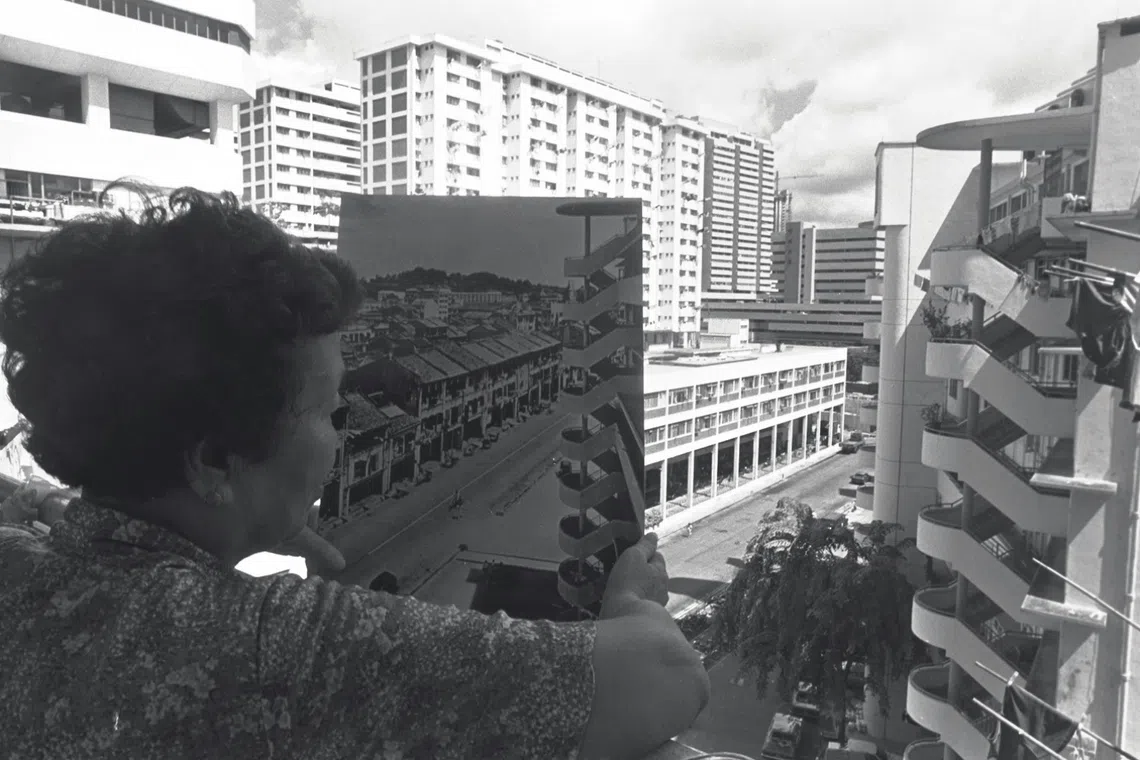
In 1984, a resident holds an older view of Hong Lim area, since transformed by a hawker centre and high-rise public housing.
PHOTO: SPH MEDIA
The Rule of Law also shaped how the young nation took its place in the world. Joining the United Nations in 1965 brought Singapore into a rules-based international order in which disputes between states were to be settled by law rather than force – an existential matter for a small, open and trade-dependent country.
And Singapore did not merely play by those rules; we helped write them.
Singaporeans such as Professor S Jayakumar, Professor Tommy Koh and then-Attorney-General Chao Hick Tin played a leading role in negotiating the United Nations Convention on the Law of the Sea, adopted in 1982, which set the legal framework governing the world’s oceans and the vital shipping lanes on which Singapore’s prosperity depends.
From nation-building to global relevance
By the 1990s, Singapore’s nation-building years were largely complete. The challenge had grown from simply holding a young country together to ensuring that the Rule of Law remained effective in a rapidly changing world.
As the economy became more globalised and society more complex, new demands were placed on the legal system.
Click here to explore key milestones that helped establish Singapore as a trusted hub for international dispute resolution.
One response was to build institutions that could support the growing volume of cross-border trade and investment flowing through the region.
Singapore’s reputation for fair and impartial justice became an engine of growth in its own right. The Singapore International Arbitration Centre was established in 1991, offering the international business community an efficient and reliable venue for dispute resolution.
This was followed by the opening of Maxwell Chambers in 2010 – the world’s first integrated dispute resolution complex, the establishment of the Singapore International Mediation Centre in 2014, and the establishment of the Singapore International Commercial Court in 2015.
Together, these institutions further cemented Singapore’s reputation as a safe, stable and neutral venue for cross-border commercial disputes.
A broader shift in thinking about dispute resolution was also underway. While courts remained essential in determining rights and obligations, increasing emphasis was placed on helping parties resolve conflicts through dialogue, compromise and mutual agreement – in ways that preserved relationships and produced lasting outcomes.
Singapore’s leadership in this field was recognised internationally when the United Nations adopted the Singapore Convention on Mediation in 2018, the first international convention to bear Singapore’s name.
This thinking extended beyond commercial disputes. The Community Mediation Centre was established in 1998 to help neighbours, families and members of the public settle disagreements amicably, while the Community Disputes Resolution Tribunals were introduced in 2015.
A similar shift was underway in criminal and family justice.
In our criminal system, the focus increasingly extended beyond punishment towards rehabilitation and reintegration through initiatives like the Yellow Ribbon Project in 2004 and the introduction of community-based sentences in 2010.
In family justice, the establishment of the Family Justice Courts in 2014 and the recommendations by the Committee to Review and Enhance Reforms in the Family Justice System paved the way for the adoption of the Therapeutic Justice Model, a problem-solving and relationship-centred approach designed to help families resolve disputes while preserving family bonds.
Laws for a new era
If earlier generations built and globalised Singapore’s legal system, this generation faces a different task: keeping it relevant against challenges that move faster than ever before.
Click here to find out more about how the Rule of Law continues to adapt to changing times.
We entered the 2020s with an upheaval no one could have anticipated: the Covid-19 pandemic, which disrupted daily life, paralysed businesses and strained contractual relationships on a scale few had imagined.
Almost overnight, businesses could not honour their contracts and tenants could not pay their rent. The legal system had to respond quickly.
Singapore passed the Covid-19 (Temporary Measures) Act within nine days, temporarily shielding individuals, families and businesses from legal action over rents, loans and contracts they could no longer meet, and allowing court hearings to continue online.
It was a bold step – having the law reach into private contracts is not something any government does lightly.
As then-Minister for Law and Minister for Home Affairs K. Shanmugam SC explained, insisting on the strict letter of contract law in such an extraordinary moment would have undermined its very spirit: the trust on which all commerce depends.
Yet the relief was carefully bounded – available only where hardship was genuinely caused by the pandemic, and designed to lapse once the crisis passed.
A new, informal system of assessors was created so that thousands of ordinary people could resolve disputes quickly, without the cost and formality of court. The Rule of Law was used as a tool – firm, fair and focused on outcomes.
If the Covid-19 pandemic tested the legal system’s ability to respond to crises, the digital age posed a different challenge: How do you govern risks that are evolving as quickly as the technology behind them?
As digital technologies transformed everyday life, new legislations were enacted to provide clear protections and safeguard public trust in an increasingly online world – from the Protection from Harassment Act to newer measures tackling online falsehoods, scams and abuse.
In 2023, the Online Criminal Harms Act was passed, which enabled the Government to issue directions where there is a suspicion of online activity carried out in furtherance of an offence.
In 2025, the Online Safety (Relief and Accountability) Act 2025 was passed, establishing a dedicated Online Safety Commission with the power to issue directions to put a stop to specified online harms, giving victims timely and accessible relief.
Yet amid all these changes, one principle remained constant – that justice must be accessible to all, regardless of means.
The Legal Aid Bureau, now nearly seven decades old, has provided civil legal aid to thousands of people over the years.
The establishment of the Public Defender’s Office in 2022 further strengthened Singapore’s criminal justice system by providing criminal legal aid to eligible accused persons who cannot afford a lawyer.
Looking ahead, further headwinds are on the horizon. Geopolitical tensions, economic nationalism, climate change and the rise of AI, which has turbocharged online harms such as deepfakes and scams.
In the face of these emerging challenges, the Rule of Law must evolve to remain meaningful and effective.
Yet the core principles of the Rule of Law remain as relevant now as they were in Singapore’s early years. Their endurance lies in their ability to adapt to changing times, to remain effective and meaningful.
As Minister for Law, Edwin Tong SC, put it: “Today, we look ahead, and think about the next Charter… keeping our laws up to date, meeting demands of the market, making sure that we evolve to remain relevant is a key feature of the Singapore justice system.”
PHOTOS: SPH MEDIA, GETTY IMAGES, MINISTRY OF LAW, “FROM FOUNDATION TO LEGACY: THE SECOND CHARTER OF JUSTICE” BY JUSTICE ANDREW PHANG, LIM KHENG CHYE COLLECTION (COURTESY OF NATIONAL ARCHIVES OF SINGAPORE), UNITED NATIONS
KioskNews shows a cleaned-up reading view extracted from the publisher’s page — the original always lives on their site, not ours.