From Green Crackers To Cold Fireworks, The Woman Chasing Smoke-Free Diwali
Nine years ago, as Delhi's air turned toxic after Diwali and concerns over pollution mounted across India, a challenge was thrown at Indian scientists. The challenge came in 2017 from Dr Harsh Vardhan, then Union Minister for Science and Environment and an ENT surgeon by training, who believed science could help preserve tradition while reducing environmental damage.
The result was a new category of fireworks that came to be known as "green crackers".
It was in 2018 that NDTV first exclusively broke the story that India's efforts to develop green crackers had come to fruition. Dr Harsh Vardhan, Science and Environment Minister, had told NDTV on October 29, 2018: "We have announced the production of green crackers where the cost will be something like 15-30 percent less, these crackers will have 25-30% less particulate matter and fifty percent less sulphur dioxide and NOx potential and be less polluting to the environment and these can be manufactured by the industry that already exists in the country with a Rs 6000 crore economy and 5 lakh workers and they will be able to manufacture them at the same facility without disturbing anything, this is happy news."
This came after scientists from the Council of Scientific and Industrial Research (CSIR) took on the challenge and developed India's first generation of green firecrackers capable of reducing pollution by about 30 per cent compared to conventional fireworks.
The breakthrough was significant. Until then, firecrackers had become the focus of an intense national debate because of their contribution to air pollution, especially in North India during winter, post-Diwali. Scientific studies had repeatedly shown spikes in particulate matter, sulphur dioxide and nitrogen oxides after large-scale bursting of fireworks.
The first-generation green crackers were developed by a team led by Dr Sadhana Rayalu, then a senior scientist at the National Environment and Engineering Research Institute, Nagpur (CSIR-NEERI). The formulation reduced the use of toxic components, including barium, and modified the chemical composition of conventional crackers through special additives and catalysts.

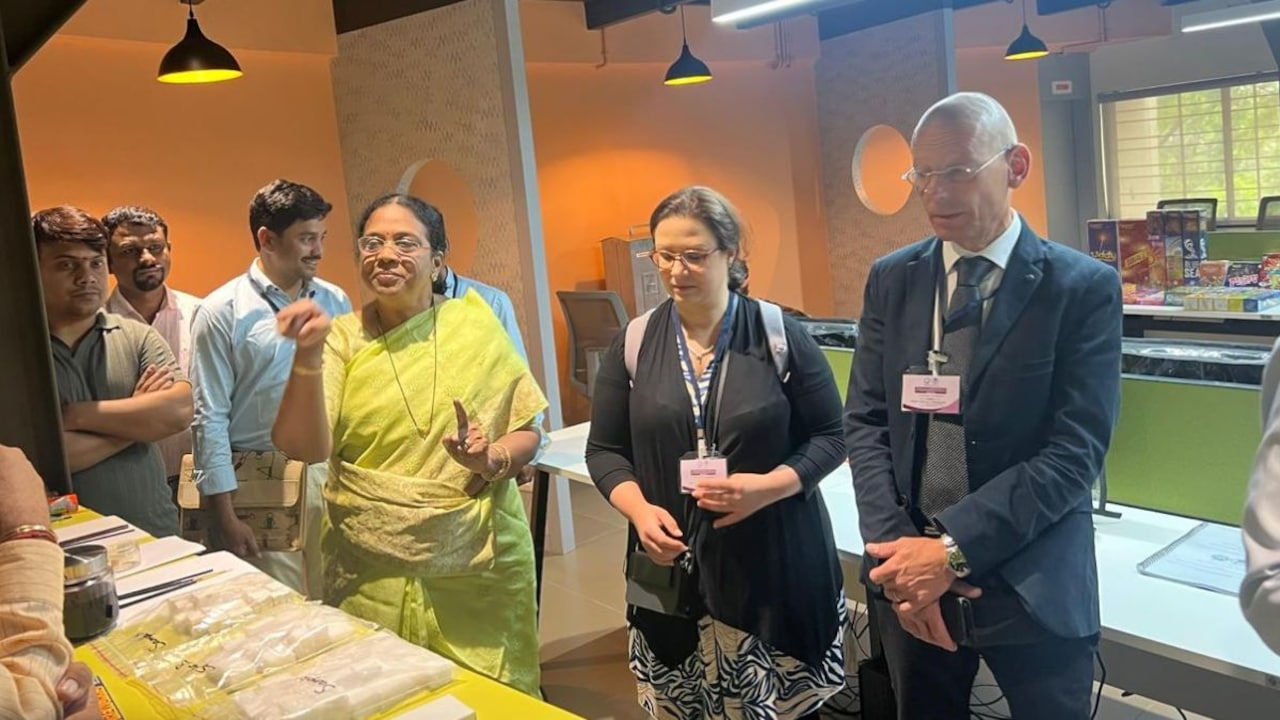
At the center of this entire story stands Dr Sadhana Rayalu
Photo Credit: NDTV
Scientists said these changes could reduce particulate emissions by roughly 30 to 40 per cent while still retaining the light and sound effects associated with fireworks.
The effort also gained importance because of the interventions of the Supreme Court. Faced with growing concerns over air pollution, the court repeatedly examined the environmental impact of fireworks and pushed for cleaner alternatives. Green crackers eventually emerged as a scientific response to judicial and public health concerns.
Scientists argued that the green cracker program helped create a regulated pathway where cleaner fireworks could remain available while reducing environmental damage.
Since then, the technology has steadily evolved.
A major milestone came in December 2025 when CSIR established a National Centre of Excellence for Green Firecrackers at CSIR-NEERI, Nagpur, and a second centre at Karaikudi. These centres were created to support testing, certification, characterisation of raw materials and research into future generations of lower-emission fireworks. Today, under a mandate by the apex court, all green firecrackers have to carry a certification by CSIR-NEERI.
The centres signalled that green fireworks had moved beyond a laboratory experiment and become an organised national research program. According to CSIR, the objective is to help manufacturers adopt cleaner technologies while supporting an industry that provides livelihoods to thousands of workers.
The most dramatic progress, however, has come in the science itself. According to researchers working with Dr Sadhana Rayalu, second-generation green crackers have now been developed using novel hybrid eutectic oxidisers and multi-component nitrate systems. These formulations are reported to achieve a further 50 to 60 per cent reduction in emissions compared to conventional fireworks. Taken together, the journey from the first generation to the second generation represents a remarkable scientific advance. From the original green crackers that cut emissions by around 30 per cent to newer formulations capable of reducing pollutants by as much as 50 to 60 per cent, Indian scientists have steadily pushed the boundaries of cleaner pyrotechnics.
Yet researchers themselves are careful not to oversell the achievement. Dr Reddithota Joshua Krupadam, coordinator of the National Centre of Excellence for Green Firecrackers at NEERI, has emphasised that green crackers do not mean pollution-free crackers.
They remain polluting products, although they emit substantially lower pollutants than conventional fireworks. According to NEERI, the latest formulations have achieved emission reductions in the range of 45 to 60 per cent, but they are still not zero-emission products. Scientists point out that this year's apex court-mandated regulatory framework has created a narrowly defined window for the use of approved fireworks. Only authorised and certified products meeting environmental norms are meant to be sold and used. The intention is to balance public celebrations with environmental protection and public health concerns.
Another development often overlooked in the debate is the decline of imported Chinese crackers that once dominated parts of the market. Scientists and industry officials have long argued that many of those products were among the most polluting because of poor quality control and uncertain chemical compositions. Greater scrutiny and restrictions on imports encouraged domestic manufacturers to transition towards regulated formulations developed and tested in India.
At the centre of this entire story stands Dr Sadhana Rayalu. A former Chief Scientist at CSIR-NEERI, an AICTE Distinguished Professional, and currently Adjunct Professor at Laxminarayan Innovation Technological University, Nagpur, as well as Visiting Professor at Ludwig Maximilian University of Munich, Germany, she has spent years working at the intersection of chemistry, environmental protection and industrial application.
Now she has a new dream.
After pioneering India's first-generation green crackers and helping drive second-generation formulations, her focus has shifted to what may become the next frontier in fireworks technology: "Smokeless and eco-friendly cold fireworks," she told NDTV all the way from London, where she is currently travelling.
Dr Rayalu and her collaborators have developed a patented platform that eliminates perchlorates and nitrocellulose from cold pyrotechnics. The system uses functional cerium ammonium nitrate along with specially engineered fuels, binders and additives.
According to the Indo-German team, the ambition is striking. According to them, these new formulations can reduce particulate emissions by as much as 85 to 90 per cent compared to conventional cold pyrotechnics.
For a country that has spent years debating whether fireworks and clean air can ever coexist, the technology offers a glimpse of a different future.
Whether that future can be realised on a commercial scale remains to be seen. But the trajectory is unmistakable. What began in 2018 with a challenge from Dr Harsh Vardhan to develop cleaner Diwali fireworks has evolved into a nationally coordinated scientific program involving dedicated centres of excellence, multiple generations of cleaner formulations and an ambitious quest for smokeless fireworks.
The message from India's scientists is clear. Firecrackers may never become completely pollution-free. But through chemistry, engineering and persistent innovation, they can become substantially less harmful than they once were. And for Dr Sadhana Rayalu, the scientist who helped launch India's green cracker revolution, the journey is far from over. A zero-pollution firecracker remains a distant Diwali dream.
KioskNews shows a cleaned-up reading view extracted from the publisher’s page — the original always lives on their site, not ours.