‘It was so satisfying when I threw a rock through the screen’: the people sick of being spied on by their smart TV

When Dan had had enough of his television, he threw a rock straight through the screen. The offence? His smart TV was downloading its third update in three days. “It drove me crazy with what seemed like daily software updates that never fixed anything and ‘features’ that never seemed to work,” says the 71-year-old from Illinois. “And of course, constantly trying to push me to subscribe to paid-for services when all I wanted to do was watch over-the-air TV, play a DVD or stream something from my computer.”
Some may accuse Dan of being a luddite, but his master’s degree in computer science and decades of experience in telecommunications would suggest otherwise. “The tech is not intimidating,” he explains, “just increasingly enshittified.”
The first smart TVs entered the market in the late 2000s, when companies introduced operating systems, media players and apps to screens that were becoming wider and thinner. In recent years, the luxury status of smart TVs has waned and increasingly affordable options are widely available. Tom Parsons, TV and audiovisual editor at the electronics magazine What Hi-Fi?, explains that these cheaper models can struggle under more advanced features. “They’re not necessarily super-fast and responsive out of the box,” he says. “And then two, three, four years down the line, they can end up slowing down quite a lot under the weight of all that processing.”
Dan is just one of a growing number of tech-savvy watchers wishing their TVs weren’t so smart. Erin McQuiston and Matthew Schroyer, a couple from Connecticut, share his smart-screen scepticism.
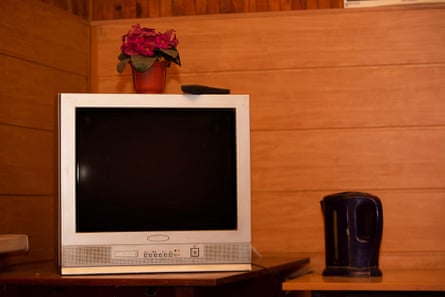
“I don’t think we’ve ever used [our TV] as anything other than just a giant display,” says McQuiston. “There was a period where we were running it through an Xbox. And that was a constant battle because that was constantly being updated and patched and then you’d have to redownload all the apps for it.”
Meanwhile, Schroyer says his job as a software engineer has influenced his decision to “intentionally keep it very dumb” by keeping their TV disconnected from the internet. “A rule of the house is: don’t give things the wifi password,” he says. “It concerns me that folks increasingly have to be IT experts to get the bare minimum enjoyable experience out of this stuff.”
Instead, the 41-year-old connects his screen to an Apple TV box as a streaming workaround, and cites privacy as well as “highly invasive” advertisements for doing so. “Our living room is not a billboard for sale,” he says.
When asked how the couple might cope in a future where TVs may have mandatory internet, McQuiston says her husband is “handy enough to break every terms of service known to man and get in there and unsolder something to manually disconnect it”.
For Helen Northmore, a 51-year-old from Wales who works in AI delivery for the UK Health Security Agency, privacy is also a worry. Her grudge against smart screens began four years ago, when her faithful dumb TV broke without warning and she had to quickly find a replacement.
“We had already decided that we didn’t want the smart functionality, but it became really clear that it was very hard to find one that didn’t have any,” she says. Northmore, whose partner works in cybersecurity, says the couple wanted to “keep control” over their devices, which cost them a premium. “We were willing to pay more. One of the boundaries in how we live our lives is we want to minimise the smart element. We don’t have smart speakers. We don’t enable or connect to the internet.”
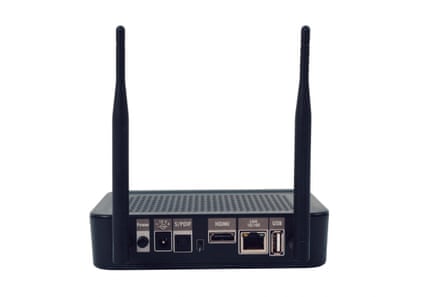
Today, she watches entertainment through a Sky box connected to her dumb TV, and dreads that when her current telly breaks there won’t be any option but to get a smart model and offer up her data.
More consumers are becoming worried about how their information is being used by manufacturers. “There are increasing privacy concerns around to what degree TVs are essentially scraping your data,” says Parsons. “TVs these days are full of sensors, including microphones, and that can make people nervous.”
But according to Parsons, despite interest in “dumber” models from some buyers, most shoppers want their TVs to be catch-all entertainment systems. The result is that the dumb TV market is almost nonexistent. “You can buy cheap monitors for signage,” he says, “but from a features point of view, you wouldn’t get the same performance that you would from a consumer TV.”
Paul, a public servant from Australia, knows just how hard finding a traditional TV can be. “When my last telly – a glorious 32-inch dumb TV – died recently, aged approximately 10 years old, I spent about three weeks scouring the city looking for something comparable. What I found is that they do not exist any more.”
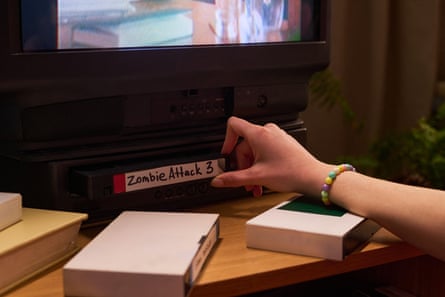
After much searching, Paul discovered a single 40-inch TV without any smart functionality in the back of a shop. “It had zero ways to connect to the internet – just a couple of plugs on the back for making it work with the aerial on the roof and my VHS player, and that was it.” He remembers that it “was very dusty and cost about 200 dollars. Naturally, we fell instantly in love.”
“My friends all laugh at it when they come over,” he admits, “but secretly I know the joke is on them. My little telly doesn’t spy on me, and has a DVD player built in.”
The punchline may eventually land on Paul, however. In September, the Australian government launched a consultation into the future of the country’s free-to-air broadcasting, asking citizens for feedback on how TV should be accessed. One of the proposed scenarios would see traditional broadcast services cut in favour of streaming services and video on-demand apps.
In the same month, the UK government released a media green paper outlining its plan to fully move away from digital terrestrial television to services provided over a broadband connection by 2034 at the earliest. Such a situation would mean viewers having to rely on broadcaster apps and streaming services.
If a similar fate befell North America, James certainly wouldn’t care. He is originally from the US but now lives in British Columbia, Canada, and says traditional broadcast TV is “dead to him” and that he prefers to watch shows on streaming services or on YouTube. For the father and husband, privacy is a top priority.
“No one expects an end-user licence agreement to include giving up autonomy,” he says. “Having my TV listen to any conversation and use that for monetary or any form of gain is above and beyond expectations on the loss of privacy.”
In September, the YouTube channel Gamers Nexus released a two-hour investigation into LG Electronics’ smart televisions, saying that the devices record audio – even when they are offline or powered down. The South Korean company denied the allegations. In the fallout, some have taken measures to modify their smart TVs, regardless of brand or model. Some videos online show users replacing motherboards, cutting out Bluetooth and wifi modules and removing microphones from their TV remote controls.
Amid the controversy, James read online advice that modifying a TV remote microphone was a simple procedure. So he surgically removed the sensor himself. “Removing the mic was literally as easy as using a [craft] knife to scrape it off the top,” he says, “and the remote continued to work fine.”
James’s willingness to dissect his tech comes from fears for his children. “My kids are not teenagers and they have no agency to protect their private information,” he says. “Someone listening in on a TV gets to find out about my daughter’s first period without her knowing. And that is a level of invasion no one should have without explicit consent.”
Frustration and controversies have sparked a DIY interest in opening up and neutering the black rectangles in our living rooms. Though the desire in the first place may lead consumers to ask themselves an important question: have our TVs become too smart for their own good?
Gutting any piece of electronic equipment should be left to professionals. However, some may find that, for a complex problem, the simplest solutions are the most elegant. As Dan recalls: “It was enormously satisfying when I threw a rock through the screen.”
KioskNews shows a cleaned-up reading view extracted from the publisher’s page — the original always lives on their site, not ours.