Poverty rate hits record low 9.7%, but millions are one crisis from sliding back
Already have Rappler+?
to listen to groundbreaking journalism.
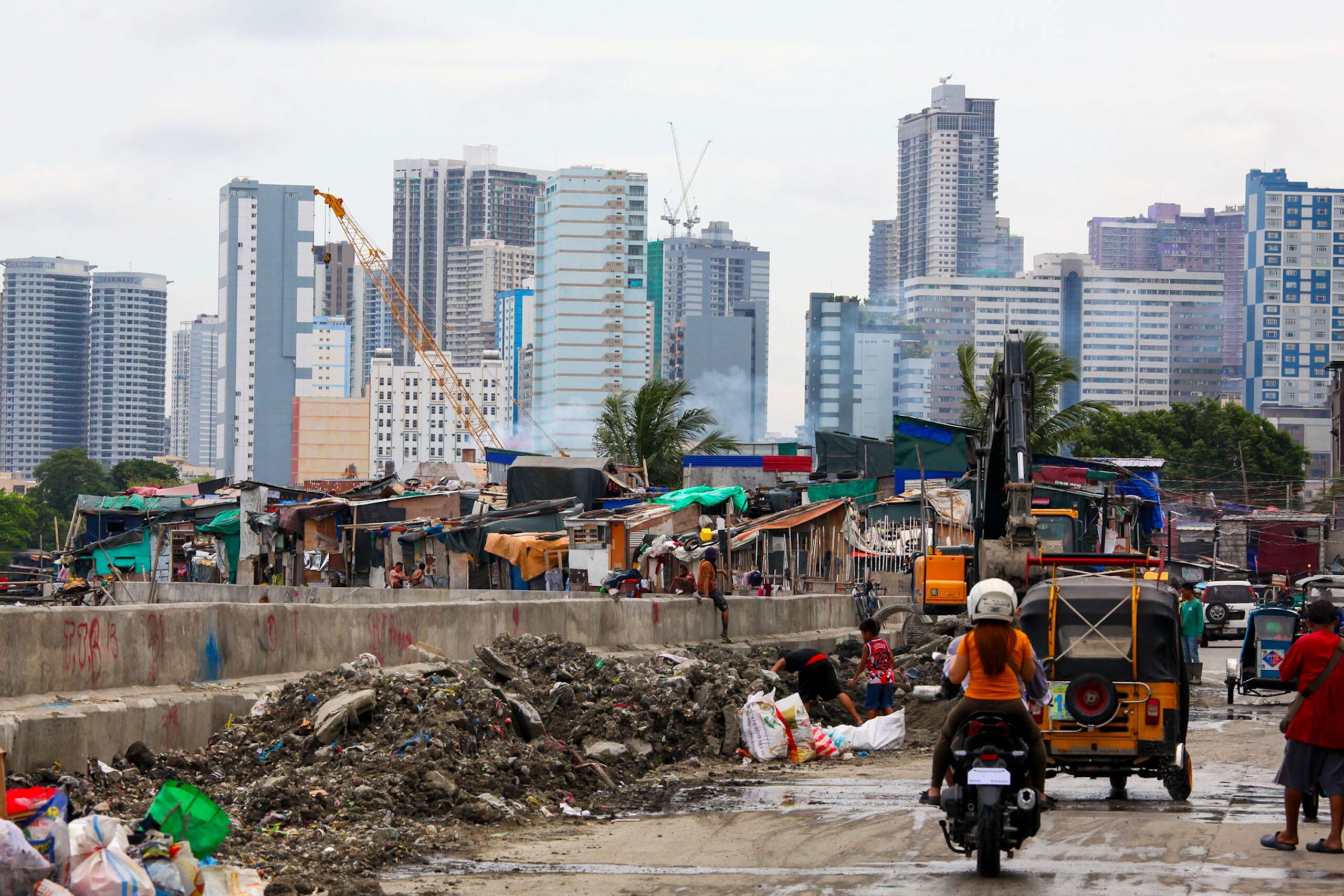
Informal settlements stand in contrast to Manila's modern high-rise buildings on July 9, 2026. While the Philippines has attained upper-middle-income status according to the World Bank, many Filipinos continue to face poverty and the rising cost of living.
Rappler
Around 6.5 million Filipinos were lifted out of poverty between 2023 and 2025, but the World Bank estimates that at least 28% of the population remain at risk of falling back into poverty
AT A GLANCE
- The poverty rate in the Philippines has dropped to 9.7% in 2025, with 6.5 million Filipinos moving above the poverty line, but many remain vulnerable to economic shocks.
- The World Bank estimates that around 28% of Filipinos live just above the poverty line, highlighting the need for effective social protection measures to prevent them from falling back into poverty.
- Government efforts must focus on controlling inflation, protecting vulnerable households, investing in health and education, and developing the manufacturing sector to ensure long-term economic resilience.
This is AI-generated. Read the article for full context. Report any errors.
MANILA, Philippines – The Philippines has finally pushed the poverty rate to single digit, but the next challenge is making sure millions of Filipinos who have only just risen above the poverty line stay there.
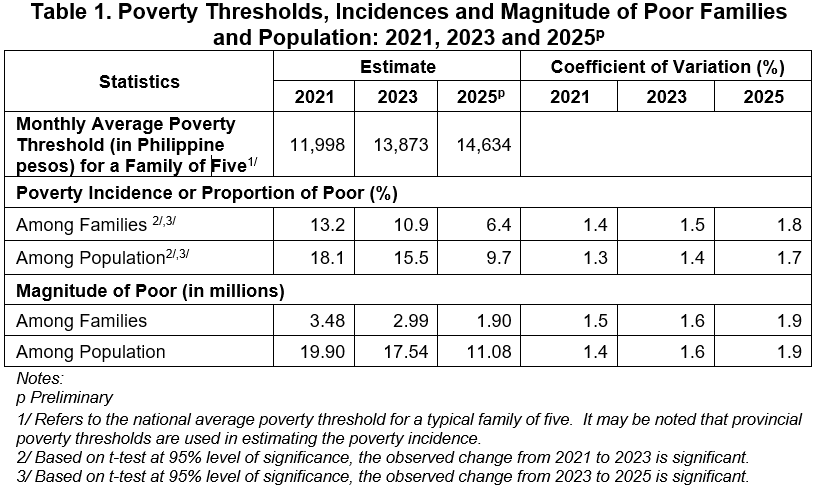
Poverty incidence fell to 9.7% in 2025, equivalent to 11 million Filipinos, from 15.5% or 17.5 million in 2023, according to the Philippine Statistics Authority (PSA). That means 6.5 million Filipinos moved above the official poverty line in two years.
“For the first time, fewer than one in 10 Filipinos is living below the poverty line,” Arsenio Balisacan, the country’s chief economist, said. “Reaching this milestone ahead of schedule demonstrates that expanding economic opportunities, complemented by effective social protection, can make a meaningful difference in people’s lives.”
While it’s indeed a milestone worth celebrating, keep in mind that “non-poor” is a statistical classification, not a guarantee of a comfortable life.
The PSA defines the poverty threshold as the minimum income or expenditure needed to meet basic food and non-food needs, including housing, utilities, health, education, clothing, and transport. In 2025, the Philippine Statistics Authority placed the national poverty threshold at just P35,121 per person a year, or about P2,927 a month. For a family of five, that works out to roughly P14,634 a month. A family earning only slightly more than that would no longer be considered poor, even if that means little room for savings, emergencies, or a good quality of life.
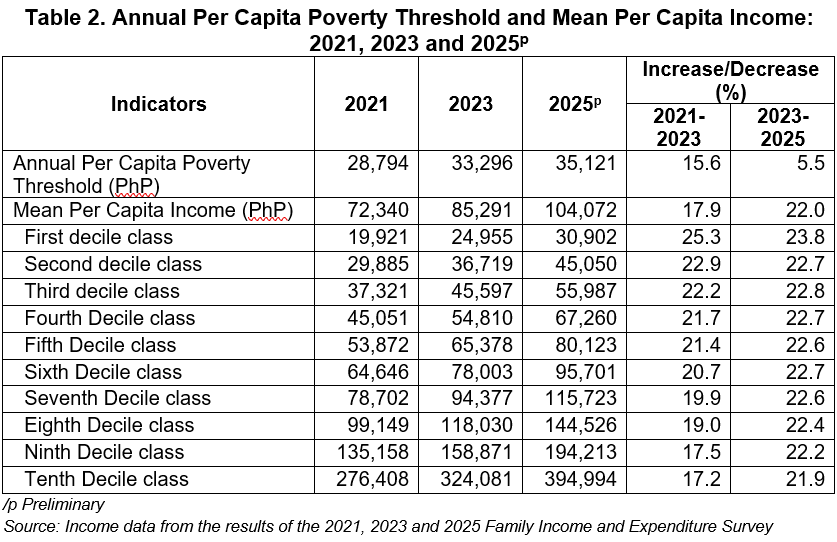
The World Bank estimates that around 28% of Filipinos live just above the poverty line, which leaves many vulnerable to price spikes, job losses, disasters, and other shocks. The bottom 30% of households are more sensitive to this year’s energy price shock because food, utilities, and transport take up a larger share of their budgets, though fortunately targeted measures such as 4Ps and UPLIFT have helped cushion the blow.
“Our overall assessment is that this has been a sound response helping to shield millions from poverty. In fact, we estimate that without intervention, almost 2 million people are vulnerable from this shock of falling into poverty. So this intervention really is very critical,” World Bank senior country economist Jaffar Al-Rikabi said during the launch of the Philippines Economic Update on August 3.
Balisacan also acknowledged the risk that many Filipinos crossing the poverty threshold remain “very close” to it, meaning a serious flood or another external shock could push them back. The task, he said, is to make those gains resilient.
Balisacan said government must keep inflation under control, protect poor and near-poor households, invest in health and education, create better jobs, and restore investment. But he also argued that the country needs to change the structure of growth itself.
The Philippines has long relied heavily on household consumption, remittances, and jumped straight into services. By contrast, its neighbors built stronger export and manufacturing bases.
“We have not invested sufficiently in developing our industry and particularly our manufacturing sector,” Balisacan told reporters back in July.
That’s already being tested in 2026. Inflation has surged on higher food, fuel, and electricity costs, while GDP growth has slowed sharply, especially in Q2. (READ: [In This Economy] The Philippine economy is stuck in a rut)
Only weeks after the World Bank formally announced that the Philippines had become an upper-middle-income economy, economic managers also slashed their growth target to just 3.5% to 4.5% for 2026 and 5% to 6% from 2027 to 2030. – Rappler.com
KioskNews shows a cleaned-up reading view extracted from the publisher’s page — the original always lives on their site, not ours.