How the quirky puffin became a symbol of the climate crisis – and hope
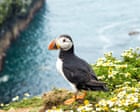
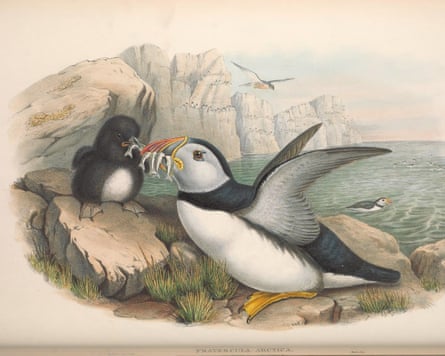
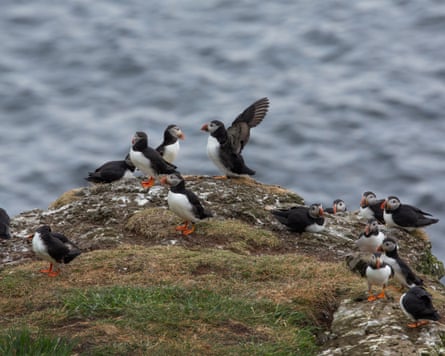
For centuries human beings have exploited puffins, harvesting them by the thousand on their breeding grounds for their food and feathers. Over time, though, this relationship has changed, so that today we have come to love them, celebrating their quirky character and comical appearance and giving them a central place in our affections – a journey described by the environmental historian Dr Rob Lambert as the shift “from use to delight”.
How ironic, then, that just as we have come to truly appreciate them, our own existence now threatens theirs. The climate crisis threatens almost all the world’s roughly 11,000 species of birds, but its consequences have particularly dire significance for seabirds, whose life cycle is so intimately connected to the timing and abundance of their food supplies.
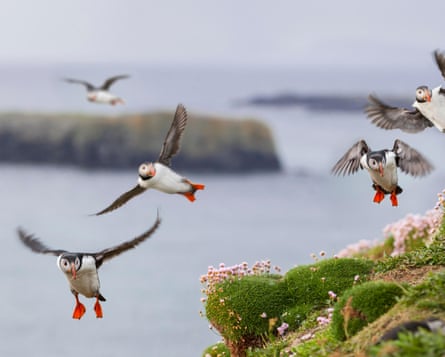
Warming oceans result in fish such as sand eels shifting their range into cooler waters, and thus either declining or disappearing from the seas around seabird breeding colonies. If puffins need to travel further to their feeding areas, or take longer to find and catch food once they get there, then their chicks have a lower chance of fledging.
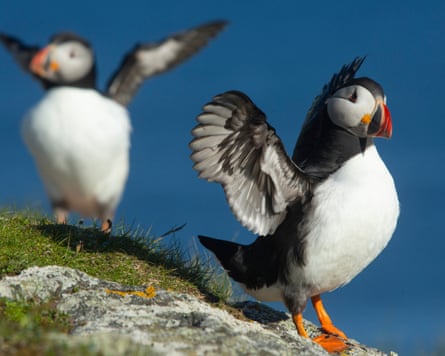
Even if they do, they are less likely to survive the following winter. Our changing climate has already led to an increase in the frequency and severity of extreme weather events such as autumn and winter storms, which leads to a higher mortality of birds outside the breeding season.
It is often forgotten that the climate crisis is not the only negative factor affecting these birds’ lives. As we have seen, increased marine pollution, especially from oil and plastic, along with less severe yet still serious issues such as disturbance and predation, are already reducing the puffin’s breeding success at many once-thriving colonies.
The dire prediction that nine out of 10 puffins could disappear before the middle of this century is hopefully pessimistic, yet we do know that serious declines are already occurring.
In early 2026, BBC News reported that following that winter’s severe storms hundreds of dead and dying puffins, guillemots and razorbills had been washed up on beaches in Cornwall, Scotland and north-east England. Conservation organisations have also reported more than 20,000 stranded birds, mostly puffins, along the Atlantic coasts of France, Spain and Portugal.
Samuel Wrobel, the RSPB’s senior marine officer, noted that this was the worst wreck for over a decade, since the catastrophic events of winter 2013-14, and warned that “after the impact of avian flu this is the last thing our seabirds need”. Moreover, as most birds are likely to have died at sea, so will never be found, the true death toll is likely to be much higher.
Peter Harrison has spent his life watching, painting and studying seabirds, and has a special affection for the puffin. I asked him what he thought about the species’ future, and he began by confirming the many threats the birds face, including a reduction in their prey due to the climate crisis, threats to nest sites and the resulting lower breeding success.
Rather to my surprise, however, Harrison feels some optimism for the puffin’s future, pointing to that famous legal victory that stopped industrial sand eel fishing in the waters around England and Scotland. He is also enthusiastic about the use of technology to track the movements and survival of all seabirds, including the puffin, since this began in the 1980s.
“Prior to that time, there was a huge void in our knowledge of what puffins and other seabirds did in their non-breeding period,” he says. “They simply went to sea, only to reappear again in their breeding areas the following season. Rapid technological advances over the last four decades have greatly increased our understanding of their movements, revealing details of seabird distribution and behaviour at sea, including important foraging areas.”
And as he points out, this knowledge does not just benefit the puffin. “Auks – including puffins – fulfil a role as important canaries in the cage, indicators of global health and sustainability. If auks are doing well, the oceans will be doing well,” Harrison says.
The one thing we have on our side, Harrison believes, is that, unlike landbirds which often only live for a few years, even small seabirds can live for several decades. As he notes, although they might have gone through bad times, seabirds have in the past shown that they can make a rapid comeback, especially if we are able to rid their breeding islands of invasive predators.
Scientists have a crucial role to play, too. In 2004 BirdLife International developed the BirdLife Seabird Tracking Database (STDB) to collate tracking data using a range of different, and rapidly improving, technologies that can track the presence and movements of seabirds when they are away from their breeding colonies, as they are for most of their lives.
The records enabled them to identify six previously unrecognised oceanic routes used by the birds on their journeys: the Atlantic Ocean, North Indian Ocean, East Ocean, West Pacific Ocean, Pacific Ocean, and the Southern Ocean Flyways. The data obtained is also used for seabird research and conservation by BirdLife scientists and their collaborators throughout the world.
As Dr Stephen Kress, the scientist who has devoted his life to successfully bringing back puffins to the US, points out: “Seabirds were once abundant along the coastlines of North America and throughout the world, but the declines we’re seeing in their populations are directly related to things humans are doing – they would be fine if we weren’t tampering with their world and messing things up.
“And so I feel that we have an ethical responsibility as stewards of the Earth to do something where we can. That’s why we’ve developed these restoration techniques. If we hadn’t done that, we wouldn’t be documenting puffin recovery, we’d be documenting extinction.”
Yet perhaps we can maintain at least a small fragment of hope for the future not just of the puffin, but of all the world’s seabirds. They may be outside our day-to-day experience for much of our – and their – lives, yet the huge affection for the puffin, held by millions of people around the world, must surely count for something.
-
This is an edited extract from The Puffin by Stephen Moss published by Vintage at £14.99. To support the Guardian, order your copy at guardianbookshop.com. Delivery charges may apply.
KioskNews shows a cleaned-up reading view extracted from the publisher’s page — the original always lives on their site, not ours.