‘I can charge my car for £6’: could new rules cut costs for EV drivers?
When Alison Williams bought her electric Volkswagen ID.3 two years ago, she thought she was making the right choice for the environment, having already upgraded her end-of-terrace London home with insulation and solar panels.
However, charging the car has proved more costly than she hoped, as she is not able to install the cross-pavement gully – a narrow electric vehicle cable channel embedded in the pavement – that she would need to charge at home. That will remain the case despite a change in the law.
From Wednesday, drivers in England who do not have off-street parking will no longer need to get planning permission to put in a pavement gully outside their home.
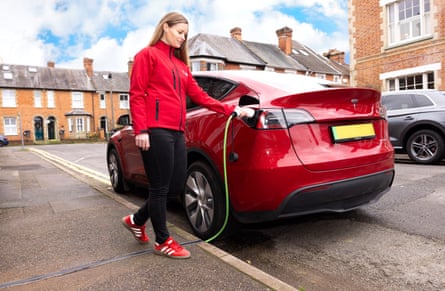
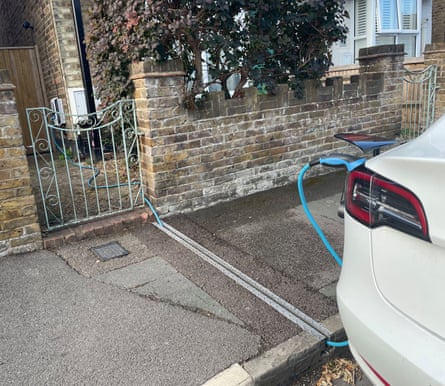
The gullies sit flush within the pavement and allow an EV charging cable to reach a parked vehicle without creating a trip hazard.
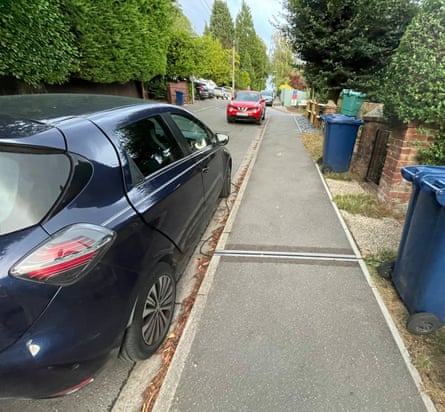
By charging in front of their house via an energy supply in their home, rather than using a public charger, drivers can slash the cost by up to 90%.
But some of the 9.3 million households without off-street parking will be left frustrated as more than 20 local authorities will still not allow the installation of gullies after the law changes.
Williams’s council is Ealing, which does not allow them for cost and safety reasons. She charges her car at a public charger, at much greater cost than if she could do it at home.
“It’s really frustrating,” Williams says. “When we decided to buy an electric car … the reason we wanted to buy one was for the environmental impact.
“You either have to have enough money to have a house with a driveway, or you have to be able to afford the additional cost of charging at a public charger.”
The rules
Motorists are not allowed to string EV charging cables across the pavement from their home to the road, but many councils allow cross-pavement charging if you use a gully. To use one, a charging cable is run from the home through the gully and then plugged into the car.
This previously meant getting planning permission from the local authority.
Removing that step will save drivers between £300 and £500. However, anyone who lives in a conservation area will still have to apply.
Caroline Pidgeon, a Liberal Democrat peer, campaigned for the change in the law. She says one in three households in England do not have a driveway. Approval for the gullies has taken up to 15 months in some areas, she says. “Simpler rules will make it easier for people to switch to an electric car,” she adds.
The government has given £25m in funding to councils in England for pavement gullies for people with on-street parking, but the money is being distributed in different ways, depending on the local authority.
The costs
How much you pay for installation varies widely around the country.
If you want to apply for a gully to be installed, you should check with your council to see whether it allows them and, if it does, it should direct you on how to apply.
Kerbo Charge, a company that installs gullies, operates a postcode checker you can use to see whether you can get one in your area and sign up for an alert if that changes.
Ben Whitaker of Kerbo Charge says the average fee for the work is about £1,200 (including VAT) without a grant.
“Some [councils] are using it [the funding] to provide half-price channels to early adopters, others are making it totally free while funds last – but, after that, residents will have to pay full price,” he says.
“For example, Surrey is £499 for the channel and installation, South Gloucestershire is £250,” he adds. “Sadly, there is quite a variety of approaches and prices.”
To illustrate the difference in prices between local authorities, Redbridge council in London says the grant will cover up to £1,200 of installation costs. But applicants must pay £815 in fees and for a bond, as well as any additional installation costs.
On top of the cost of installing the gullies, some councils charge an additional annual fee for maintenance. For example, Redbridge charges an “ongoing annual licence fee” of £185. Enfield, also in London, charges £107 a year.
Shayne Rees of Gul-e, a company that has installed 400 gullies, says it takes between one and two hours to put the unit in place. “It’s a really heavy-duty steel channel that can take a truck driving over it, and once we put it in the ground, that will be there for decades and decades without any maintenance,” he adds.
Council refusals
It emerged in May that more than 20 local authorities appear to be holding out against having the gullies installed, among them Kent, Leicester and Worcestershire. Most of the holdouts are in London, including Waltham Forest and Hackney.
The reasons given often concern safety and maintenance, and because of issues over who will be liable if there is an injury. For example, Waltham Forest says gullies “raise significant concerns including safety and accessibility of footways, parking pressures, maintenance responsibilities and liability, electrical safety and earthing standards”.
Leicestershire county council says: “This is a new and very challenging area for local highway authorities to address.”
Ealing council says it decided not to proceed with a trial of the gullies.
“We took into account the needs of the people using the borough’s pavements, including elderly people and less able-bodied individuals, especially those on wheels and people with visual impairments,” a spokesperson says. “Gullies can have a significant impact on the feel and safety of pavements for residents walking or wheeling.”
Carl Cashman of the Local Government Association, which represents councils, says local authorities would like to support on-street charging as much as possible “but have limited resources and significant demands to meet”.
The different views of councils, sometimes neighbouring ones, have frustrated some drivers. Nick Theobald lives in Fulham in London, where he is not allowed to put one in yet. A pilot scheme with a small number of houses has been launched by Hammersmith and Fulham council.
“You’ve only got to go over the river to Richmond and it’s completely permitted there,” he says.
‘A public charger would be considerably more’
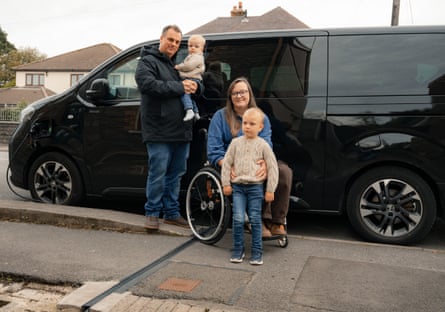
For people without off-street parking, charging an EV at home is much cheaper than doing so at public charge points.
Since the beginning of this month, the VAT charged on domestic electricity has been cut from 5% to 0%, while the tax on public charging remains at 20%.
Gregg Francis, who lives in Carmarthenshire in Wales, had a gully fitted outside his house two and a half years ago for free, as part of a scheme run by the local council. This allows him to fully charge his Vauxhall Vivaro Life for £6. He usually recharges it fully twice a week.
“If we went to the public charger, we could be looking at £30 to £63 for the same amount of electricity,” he says.
“We had a diesel Ford Focus that would cost about £70 a week to use on normal routine. That would now be considerably more as I’m comparing with two years ago.”
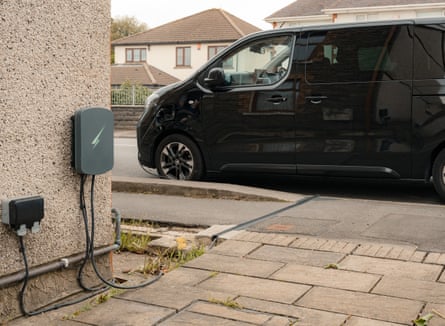
Figures from ChargeUK, the industry’s trade group, put the average cost per kWh for off-peak at-home charging at 8p, while the standard public charging cost averages 54p.
Vicky Edmonds, the chief executive of EVA England, which represents drivers, says people with a driveway can save an average of £1,400 a year compared with driving a petrol or a diesel car. Some of her members who do not have off-street parking estimate that they are now paying more than when they had a car using fossil fuels, she says.
KioskNews shows a cleaned-up reading view extracted from the publisher’s page — the original always lives on their site, not ours.