Egypt-Sudan sign agreement to defend water security
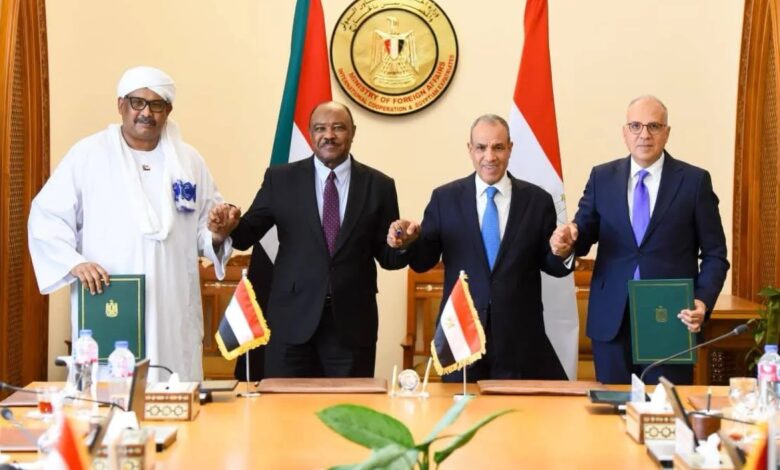
Egypt and Sudan affirmed their total rejection of any unilateral actions in the Eastern Nile Basin.
They agreed that the Grand Ethiopian Renaissance Dam (GERD) – constructed unilaterally in violation of international law – carries grave consequences, and poses a persistent threat to the downstream Nile Basin states, particularly given Ethiopia’s unilateral management of the GERD and the absence of a binding legal mechanism for its governance.
During the third round of the “2+2” consultative meetings, involving the foreign and irrigation ministers of Egypt and Sudan – along with their respective delegations – both sides reviewed developments regarding the Nile River issue.
They emphasized that the water security of Sudan and Egypt is inextricably linked.
Furthermore, they agreed on the necessity of defending the water security of the downstream Nile states, upholding the full water rights and usage entitlements of both nations as stipulated in the 1959 agreement, and ensuring that no infringement upon these rights is permitted.
The two sides called on Ethiopia to abandon its unilateral policy and restore cooperation in accordance with applicable international law, specifically the principles of avoiding harm, providing prior notification, engaging in consultation, and reaching consensus, to ensure the sustainability of the Nile River.
They further emphasized that the issue of the Ethiopian dam concerns only the three Eastern Nile Basin states—Egypt, Sudan, and Ethiopia—and rejected Ethiopia’s attempts to involve other Nile Basin nations in the matter.
Memorandum of understanding
The governments of Egypt and Sudan on Monday signed a memorandum of understanding to implement development projects related to water resources in Sudan, as part of an Egyptian initiative for the development of Nile Basin countries.
The signing took place in the presence of Egyptian Foreign Minister Badr Abdelatty and his Sudanese counterpart, Mohieddin Salem.
Egypt’s Minister of Water Resources and Irrigation, Hany Sewilam, emphasized that the primary challenge in the Nile Basin is not a scarcity of water resources, but rather a lack of cooperation among the basin countries.
Vast water resources
The minister noted that the region possesses vast water resources; the core of the dispute lies in the management and control of the Nile’s waters, even though technical solutions exist that could address both water and energy needs.
Sewilam explained that the 11 Nile Basin countries receive approximately seven trillion cubic meters of rainfall annually, a figure that encompasses the water resources of the Nile River, the Congo River, and other rivers within these nations.
He added that the Nile Basin alone holds an estimated two trillion cubic meters of water resources, of which Egypt receives only about 2.7 percent.
Sewilam added that Ethiopia receives over 1,000 billion cubic meters of rainfall annually and possesses more than 80 billion cubic meters of renewable groundwater that can be tapped into and is replenished each year.
The dispute with Ethiopia concerns the issues of water and energy, he said, noting that technical solutions exist for both.
Sewilam pointed out that Ethiopia has significant potential in solar energy, reaching up to 50 gigawatts, and wind energy, ranging between 30-50 gigawatts, yet it insists on building mega-dams.
KioskNews shows a cleaned-up reading view extracted from the publisher’s page — the original always lives on their site, not ours.