Kelly McParland: High-speed rail, the project that will not die
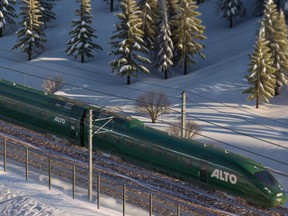
It’s probably a coincidence (and I’m probably going to win the lottery) that Thursday’s gangbusters announcement of a new pipeline for Alberta came on the same day we got an updated cost estimate for a high-speed train linking Quebec and Ontario.
Sign In or Create an Account
On the one hand was a plan able to boost oil exports worth billions in profits, create thousands of jobs, fortify the economy and maybe reduce Albertans’ conviction that nobody loves them.
On the other was a monumentally expensive project with questionable commercial advantages in an industry famed for vast cost overruns and an extensive history of failure.

Columnist Jesse Kline keeps you up to date with what’s happening in Israel and the effects of antisemitism on life here in Canada. Friday mornings.
By signing up you consent to receive the above newsletter from Postmedia Network Inc.
A welcome email is on its way. If you don't see it, please check your junk folder.
The next issue of Channel Israel will soon be in your inbox.
We encountered an issue signing you up. Please try again
While Prime Minister Mark Carney delivered a lengthy address extolling the pipeline amid a crowd of dignitaries, onlookers and reporters in Fort McMurray, Alta., the Parliamentary Budget Office (PBO) railway estimate landed on Ottawa computer screens with the technological equivalent of a thud. The pipeline extravaganza offered cameras, drama, political luminaries and front-page treatment; the PBO report ran straight into doubters wondering why yet another kick was being taken at a creaky old can, while Conservatives pledged that, given the opportunity, they’d kibosh the whole wild idea.
The PBO report was a typical bit of dream-puncturing for an organization set up a decade ago to provide “independent financial and economic analysis to Canada’s Parliament.” Overfed rhetoric and high-minded dreams have a way of plummeting earthward when some cubicled PBO gerbil sorts out the probable cost.
Thursday’s document was no different. Right off the bat, it predicted the cost of building a high-speed rail line (HSR) from Toronto to Quebec City wouldn’t be anywhere near the $60 billion to $90 billion government estimate. More likely, the cost would range from $75 billion to $113 billion, not including operating costs and a lengthy menu of such expensive add-ons as a tunnel under Montreal and a diversion to add a station in Kingston.
Canadian governments have been pondering ways to speed up train travel since at least 1970, when an “Inter-City Passenger Transport Study” was prepared for the Canadian Transport Commission. The 1980 report saw a “feasibility concept” for Transport Canada, 1990 a “pre-feasibility study” for Bombardier Inc., 2002 produced “ViaFAST” courtesy of Via Rail; with numerous other studies generated right up to 2025’s C.D. Howe report on “The Benefits of Faster, More Frequent Passenger Trains … and The Costs of Delay.”
Former leader Michael Ignatieff’s Liberals considered a plan then estimated to cost $20 billion, while a witness at a 2023 House of Commons committee complained that a previous HSR scheme “was decision-ready by summer of 2018” and could have been ready to go by now if Ottawa hadn’t dragged its feet.
Thursday’s report made the reasons for the decades of hesitation all too evident. While the attractions of a smooth, efficient and comfortable train ride whisking along at 200-300 kilometres an hour offers much to be wished for — not least an alternative to increasingly unappetizing air travel — the hazards are enough to sober all but the most oblivious enthusiasts.
And while projections advocating for HSR are just that — calculations based on a collection of variables that may or may not occur — the risks are backed by actual examples of real-life disasters. Almost 20 years after it was approved, a California plan to build more than 2,000 km of high-speed line from Sacramento to San Diego hasn’t sold a single ticket amid spiralling costs, repeated delays and abandoned plans. Only a much-reduced segment touching none of the state’s major cities is currently under construction, with completion dates stretched to the late 2030s.
A similarly ambitious U.K. plan to link London to Birmingham has been termed “Britain’s most expensive infrastructure failure,” with cancelled segments and major cost overruns, including more than 100 million pounds for a special shed to protect bats along the route.
The PBO report blithely attributes the U.S. and U.K. problems to “difficulties with land acquisition, permitting, litigation, design changes and project-management weaknesses.” Such things could never happen in Canada of course. Nonetheless — just in case — it notes that Carney’s Liberals have adopted legislation to “mitigate” the risks. All the same, the report insists that “the robustness of these provisions before Canadian courts, as well as their inherent effectiveness in targeting sources of cost escalation, will be a key success factor in mitigating significant project risks of the baseline estimate.”
In other words, all bets are off until environmental groups, activists and indigenous communities have finished deploying legions of lawyers to stymie as much progress as possible.
Still, it will take more than compliant courts, satisfied activists, faster permitting, better management and neutralized bureaucrats to overcome the considerable challenges inherent in any effort to bring increased speed to a sclerotic railroad — the realities of geography, for example.
“The Canadian Shield represents an important engineering challenge,” the report notes dryly, something builders of the Canadian Pacific Railway noticed 140 years ago. About 130 km of track between Ottawa to Peterborough would cross the shield, it says, requiring extensive rock cutting, grading and filling.
In addition, joining Montreal to a station in Laval would require a 15-km tunnel under the city. That’s almost twice the distance the Coalition Avenir Quebec (CAQ) government pledged to build under the St. Lawrence river to ease traffic from Quebec City to Levis, a proposal that never manifested, blew up in the CAQ’s face and helped get it ousted from office.
Delays for this new proposed tunnel, of course, would be pricey: about $1.5 billion a year, while each additional kilometre of the tunnel would add about $169 million, a considerable concern given the PBO questions descriptions of the route as 1,000 km. long, pointing out that the current highway distance is less than 850 km. It says construction would certainly create jobs, but the economic impact would be “modest” and might actually delay other projects due to the labour demands.
While Carney was singing the praises of pipelines in Fort McMurray, the only sign his government had noticed the PBO document came from a statement released on behalf of Transport Minister Steve MacKinnon identifying the rail plan as “a generational project that will transform how Canadians move across the corridor” and pledging to “incorporate its relevant findings into our planning.”
He had nothing to say about the costs, though the PBO had an opinion on that, too.
“Since this is a new build for Canada, we judge that the risk is more likely that the project will go over budget rather than under,” it said. As if we didn’t know.
Alto, the Crown corporation developing Canada’s high-speed rail project, will hold its annual public meeting on Wednesday at 12.30 EDT.
National Post
Join the Conversation
This website uses cookies to personalize your content (including ads), and allows us to analyze our traffic. Read more about cookies here. By continuing to use our site, you agree to our Terms of Use and Privacy Policy.
KioskNews shows a cleaned-up reading view extracted from the publisher’s page — the original always lives on their site, not ours.