FIRST READING: Mark Carney’s evil regime world tour
First Reading is a Canadian politics newsletter curated by the National Post’s own Tristin Hopper. To get an early version sent directly to your inbox, sign up here.
Sign In or Create an Account
Qatar and Turkey are two of the world’s only countries to maintain diplomatic relations with the terrorist group Hamas.
The Qatari capital of Doha has been home to Hamas’s official political office since 2012. Turkey’s foreign minister hosted a Hamas delegation just two weeks ago, and President Recep Tayyip Erdogan has praised Hamas as a “group of liberators.”
Both Qatar and Turkey are autocracies. Qataris have been subject to the executive rule of a hereditary monarch ever since independence in 1971. Turkey is a relative newcomer to autocratic rule, thanks to an all-out crackdown on political opposition by Erdogan.

Columnist Jesse Kline keeps you up to date with what’s happening in Israel and the effects of antisemitism on life here in Canada. Friday mornings.
By signing up you consent to receive the above newsletter from Postmedia Network Inc.
A welcome email is on its way. If you don't see it, please check your junk folder.
The next issue of Channel Israel will soon be in your inbox.
We encountered an issue signing you up. Please try again
Both countries have problems with modern slavery. According to the keepers of the Global Slavery Index, Turkey has as many as 1.3 million individuals “living in modern slavery.” When Qatar hosted the World Cup in 2022, several rights organizations published reports alleging that venues had been constructed by migrant forced labour.
And the newest thing Qatar and Turkey now share in common is that in 2026 they both received their first bilateral visit from a sitting Canadian prime minister.
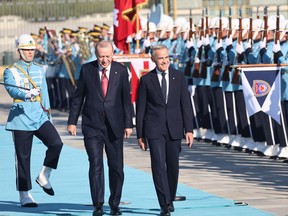
Mark Carney dropped in on Qatar in January and just wrapped up a three-day visit to Turkey over the weekend. In both instances, the Prime Minister’s Office cited the “historic” significance of Carney being the first of 24 Canadian prime ministers to make a dedicated visit.

Carney’s visit to Turkey just so happened to coincide with a government crackdown on gay rights organizations. In cases highlighted by Human Rights Watch, infractions as simple as a social media post depicting two men kissing could be grounds for raids on a gay rights non-profit and the detention of its staff.
In fact, Global Affairs Canada had only just signed on to a letter by the Equal Rights Coalition denouncing the “persecution of LGBTIQ+ activists … under the pretext of protecting children, adolescents, or the family.”
Although it didn’t mention Turkey by name, the letter’s timing suggests it was inspired by the Turkish crackdown, which had begun just three weeks prior.
When presented with these alleged contradictions at a Friday press conference in Istanbul, Carney responded that Canada couldn’t defend the gay rights of its own citizens without being a “truly sovereign nation,” and that sovereign nationhood required a “broad range of partnerships.”
“The engagement in those partnerships does not mean approval,” he said.
Nevertheless, this is belied by the soaring praise that the Prime Minister’s Office offered to both Turkey and Qatar in official communiques. In both instances, the official Canadian statements went well beyond sedate discussions of shared economic interests.
Turkey was called “one of the world’s most dynamic economies” and praised as a champion of human rights and democratic freedoms.
“As NATO Allies, Canada and Türkiye are bound together by shared values: human rights, individual liberties, democracy and the rule of law,” reads a joint statement by Carney and Erdogan. The Canadian delegation also praised Turkey for its “warm and friendly hospitality.”
Canada's prime minister says Turkey values human rights, democracy and rule of law after meeting with Erdogan.— Kristina Jovanovski (@kjovano) October 22, 2026Turkey has:
• imprisoned the main opposition figure whose on trial
• taken over a pro-opposition news channel
• detained LGBT activists + broke into their offices pic.twitter.com/1PzAApTWtB
In Doha, the Carney delegation said Qataris had “similar values” to Canadians and praised their “warm welcome and generous hospitality.”
“Qatar is an effective, expansive, and increasing diplomatic force in the world today,” Carney said in an official quote.
In a joint statement with the country’s emir, Sheikh Tamim bin Hamad Al Thani, Carney wished for a “future marked by even deeper cooperation and prosperity, that is strengthened by mutual trust, close friendship and a common vision for advancing the partnership between the two friendly nations.”
Celebrating Qatar’s National Day in Ottawa and the growing partnership between Canada and Qatar — grounded in friendship, cooperation, and shared values. And of course looking forward to a special moment when our two countries meet in #Vancouver at the #FIFAWorldCup! 🇨🇦🇶🇦 pic.twitter.com/ss0ejo8ue7
— Anita Anand (@AnitaAnandMP) December 11, 2025
The rhetoric is similar in two other instances of Carney paying a rare visit to a notorious human rights abuser.
In July, Carney’s arrival in Saudi Arabia was trumpeted by his office “as the first visit to the country by a Canadian Prime Minister in 26 years.”
The earlier prime ministerial visit to Saudi Arabia, by Jean Chrétien in 2000, was part of a 12-day tour of the Middle East that included stops in Egypt, Syria and Israel.
And at the time of Carney’s visit, a Global Affairs travel warning for the country urged Canadians to “avoid non-essential travel,” and warned that their social media history could land them in a Saudi jail.
“Saudi nationals and foreigners have been sentenced to lengthy jail sentences for social media activities, including posts or simple ‘likes’. This included social media activity that took place outside Saudi Arabia and sometimes many years in the past,” it reads.
Nevertheless, in a joint statement with Saudi Crown Prince Mohammed bin Salman, Carney didn’t just speak of increasing trade, but of a “partnership … based on trust, friendship and a shared vision of confronting global challenges with pragmatic, swift and tangible cooperation.”
On the same foreign trip that included Qatar, Carney also paid a visit to Beijing, where he praised the People’s Republic of China as a partner in a “new world order.”
Trips to Beijing are more common for Canadian heads of government, but this was the first in nearly 10 years following a deep chill in Sino-Canadian relations brought about by allegations of Chinese interference in Canadian elections and Beijing’s arbitrary 1,000-day detention of Canadians Michael Spavor and Michael Kovrig.
In a meeting with Chinese Premier Li Qiang, Carney said “the world has changed much since that last visit and I believe the progress that we have made, and the partnership, sets us up well for the new world order.”
A joint statement, meanwhile, would pledge closer “law enforcement cooperation” between Beijing and Canada.
It is rare that a politician will deliver a concession speech saying what they really think. Rather, the usual script is to deliver a few bromides accepting the outcome, congratulating the victor and thanking one’s campaign staff.
The most notable exception was on Oct. 30, 1995. After losing a Quebec independence referendum by only a few thousand votes, Jacque Parizeau went off on an extended rant blaming “money” and “ethnics” for the loss.
And now B.C. has yielded another example.
B.C. Green Leader Emily Lowan, 26, never had a realistic chance of becoming premier. But at the outset of the recently wrapped B.C. election, there was the possibility she might hold the balance of power in a minority NDP government.
Instead, she will occupy one of two Green seats in a B.C. Legislative Assembly dominated by a landslide Conservative majority.
In an angry, 20-minute election night speech, Lowan said the new government would auction off the province to corporate interests, destroy the natural world and undermine the “basic tenets of a dignified life.”
“We are the only party who is equipped to stand against the conservatives and their … and their existence,” she said.
She also wasn’t too happy with outgoing B.C. NDP Premier David Eby, whom she accused of being a corporate sellout who “stole power from social movements.”
First Reading is a Canadian politics newsletter curated by the National Post’s own Tristin Hopper. To get an early version sent directly to your inbox, sign up here.
Join the Conversation
This website uses cookies to personalize your content (including ads), and allows us to analyze our traffic. Read more about cookies here. By continuing to use our site, you agree to our Terms of Use and Privacy Policy.
KioskNews shows a cleaned-up reading view extracted from the publisher’s page — the original always lives on their site, not ours.