Will the KMT’s setbacks in Taiwan’s local elections affect its chances in 2028?

Despite its high-profile win in Taipei, the KMT’s setbacks in Taiwan’s local elections – including an unexpected defeat in the central bellwether of Taichung – have sounded alarms throughout the opposition camp, raising fresh questions about its momentum heading into 2028’s leadership contest, according to analysts.
The Kuomintang won just 11 of Taiwan’s 22 city and county races on Saturday – down from 15 – while the ruling Democratic Progressive Party’s (DPP) tally rose from five to 10, a net gain of five seats in the races widely viewed as a midterm test for Taiwanese leader William Lai Ching-te. The remaining contest was won by an incumbent independent candidate.
“A modest shift towards the green camp [a coalition informally led by the DPP] was part of the expected broader picture – but it is essentially a narrow win for the DPP and a limited loss for the KMT,” said Wang Jianmin, a Taiwan affairs specialist with Minnan Normal University in Fujian province.
Notably, Wang said, the KMT held onto Taipei as incumbent mayor Chiang Wan-an defeated DPP challenger Puma Shen Pao-yang in a fiercely contested race, and retained New Taipei City with candidate Lee Shu-chuan.
The biggest surprise – and setback for the KMT – was Taichung, a loss that could reshape the nationalist party’s 2028 line-up, he said.
The loss in Taichung would “deal a blow” to the outgoing mayor, the KMT’s Lu Shiow-yen, who had governed the city for the past eight years and was widely seen as a leading contender for the party in 2028, he said.
Losing that political anchor would force Lu to “confront a much tougher political reality within the party as she seeks to maintain influence or pursue the KMT’s 2028 nomination”, said Wang Kun-yi, head of the Taipei-based Taiwan International Strategic Study Society.
Widely viewed as Taiwan’s premier swing municipality and a key general-election barometer, Taichung has alternated between KMT and DPP control over the past two decades.
Chen Xiaoxiao, a Taiwan affairs analyst at Jimei University in Fujian province, said voting patterns in Taichung had long closely mirrored island-wide trends.
“[However] while Taichung offers a valuable window into swing voters, young people and the ‘blue-white’ coordination, the outcome cannot be directly equated with the 2028 race,” she said, referring to cooperation between the KMT and the smaller Taiwan People’s Party.
The KMT also lost Hsinchu county, Changhua, Chiayi City, Yunlin and Yilan to the DPP, but its win in Taipei indicated that Shen’s social media-driven campaign, dubbed the “ocean current”, was not enough to break through traditional partisan loyalties.
“The ‘ocean current’ failed to breach Taipei’s blue bastion, highlighting instead that Taiwan’s local politics still rest on entrenched voter bases that remain difficult to shake,” said Wang Kun-yi.
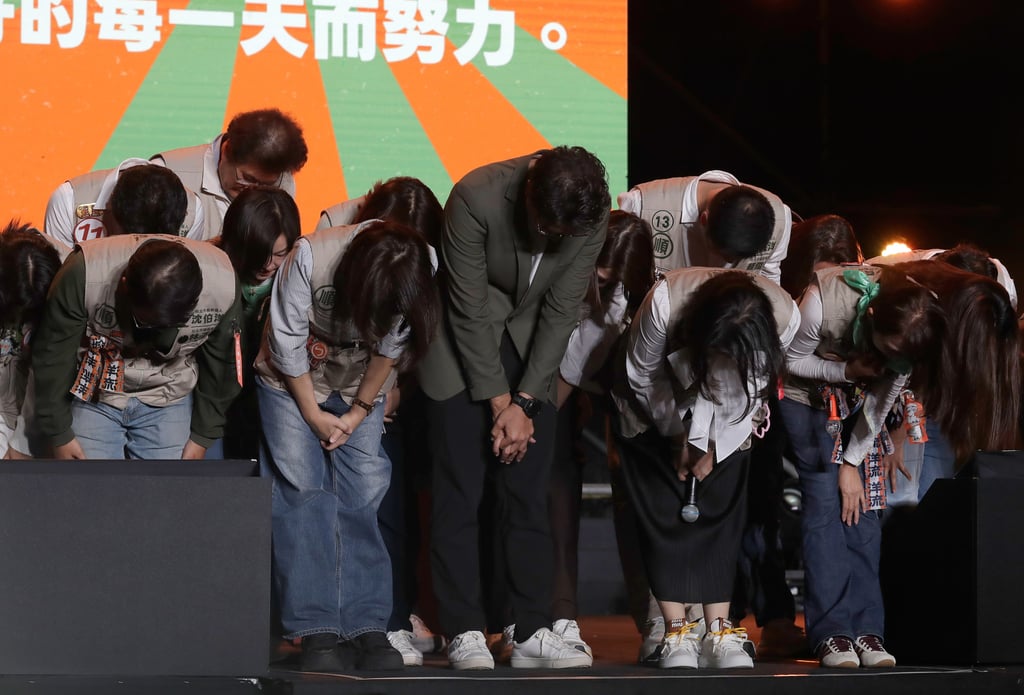
The “ocean current” – a campaign concept based on Shen’s name – turned Taipei into the election’s fiercest battleground.
Chen from Jimei University said that over the longer term, the KMT faced a “steadily approaching structural voter crisis” as older supporters gradually exited the electorate, putting sustained pressure on the party’s traditional base.
Analysts said the results could have been worse for the opposition.
“Blue-white coordination between the KMT and the TPP succeeded in helping the KMT stabilise its hold on the municipalities it governs, with TPP founder Ko Wen-je joining the campaign in Taipei,” Wang of Minnan Normal University said. “Without that alliance, the KMT would have suffered even heavier losses.”
New Taipei City offered a textbook example of successful “blue-white” coordination, he noted. In April, KMT candidate Lee Shu-chuan and TPP chairman Huang Kuo-chang settled their nomination through a joint public opinion poll.
By contrast, a collapse in “blue-white” coordination – compounded by internal KMT primary rifts – cost the opposition its 25-year hold on Hsinchu county, opening the way for DPP challenger Cheng Chao-fang to beat KMT nominee Hsu Hsin-ying.
“Where ‘blue-white’ coordination held, the opposition had a chance to win; where it fell apart, it had none,” Chen said.
“More deeply, this reflects the KMT’s structural malaise – its traditional base of older voters is steadily shrinking, and it has yet to bridge its gap with younger and independent voters.
“These losses will put pressure on the party’s direction, its leadership and its 2028 line-up.
“The KMT must rethink how to balance internal factions, operationalise ‘blue-white’ cooperation, and build policy messaging that appeals to younger and swing voters, instead of relying on old-style local political machinery.”
KioskNews shows a cleaned-up reading view extracted from the publisher’s page — the original always lives on their site, not ours.