‘Professional jealousy… he has no business’: Former Rajasthan acting Chief Justice breaks silence on claims by Supreme Court judge
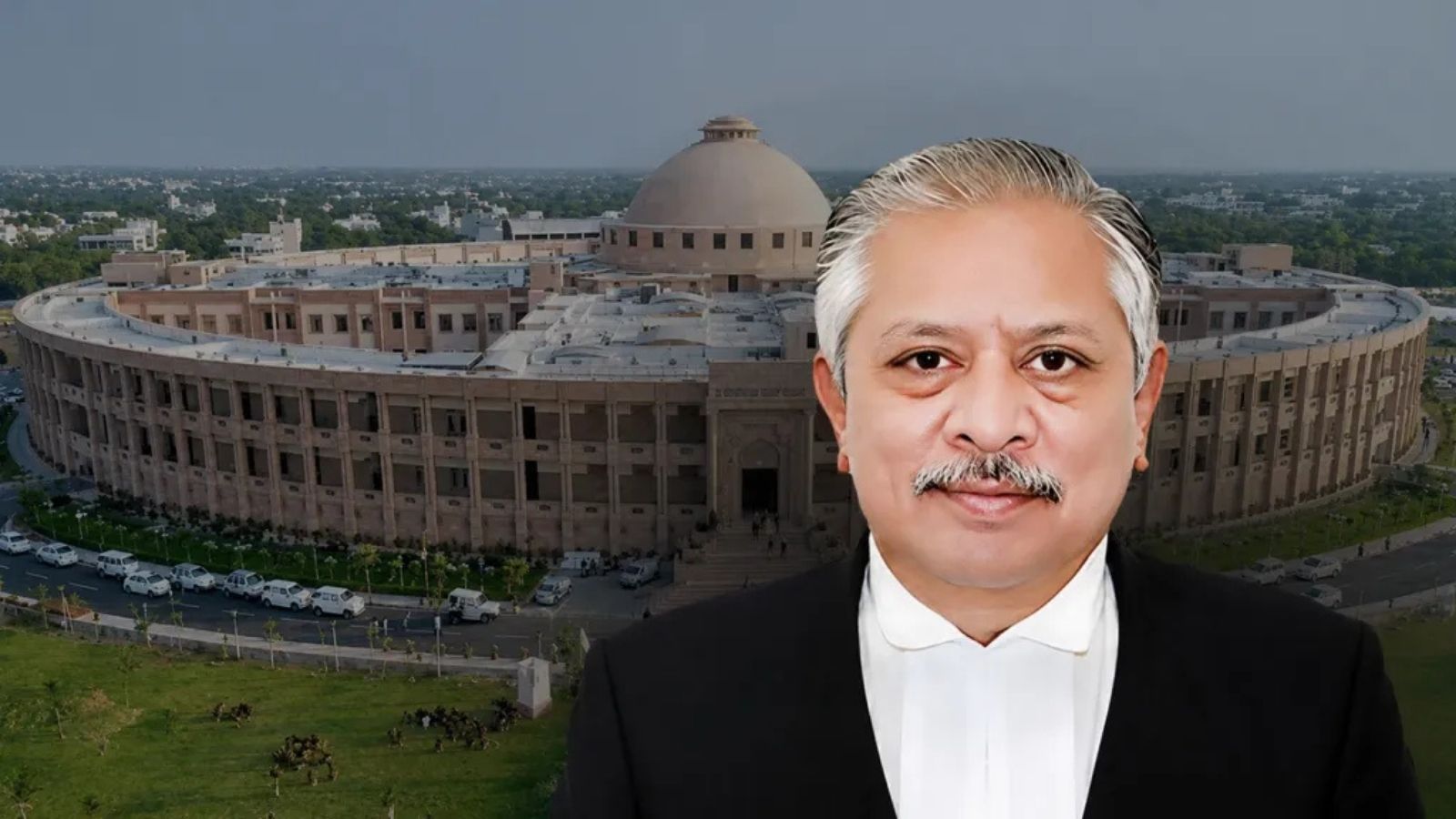
Justice (retd) Sanjeev Prakash Sharma, former acting Chief Justice of the Rajasthan High Court, has opened up for the first time on the allegations levelled against him by Supreme Court Justice Sandeep Mehta, saying that they may be borne out of “professional jealousy” and that Justice Mehta had “no business” intervening in the matters of a High Court.
In an exclusive interview with The Indian Express, Justice Sharma, who retired as a judge of the Rajasthan High Court last week, said he should be allowed to cross-examine Justice Mehta and alleged that he had instigated lawyers in Rajasthan to go on protest.
In a series of letters sent to the Chief Justice of India in August and copied to other members of the Supreme Court Collegium, Justice Mehta had accused Justice Sharma of “misuse of powers” and claimed he had received “several complaints”, which “raise doubts” about his “integrity”. Based on this, Justice Mehta had sought the transfer of the acting CJ to another High Court and the appointment of a new Chief Justice.
Later that month, the Supreme Court Collegium recommended Chhattisgarh High Court Judge Sanjay K Agarwal as the Chief Justice of Rajasthan High Court. This came hours after Sharma went on leave amid protests by lawyers.
Speaking to The Indian Express, Sharma denied allegations of favouring influential litigants, manipulating rosters, interfering in inquiries or transferring judicial officers to benefit particular parties. He said a difference in functioning style doesn’t automatically mean one is wrong, and defended his administrative record as Rajasthan’s acting Chief Justice, citing pending promotions, transfers and increased funding.
“I am surprised, if there is a complaint, would it not go to the Chief Justice (of India) first,” Sharma said, adding that apart from submitting responses to Justice Mehta’s four letters, he has also written to the CJI raising an issue with regard to whether a judge of the Supreme Court can interfere in the affairs of the High Court.
“These kinds of issues, internally between the judges, have arisen several times earlier. But it has never come to the limelight in the newspapers. Nobody goes to social media. There is a celebrated judgment of the Supreme Court, Prakash Chand versus State of Rajasthan, from 1997. The matter travelled to the SC, which laid down strict guidelines. Now all of us are bound by those strict guidelines; it binds me as well as a judge sitting in the Supreme Court,” he said.
Story continues below this ad
“If he, as the SC judge, does not act accordingly, then some action should be taken against him also. I had a huge practice and left that just to give back whatever I have learnt. That is why I maintained that dignity… judges are not supposed to be tried on social media. The faith of the general people should not be affected,” Sharma said.
“If we start judging each other’s working style, it is not done. And if you start saying in the media that this particular judge has doubtful integrity – as he said – and he has no concern, no business to say this. But he did it. Now what is its effect? Lawyers said that if a Supreme Court judge is saying that, then this means that this judge has doubtful integrity; they went on strike,” he said.
“For eleven and a half months into my tenure as the acting CJ, there was not even a single strike in Rajasthan, but he instigated them (lawyers). It doesn’t matter. They didn’t confirm me as Chief Justice; it was a stroke of luck that I got a chance to be the acting CJ of Rajasthan. And I took it as an opportunity to do something better for Rajasthan,” he said.
“I don’t know from where he got the idea that my administrative capabilities are not up to the mark and that I should be transferred from here. I was amazed, because he has never been with me, we have not worked together, we were not together as lawyers. He was practising in Jodhpur and I was in Jaipur. As judges also, he was in Jodhpur and I was in Jaipur. Our field of work was also different because he was essentially in the criminal side and I was a constitutional lawyer. Then, for four years, he has been away from Rajasthan. How would he know about the problems here?” Sharma said.
Story continues below this ad
“What I finally say is judges should know their limits, where they should speak, where they should not. We are people who speak through our judgements; our judgements are tested. I have decided more than 88,000 cases in my short tenure of nine and a half years. I have decided cases which had long repercussions and have been upheld by the SC, whichever has been tested (by the SC),” he said.
On why he believes the allegations were made by Justice Mehta, he claimed, “I have absolutely no idea. Might be simple professional jealousy. In 2011, both of us were elevated as senior advocates. I was elevated without moving an application; the entire full court selected me to become a senior advocate. He had applied, of course. And I am a first-generation lawyer. I have no one in my family background, and he comes from a reputed judicial family… Both of us were made senior advocates together, and when the issue came for elevation, he saw to it that I didn’t become (Chief Justice). And this thing has its own play; judges are influenced by the family you come from.”
On the allegation that he was benefiting influential or rich litigants, Sharma said, “Who are they? There has to be some complaint from someone.”
“I was working as the acting CJ, the Executive Chairman of the Legal Services Authority, and the Administrative Judge. Every 15 days, I was travelling to Jodhpur by road. There was no occasion to even examine who the litigant was. And we don’t do it. If I would have helped, I would have helped my own family. My mother’s pension case is pending – my father was in the Army. My brother’s (formerly in the Army) petition is also pending. I don’t allow them to interfere in my work, and I don’t interfere in whatever they are doing,” he said.
Story continues below this ad
He said the controversy made him “sad, very sad”. “I have had a distinguished career as a lawyer, have been practicing since 1987,” he said, adding that despite three heart attacks, he was still putting in 18 hours daily as the acting CJ.
On meeting a litigant in Bundi – an allegation raised by Justice Mehta – he said, “My wife is also an Atri (from the community), and she and Raghubir Singh Atri are brother-sister. She ties him a rakhi; he is 70 years old. He came for vacations and took us to a temple, so we all went… Now they churned up a story that he has a litigation. His litigation has been going on since 1992. And he had moved some application for dismissing the suit filed by his brother, which was dismissed. Had I been influencing, then I would have got that application allowed. That all happened before I came.”
On the claim that Judicial Officers who did not pass favourable judgements in Atri’s case were transferred, Sharma said, “It’s absolutely ridiculous; 800 transfers were made. Usually, they are done by the Registrar General, and he gives me inputs… we see how much time a person has spent in a location… If a Judicial Officer has been transferred, he would file a complaint somewhere, and he would not complain to Sandeep Mehta only. Why should he? There is another judge from Rajasthan (in the SC).”
Responding to Justice Mehta’s claims that he was humiliated, Sharma said, “He inaugurated the Arbitration Centre; he came individually… We honour every judge… Why should a Supreme Court judge expect that he be called in all programmes? When we called him for the Arbitration Centre programme, we did not call the other judge (from Rajasthan). The other one should start feeling humiliated.”
Story continues below this ad
“His only problem is that I was here in Rajasthan and he didn’t want me here. The long and short is this,” he claimed.
On the claim that the roster was manipulated and cases were selectively shifted to his Bench, he said, “The power is available with the Chief Justice; we get several inputs. There may be some reasons: sometimes the Chief Justice is apprised of the problems the lawyers are facing; sometimes we get an input from the government with regard to pendency of certain cases. And we have to take decisions and shift cases.”
On the allegation that he threatened people with retributive action citing closeness with the CJI, he said, “How is the CJI close to me? Because he comes to Rajasthan to attend functions? Which were already planned even before I came here. If there is an international conference, it is planned almost eight-nine months earlier. I was told that there is going to be an international conference in July. How would I know that I would be there, or that I would continue? I could have been transferred somewhere out as Chief Justice.”
Sharma also defended hearing the multi-crore Udaipur Development Authority case, saying he took it up after three judges recused themselves and the Advocate General requested him to hear the appeal.
Story continues below this ad
He dismissed the lawyers’ agitation against him, saying judges don’t have to appease lawyers if their issues have no basis.
KioskNews shows a cleaned-up reading view extracted from the publisher’s page — the original always lives on their site, not ours.