Donna Kennedy-Glans: The more important ballot questions in Alberta are the ones no one’s talking about
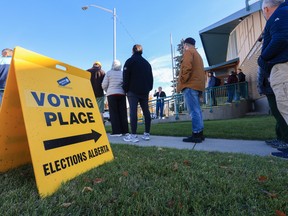
I have voted in Alberta’s referendum. My mail-in referendum ballot arrived last week. I am one of more than 658,000 Albertans who asked for a special ballot, hoping to skip the lineups on Oct. 19. Advance polls are open this week.
Sign In or Create an Account
Ten ballots: it was a thick packet. The one that got all the attention asked whether Alberta should remain a province or start the formal process toward a binding vote on separation. I marked remain. The other nine were just sitting there. Hardly anyone has been talking about them. That quiet is the part that interests me.
Five of the questions are about immigration and who gets what from the province. Should Alberta take more control over immigration numbers, favour people coming to work and put Albertans first for new jobs?

Columnist Jesse Kline keeps you up to date with what’s happening in Israel and the effects of antisemitism on life here in Canada. Friday mornings.
By signing up you consent to receive the above newsletter from Postmedia Network Inc.
A welcome email is on its way. If you don't see it, please check your junk folder.
The next issue of Channel Israel will soon be in your inbox.
We encountered an issue signing you up. Please try again
Should health care, schools and social programs be limited to citizens, permanent residents and people Alberta itself has approved? Should temporary residents wait a year before they qualify for supports? Should they pay a fee for health care and schooling? Should people be required to provide proof of citizenship to vote provincially?
Quebec has long selected its own economic immigrants and set its own criteria under the Canada-Quebec Accord. When Quebec cuts levels or prioritizes economic migrants, almost no one calls it scapegoating. Alberta is now asking for a larger voice in the same conversation. The difference in how the two are received is striking.
The other four questions are constitutional. Should provinces pick the judges for the Court of King’s Bench and the Court of Appeal instead of Ottawa? Should the Senate be scrapped? Should provinces be allowed to opt out of federal programs and keep the money? Should provincial law take priority when it collides with federal law?
We’ve already talked about the constitutional ones. I sat on then-premier Jason Kenney’s Fair Deal Panel in 2020, which canvassed those options. Premier Danielle Smith’s Alberta Next panel revisited the same ground and added the immigration questions in 2025. Some of the immigration items have majority support in the polls; the constitutional ones don’t.
Smith has said yes on the nine, and “remain” on separation. She’s basically telling people not to treat the independence ballot as a way to complain about Ottawa. If you want the message sent — stay in your lane, stop taking the West for granted — use the other nine.
There are vocal No campaigns. Political strategist Stephen Carter has pushed the “No to the Nine” campaign. The Calgary Alliance for the Common Good is running a “Vote for the Common Good” campaign, with its co-chair calling the immigration items “fundamentally dehumanizing.”
Ordinary talk among friends has been thinner, as the separation question has largely swallowed the coverage. Some of the nine, which are more specific and in several cases more immediately actionable, have been treated as radioactive.
That is not an accident of news values, it is a social fact. Supporting tighter controls on immigration levels, residency requirements before receiving provincial benefits or priority for citizens and permanent residents is the kind of position that, in many workplaces, family chats and group texts, invites labelling rather than argument. People will mark a private ballot; far fewer will be willing to say out loud why they did.
The pattern shows up on both sides of the border. A recent Knight Foundation–Ipsos study of American young adults found that large majorities strongly value “free speech as a democratic principle, but (are) less confident about exercising it without consequences.” Confidence has declined sharply over the past five years. Self-censorship is common, driven less by formal rules than by the expectations of social costs — shaming, exclusion, a quiet professional penalty.
Canadian data points the same way. A 2025 Aristotle Foundation survey of students at 34 universities found nearly half were reluctant to reveal their opinions on a controversial political issue, and only about one in four felt free to discuss their views across the full range of sensitive topics. Eighty-five per cent of students who described themselves as “very conservative” feared a lower grade for speaking honestly.
Affirming open discussion is easy; conducting it when the topic is who pays for what, and who comes first, is not. The effect on this referendum is practical. A private Yes or No on any of the nine questions is costless. Explaining, in mixed company, why one marked Yes on residency requirements or voter identification is not.
The result is that the questions most likely to shape day-to-day policy if the government treats strong results as a mandate are the ones least tested in ordinary argument. The separation question, by contrast, has been endlessly discussed. That imbalance leaves voters with less shared language for the cluster of proposals that actually concern employment priority, program eligibility and the constitutional the division of powers.
I’m not telling anyone how to mark the nine. I’m saying the cost of certain answers is real and it isn’t evenly shared. Younger people are quicker to treat a disagreement on immigration or status as a moral failing. Older people aren’t free of it either, but it bites harder when professional and social networks overlap. The ballot stays private, the conversation that would make the ballot choice clearer mostly doesn’t happen.
National Post
Join the Conversation
This website uses cookies to personalize your content (including ads), and allows us to analyze our traffic. Read more about cookies here. By continuing to use our site, you agree to our Terms of Use and Privacy Policy.
KioskNews shows a cleaned-up reading view extracted from the publisher’s page — the original always lives on their site, not ours.