Canadians split on how much power Ottawa should have in ending labour strikes: poll

Most Canadians believe the federal government should be able to end a labour strike but are divided over how it should be done, as Prime Minister Mark Carney seeks to entrench a controversial power used by the labour minister to intervene in some disputes.
Sign In or Create an Account
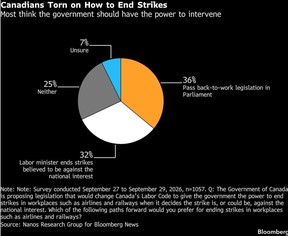
A poll conducted by Nanos Research Group on behalf of Bloomberg News found 32 per cent of Canadians support giving the federal labour minister the power to end strikes that are believed to be against the national interest, while 36 per cent said the government should have to pass back-to-work legislation to do so. Meanwhile, 25 per cent of respondents said the government should not be allowed to end strikes at all.
Labour groups have pushed back against proposed Carney government legislation that puts conditions on the use of Section 107 of the Canada Labour Code to end strikes. In recent years, labour ministers have invoked the provision to direct a quasi-judicial body to resolve disputes involving flight attendants, postal workers and rail and port employees — without having to go through the politically fraught process of passing back-to-work legislation.

Get a dash of perspective along with the trending news of the day in a very readable format.
By signing up you consent to receive the above newsletter from Postmedia Network Inc.
A welcome email is on its way. If you don't see it, please check your junk folder.
The next issue of NP Posted will soon be in your inbox.
We encountered an issue signing you up. Please try again
The government has said that the proposed changes will raise the bar for ending strikes using Section 107, while several unions have argued that the government is doubling down on a power it should not have by enshrining it in law.
Business groups have long called on the government to play a more active role in ending labour disputes, arguing that strikes carry significant economic costs and cause uncertainty, both of which could discourage investment.
Nik Nanos, the founder of Nanos Research, said the poll results suggest the government’s solution is not a “slam dunk” politically. That means it will have to put in work to win over Canadians on the issue, he said.
Young people between the ages of 18 and 24 were the least likely to support giving the labour minister the power to end a strike and the most likely to say that the government should not be allowed to play a role.
The poll was conducted between Sept. 27 and 29 with 1,057 respondents, as is considered accurate within three percentage points, 19 times out of 20.
Our website is the place for the latest breaking news, exclusive scoops, longreads and provocative commentary. Please bookmark nationalpost.com and sign up for our daily newsletter, Posted, here.
Join the Conversation
This website uses cookies to personalize your content (including ads), and allows us to analyze our traffic. Read more about cookies here. By continuing to use our site, you agree to our Terms of Use and Privacy Policy.
KioskNews shows a cleaned-up reading view extracted from the publisher’s page — the original always lives on their site, not ours.