What can a century-old Kuomintang building tell us about Australia?
On Ultimo Road in Haymarket, just a few minutes’ walk from Paddy’s Markets, stands an unassuming building with an unusual history. Built in 1921 for the Sydney branch of the Kuomintang (KMT), or Chinese Nationalist Party, it later became the headquarters of the party’s Australasian organisation.
More than a century later, the building has been heritage-listed by the City of Sydney. It’s not only the building itself that is valuable, but the archives, objects and stories preserved there. Together, they challenge some familiar assumptions about Australia’s past.
Most people associate the KMT with China and Taiwan. Emerging from Sun Yat-sen’s republican movement in the late 19th century, it later governed China under Chiang Kai-shek until its defeat by the Chinese Communist Party in 1949. In Taiwan, it imposed martial law and maintained authoritarian rule for decades. Martial law was lifted in 1987, paving the way for Taiwan’s democratisation in the 1990s.
So what was this party doing in Sydney? And what can its headquarters tell us about Australia?
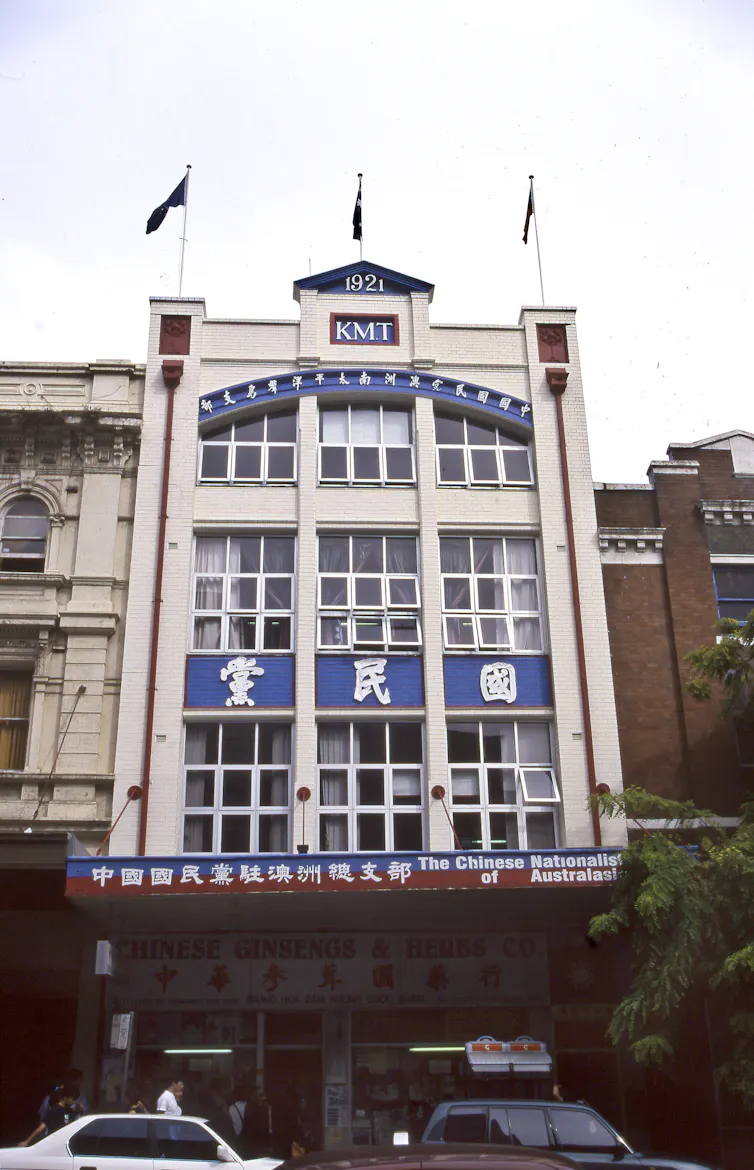
In September, the Museum of Chinese in Australia invited me to talk about the building’s history. But the discussion that followed my talk quickly moved beyond the building itself.
The audience brought together migrants from mainland China, Hong Kong and Taiwan, descendants of long-established Sydney families, policymakers, history enthusiasts and groups of international studies and high school students.
Some asked whether migrants are still viewed with suspicion from the wider Australian public over divided loyalties. Others wondered how changing attitudes towards immigration might affect their communities. Their questions showed how this building can open conversations about Australia today.
Australia was never simply a destination
We often tell Chinese Australian history as a story of arrival: miners, market gardeners, merchants and families who endured the restrictions of White Australia and built lives here.
These stories are all true, but go in one direction. They make Sydney the end of the journey.
Those who built the KMT had different views of the city. For them Sydney was a hub.
Chinese-language newspapers, telecommunications, shipping routes and political organisations connected Sydney with Hong Kong, Japan, San Francisco, Vancouver and the Pearl River Delta. Chinese Australians raised funds, organised meetings and debated China’s political future, from Australia.
Over time, even as the building stayed essentially the same, what the KMT represented changed – through the course of war with Japan, China’s civil war, the Cold War, authoritarian rule in Taiwan and Taiwan’s democratisation.
Australians often date their engagement with Asia from the 1970s. This building reminds us that Chinese Australians were active in regional political networks much earlier. Australia was not watching Asian history from the sidelines. Some of that history was being debated and organised here.
The Kuomintang headquarters is a tangible trace of that transnational world.
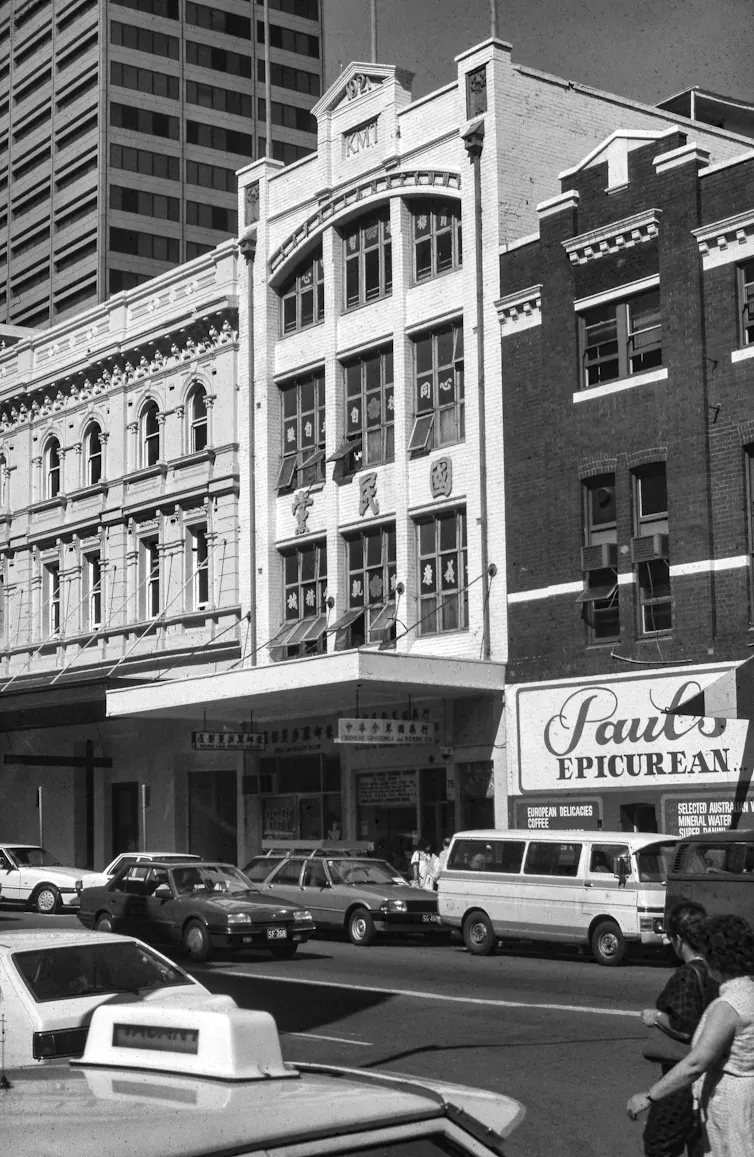
One building, different memories
The museum discussion also revealed that Australians do not necessarily remember the same political past in the same way.
For descendants of early members and some older Chinese Australians, the party represents a history of republicanism, wartime mobilisation and community organisation around White Australia policies. For those forming political memories in Taiwan, the party may represent a very different thing.
I grew up in Taiwan, during the final years of martial law. From this perspective, the history of the Kuomintang is inseparable from the February 28 Incident in 1947 when thousands were killed in the KMT government’s violent suppression of an uprising; and the White Terror, decades of political repression that intensified under martial law from 1949.
Neither history disappears when people move to Australia. The revolutionary organisation of the 1920s, the authoritarian government of Cold War Taiwan and the party competing in Taiwan’s democracy operated in very different political circumstances.
This reveals something important about multicultural Australia. Migrants bring more than food, languages and traditions. They also bring political experiences and memories that may conflict with those of their neighbours.
Preserving history without silencing it
Heritage listing is about more than celebrating cultural diversity. It also means recognising histories that are difficult or uncomfortable to tell.
Making history accessible should not mean removing its political conflicts or uncomfortable truths.
The KMT’s own history reminds us of the consequences of censorship. During its authoritarian rule in Taiwan, people were punished for expressing political views the government opposed.
The freedom to tell difficult histories also matters in Australia today. Historian John Fitzgerald recently raised concerns about political pressure on Australian cultural institutions and disputes over how Chinese Australian history is presented.
Fitzgerald’s concerns and the KMT’s history of censorship involve different circumstances, but both remind us how political power can shape – and simplify – historical narratives.
Preserving the KMT headquarters does not mean endorsing the party. Nor should its authoritarian past erase its place in Chinese Australian history.
A century-old building cannot settle these disagreements. But it can give Australians a place to examine them.
Heritage listing is an important first step, but it should not be the last. The building and its archives hold stories that remain little known. Opening them up to the wider public would allow more people to explore these histories, ask questions and bring overlooked stories to light.
The building reminds us that Australia’s connections with the Asia Pacific were shaped not only by governments and trade, but also by migrants who brought political struggles, competing visions and different memories.
Understanding Australia’s past means making room for these histories, including those that are difficult to tell.
KioskNews shows a cleaned-up reading view extracted from the publisher’s page — the original always lives on their site, not ours.