Deadly Krakow attack heightens fears as Poland faces key political flashpoints
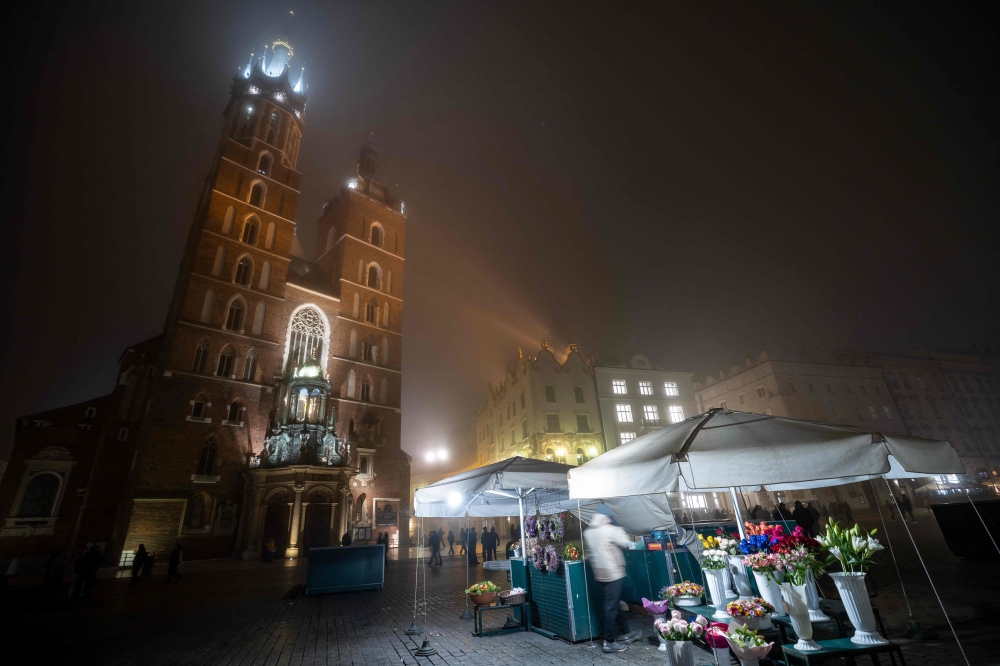

A street vendor sells flowers in front of St Mary's Basilica (Bazylika Mariacka) at the Main Market after it was open to the public a day after a gunman opened fire killing six people and wounding around a dozen others in the historic centre of the Polish city of Krakow, on November 8, 2026. A 24-year-old Polish national opened fire at random on November 7, 2026 in the heart of Krakow's historic centre, in what Poland's Prime Minister Donald Tusk called an act of "terrorism". A British national was among the dead in Poland's second city, according to police. And among the 15 wounded were nationals from Austria, Britain, Germany, Portugal and Russia, authorities told the PAP news agency. Three more bodies were later found at the suspect's home in Ostrowiec Swietokrzyski, around 150 kilometres (95 miles) northeast of Krakow. Police said they were his parents and a sister. — AFP pic
First Published: Monday, 09 Nov 2026 4:05 PM MYT
Last Modified: Monday, 09 Nov 2026 4:13 PM MYT
WARSAW, Nov 9 — Poland is facing a week of political tensions after the deadliest shooting in decades shattered residents’ sense of security in the deeply divided nation.
The country had been spared from such attacks and was unaccustomed to everyday violence until Saturday, when a gunman opened fire at random in the historic market square of Krakow, the country’s second city.
Six people, including two foreigners, were killed, and about 15 others were wounded, in Poland’s worst fatal shooting since the end of communism in 1989.
The gunman is suspected to have killed nine people in all after the bodies of three people — his parents and sister — were found at their home two hours’ drive from Krakow. Police announced on Monday that the suspect had died in hospital.
Prosecutors on Sunday opened an investigation into an “act of terrorism” and Poland’s interior minister has said the suspect was fascinated by “far-right ideologies”, which has drawn the ire of the conservative and nationalist opposition.
The shooting comes as Poland — a nation deeply divided politically — prepares for a critical week.
Court appointments row
Tomorrow, a high-stakes meeting of the Constitutional Tribunal is due to be held, a focal point in the ongoing battle between Donald Tusk’s government and its opponents over judicial appointments.
The right-wing opposition accuses the liberal, pro-European administration of undermining the constitutional order.
The governing coalition, for its part, maintains it is trying to correct “political” nominations to the court and reforms made by the nationalists, which it claims run counter to European democratic standards.
For several weeks, nationalist protesters have camped outside the court to “defend it” but the crisis escalated abruptly late last month.
Riot police moved in to block access and a judge newly appointed by the parliamentary majority said she was taking over in the interim — effectively suspending the incumbent, who is close to the right and to the nationalist head of state Karol Nawrocki.
After the Krakow shooting, the nationalist Law and Justice party (PiS), which was in power from 2015 to 2023, called off planned protests for Monday and Tuesday.
But they could resume later in the week.
Radicalised discourse
Wednesday’s Independence March is causing the greatest concern, however.
The annual event draws up to hundreds of thousands of right-wing supporters, from Catholic conservatives and white-supremacist fringe groups to antisemitic, pro-Russian far-right elements.
President Nawrocki has announced his attendance.
Some observers have described it as “high-risk”, fearing that the crowd may deviate from its agreed route and head instead to the Constitutional Tribunal.
Prime Minister Tusk yesterday dismissed rumours that the march could be stopped.
“No one intends to ban the Independence March,” he wrote on X. “Speculation on this matter is nothing but disinformation.”
But he urged participants to “refrain from aggression” and warned against taking part in counter-demonstrations.
His appeals may well go unheeded given the divisions in Polish politics, which are unfolding against the backdrop of a rising far-right movement.
“An extremely destructive polarisation which does not merely dismantle the state in an institutional sense but also divides society even more deeply on an emotional level,” said leading writer Boguslaw Chrabota in the weekly Rzeczpospolita on Sunday.
Radicalisation of political discourse “gives rise to Polish Breiviks”, he argued, referring to the Krakow shooting and Anders Breivik, who killed 77 people in Norway in 2011.
Political scientist Ewa Marciniak, from Warsaw University, suggested that the tragedy in Krakow could soon be exploited for political gain.
“Tragedies like the one in Krakow only serve to sharpen political divisions,” she told AFP.
“After a period of shared mourning comes the search for those responsible, all taking place in a political climate defined by deep-seated, mutual hostility among political leaders.”
With parliamentary elections scheduled for autumn 2027, events such as the Krakow tragedy or the ongoing crisis surrounding the Constitutional Tribunal, are likely to be used “to deepen conflicts” and “draw the public into them”, she added. — AFP
KioskNews shows a cleaned-up reading view extracted from the publisher’s page — the original always lives on their site, not ours.