Dry for a decade, Bihar hit by a new lethal high: Drugs & addicts
In the 10 years since Bihar imposed prohibition, its police have seized around 3.16 crore litres of liquor and made around 7.15 lakh related arrests across the state — around 8,650 litres and 196 arrests on an average, every day. This is known. What is under the radar, however, is that beyond the smuggled bottle, a parallel world of intoxicants is taking shape — one that involves pocket-sized packets, tablet strips, heroin to a distinctive variant “kota”, vials, soap boxes or even a petticoat fold.
For a police force that spent a decade learning to find contraband liquor in trains, tankers and horse-borne consignments, the fast-emerging market in drugs has set off a series of alarm bells they have begun tuning into, an investigation by The Indian Express shows.
Over the past three months, this newspaper reviewed case records and official data, and spoke to police officers, social workers and doctors to find how Bihar’s drugs map has steadily — and very sharply — expanded, shifting to newer districts; how police fear this market is fuelling juvenile crime; and how treatment has hardly kept pace, with Centrally supported facilities operating in less than one-third of the state’s districts.
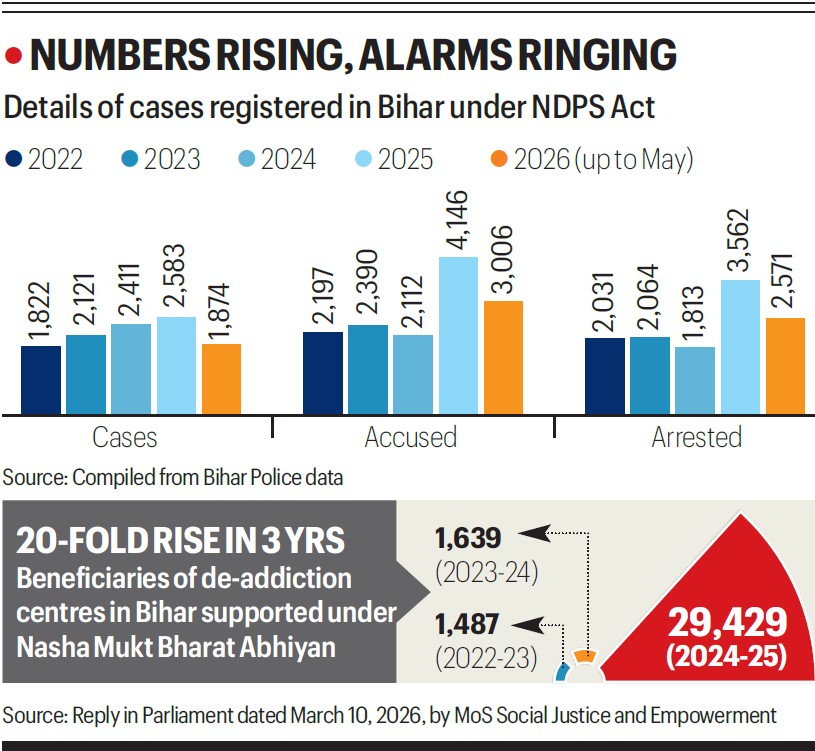
The numbers from the state and Centre capture the crisis — key indicators have jumped:
- Data compiled by the Bihar Police HQ shows that the number of cases registered under the National Drugs and Psychotropic Substances (NDPS) Act in the first five months of 2026 alone (1,905) was 83 cases more than those registered in the whole of 2022 (see chart). This number was only 697 in 2019.
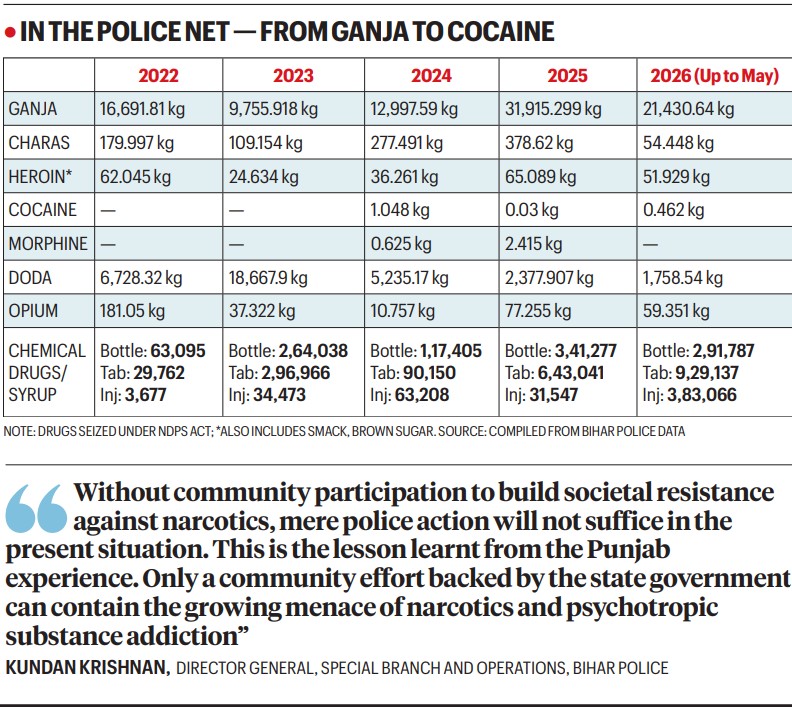
- The data also shows 16,691.81 kg of ganja seized in 2022, rising to 31,915.29 kg in 2025 — nearly double in three years (see chart). In fact, the number of “tablets” seized under the NDPS Act illustrates the dramatic uptick: 29,762 pieces in 2022 to 9.29 lakh pieces in the first five months of 2026 alone — from sedatives, opioid painkillers and anti-anxiety drugs procured illegally to counterfeit pills made using chemical powders and industrial machinery.
- The narcotics cell of Bihar Police’s Special Task Force (STF), which was formed last April to deal with drug trafficking, seized Rs 52.32 crore worth of drugs and arrested 315 people until October 10, 2026. Of this, Rs 25.58 crore worth of drugs were seized this year.
- State data shows that just 11 juveniles were detained under the NDPS Act in seven years, from 2016 to 2023 — but 50 in 2024 alone, according to most recent data recorded.
Then there’s that one figure that captures the human cost. A reply in Parliament, dated March 10 this year, by the Union Ministry of Social Justice and Empowerment states that beneficiaries of de-addiction centres supported by it in Bihar rose from 1,487 in 2022-23 to 29,429 in 2024-25 — a nearly 20-fold rise.
So sprawling is the challenge that the response also needs to go beyond the police station.
Speaking to The Indian Express, Kundan Krishnan, Director General of Bihar Police’s Special Branch and Operations, called for a coordinated effort to tackle the growing menace.
“Without community participation to build societal resistance against narcotics, mere police action will not suffice in the present situation. This is the lesson learnt from the Punjab experience. Only a community effort backed by the state government can contain the growing menace of narcotics and psychotropic substance addiction,” he said.
Story continues below this ad
The state government has taken note. While the Special Task Force focuses specifically on organised narcotics trafficking, the government established another standalone branch, Prohibition and State Narcotics Control Bureau, in September 2025. This new bureau merged the Anti Narcotics Task Force (ANTF), which was set up in 2022, with the existing prohibition wing of the police.
A senior official said the situation is expected to improve with the Union Home Ministry’s announcement of a campaign under the Centre’s flagship Nasha Mukt Bharat Abhiyan with 2029 as the target year. “Top officials are now holding regular review meetings to monitor progress,” the official said.
“The real issue is not just the rise in numbers but the changing profile of the patients as well,” Dr Rajesh Kumar, head of psychiatry at the Indira Gandhi Institute of Medical Sciences (IGIMS) in Patna, told The Indian Express.
“Previously, more of them were dependent on cannabis or other plant-based substances, but that ratio is shifting rapidly towards semi-synthetic and synthetic drugs, with many new patients coming in with heroin dependence,” he said.
Story continues below this ad
The Ministry of Social Justice and Empowerment did not respond to an emailed query from The Indian Express on the reason behind the spike in the number of beneficiaries of de-addiction centres supported by it under the Nasha Mukt Bharat Abhiyan in Bihar.
The roots: How a new market grew
It was on April 5, 2016, that Bihar imposed complete prohibition, presented as an effort to curb alcoholism and the social and economic harm tied to it. But as the police cracked down hard on the liquor trade, starting with the seizure of 21.26 lakh litres and 75,225 arrests in the first year alone, a “second, cheaper market” began to take root.
“Illegal liquor can cost Rs 1,000 to 1,200 a bottle, and the intoxication may last only a short while. Some users, once exposed to narcotics, begin to compare: for the same money, or a little more, a much smaller quantity of a drug can keep a person intoxicated far longer, and one session’s liquor money can sometimes buy a drugs supply that lasts several days,” a senior officer from the state police’s narcotics cell said.
Consider this: A 750-ml bottle of an Indian whisky brand, which may retail for around Rs 650-750 in other states, sells for around Rs 1,500 in Bihar’s black market. At the same time, the officer said, a packet of adulterated brown sugar, containing a fraction of a gram, can sell for Rs 300-500.
Story continues below this ad
Many police officers and doctors believe the Covid lockdown marked a tipping point of sorts, accelerating a market that was already developing as it saw an unprecedented expansion into rural areas. “As the legal liquor market disappeared and demand for intoxicants did not, plant-based drugs such as ganja and afeem first emerged as alternatives in rural areas,” a senior doctor in Patna said.
A key factor fuelling this switch was reverse migration, they said. “During the pandemic, daily-wage labourers and factory workers came home from Punjab, Haryana, Delhi-NCR, Mumbai and Gujarat. Some of them had already been exposed to harder substances, synthetic sedatives and semi-synthetic drugs. When they returned, some of those substances, contacts and knowledge came with them,” said a senior police officer in Patna.
The spread: Border routes, changing menu
Geography is integral to the spreading narcotics map. Bihar borders Nepal and sits on major road and rail links to the Northeast, where established drug markets and supply routes exist. An officer at the Bihar Police HQ said the state is “naturally a route for certain narcotics, and the concern is that once supply passes through regularly and a void creates demand, some of it begins finding consumers here”.
An ANTF officer said ganja, which remains one of the largest components of recorded seizures (see chart), arrives through Nepal, Tripura, Odisha and Andhra Pradesh, and part of it passes through Bihar to northern and western markets.
Story continues below this ad
“High-quality charas comes mainly from Nepal and is largely moved to other states. Poppy husk reaches Bihar from Nepal and Jharkhand. It is also grown in some pockets of Bihar from where it is supplied to other parts of the state,” the officer said. Officers say illegal poppy cultivation has been found in forest areas along the Bihar-Jharkhand border. Police also name Ara, Buxar, Rohtas and parts of Patna as places where this is more visible. “New hotspots are cropping up in Samastipur, Muzaffarpur and Vaishali, especially in the Raghopur region,” a narcotics cell officer said.
The sharper change, however, is in drugs not measured in sacks. The use of pills and capsules, medicinal preparations, cough syrup and injection vials have all risen steeply. For instance, state records show, Bihar Police recovered 3,677 pharmaceutical injections in 2022 and 63,208 in 2024 — and 3,83,066 in just the first five months of 2026. “A strip of tablets or a small vial can travel in a pocket or bag without looking unusual, so detection often depends on information arriving first,” an investigator said.
Heroin has climbed as well: police recorded 65.08 kg seized all through 2025 and 51.92 kg in the first five months of 2026 alone. Officers say heroin, smack and brown sugar are street names for forms of the same opioid market, and what reaches users is often heavily “cut”. “Much of the supply is linked to the Northeast, with Assam figuring in the routes, and some consignments move through East Champaran, Kishanganj, Vaishali and Bhojpur. Parts of the network have now begun to terminate in Bihar,” an officer said.
The range: ‘Kota’ & the ‘death triangle’
Within the trade, officers and social workers say, a “new substance” has now begun to appear in Bihar: “kota”. “The name appears to have originated from the word ‘dose’. In local parlance, addicts and peddlers refer to a drug dose as a ‘quota’, and over time, the substance itself came to be known among users as ‘kota’,” a narcotics officer said.
Story continues below this ad
Officers describe “kota” as a form of raw heroin, mainly inhaled with cigarettes. It resembles crumbly mustard seeds, pale or saffron-white, and is kept in soap-box-type containers because pressing damages it. A box typically holds around 10 to 12 grams, which in Bihar is broken into roughly 400 to 500 tiny vials. The boxes come ready-made from Myanmar into the Northeast and move onward by the Silchar (Assam) route, an officer said.
When the trade began to expand, a box cost around Rs 25,000-30,000 and each vial sold for Rs 100-150. As arrests and seizures rose, so did prices, and a box now costs around Rs 50,000 and a vial Rs 300-400. That, officers say, is why it attracts people without the capital normally needed for wholesale trafficking.
The wider geography runs back to the “Death Triangle”, the term used to group Myanmar, Laos and Thailand in this context. Once known for opium and heroin, its economy has shifted increasingly to synthetic drugs, particularly methamphetamine or “Yaba” tablets from clandestine laboratories in Myanmar.
“High-grade heroin and methamphetamine enter India through porous stretches of the Mizoram and Manipur borders, as does kota, and traffickers use the Champhai-Aizawl-Silchar corridor to move consignments into Assam. A newer pipeline from Changlang in Arunachal Pradesh to Tinsukia in Assam is believed to bypass intensified checks,” a senior officer in the police HQ said.
Story continues below this ad
The pipeline: There’s a Northeast connection
Couriers, who travel to Northeastern states, collect the boxes and return by train, are a key link at this juncture, officers say. A typical carrier handles five or six boxes, though police have intercepted as many as 20 at one time.
Women are increasingly part of the movement. Women police personnel have found specially stitched compartments in petticoats and blouses, which a quick frisking would not reveal. “Some women carry children, travel with friends or bring the whole family, so the journey looks ordinary. The quantities are small enough to slip past scanners, there is no metal signature for detectors, and sniffer dogs are of limited use in crowded trains. In such a scenario, we work mostly on experience and advance intelligence,” said a woman officer from Muzaffarpur.
Many couriers start on commission or on money from a Bihar distributor, and after two or three successful consignments begin using their own, learn the chain and start recruiting friends. Police estimate that around 80 per cent of those arrested in “kota” cases have links to Vaishali, from where people go to the Northeast as labourers.
Traffickers have also learnt the law. “Some accused ask during interrogation which section has been applied, because they know the NDPS Act’s punishment depends on whether the quantity is small, intermediate or commercial,” an officer said. Under the Act, for instance, the “small” quantity threshold for ganja is 1 kg and the commercial mark is 20 kg.
Story continues below this ad
Officers say consignments are now also divided among several carriers so that each carries less, as the quantity recovered from an individual can affect the legal outcome, including bail. “Locally, the material moves through direct contacts and through tea shops, paan and cigarette outlets and roadside sellers, in a loose chain rather than one large gang. A courier can become a financier, a financier a supplier, a supplier a recruiter. Some narcotics are altered after they enter Bihar,” an STF officer said.
Investigators cite chalk powder, powdered sugar, caffeine powder, malted drinks and even dried animal dung as adulterants. “A person may not receive the same material that left the source, which can be dangerous. For example, diazepam, which is used to make weak heroin seem stronger, is incredibly lethal because it impacts breathing,” an investigator said.
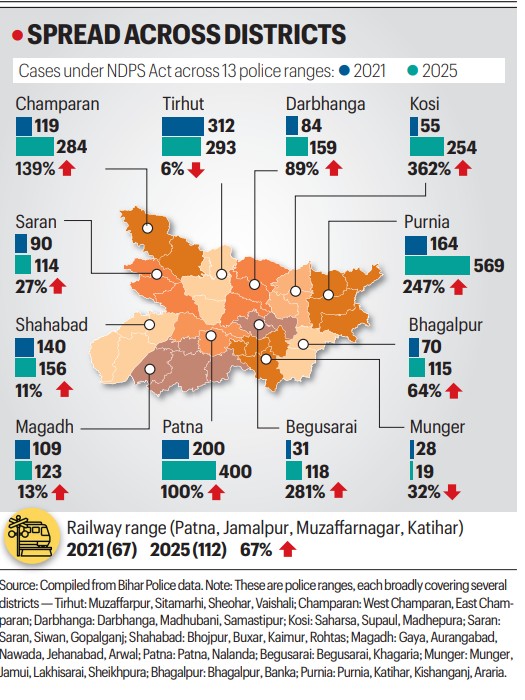
A small consolation, officers say, is that Bihar is not yet a major centre of manufacture. But they warn that the network is spreading. Patna, the consumer-dense urban centre, was among the top five districts on the state’s NDPS cases list in every year from 2016 to 2025 — it recorded 389 cases in the first five months of 2026, against 372 in all of 2025. The other districts are not far behind (see chart).
The future: Young lured by cheap drugs
But more than all of the above, the police are most worried about cheap drugs reaching the economically marginalised, mainly juveniles, a concern social workers dealing with street children in Patna have raised repeatedly.
The closest broad measure of juvenile use is a national survey cited in a 2023 report of the Parliamentary Standing Committee on Social Justice and Empowerment. It estimated 99,000 cannabis users among Bihar’s 10-17-year-olds, 40,000 opioid users and 29,000 inhalant users, besides 8,000 sedative users.
Dr Kumar, from IGIMS in Patna, said dependence on semi-synthetic and synthetic drugs can set in far faster than what young users expect. “Young people may begin under peer pressure or out of curiosity, without understanding how difficult it can become to stop,” he said.
Money, police say, also decides what is used. A young person with Rs 150-200 can afford only small quantities, making cheaper substances easier to access than black-market liquor. According to officers, roadside outlets are the usual points of first contact, where buyers may be offered “something new” for a nominal price. And, they warn, all it takes is a semi-synthetic drug such as kota, taken with a cigarette, to hook a user within a few trial doses.
(Tomorrow: Liquor to drugs, de-addiction centres scramble to cope)
KioskNews shows a cleaned-up reading view extracted from the publisher’s page — the original always lives on their site, not ours.