India Inflation Breaches RBI's Limit. What Happens If It Remains Above 6%
India's inflation problem is no longer just about expensive vegetables, cooking essentials or the monthly grocery bill. Food remains the biggest reason prices are rising, but the latest data points to a more uncomfortable development: inflationary pressure is spreading across a much wider range of goods and services.
Retail inflation climbed to 6.09 per cent in October, up from 5.54 per cent in September, breaching the Reserve Bank of India's upper tolerance limit of 6 per cent for the first time in two years. Food inflation accelerated to 8.94 per cent, making it the biggest contributor to the increase.
But there is another number worth watching. As many as 19 of the 43 consumer price index (CPI) sub-groups recorded inflation of at least 4 per cent. This suggests that the price problem is not confined to food alone. The October inflation reading is significant for two reasons:-
Also Read | Layoffs Are Rising In Tech, But These Skills Are Helping People Unlock Better Pay
First, it has moved outside the RBI's permitted inflation range. The central bank targets inflation at 4 per cent, with a tolerance band of 2 per cent to 6 per cent. A reading above 6 per cent is not merely an uncomfortable number. It puts inflation beyond the range within which the RBI is mandated to keep it.
Second, the increase has not been limited to a handful of food items. The number of CPI sub-groups with inflation of 4 per cent or more rose from 14 in September to 19 in October. That is an important change in the breadth of price pressures.
Food Is Still The Biggest Culprit. But It's Not The Only One
Food inflation rose to 8.94 per cent in October from 7.74 per cent in September. The acceleration has been particularly sharp in some everyday items.
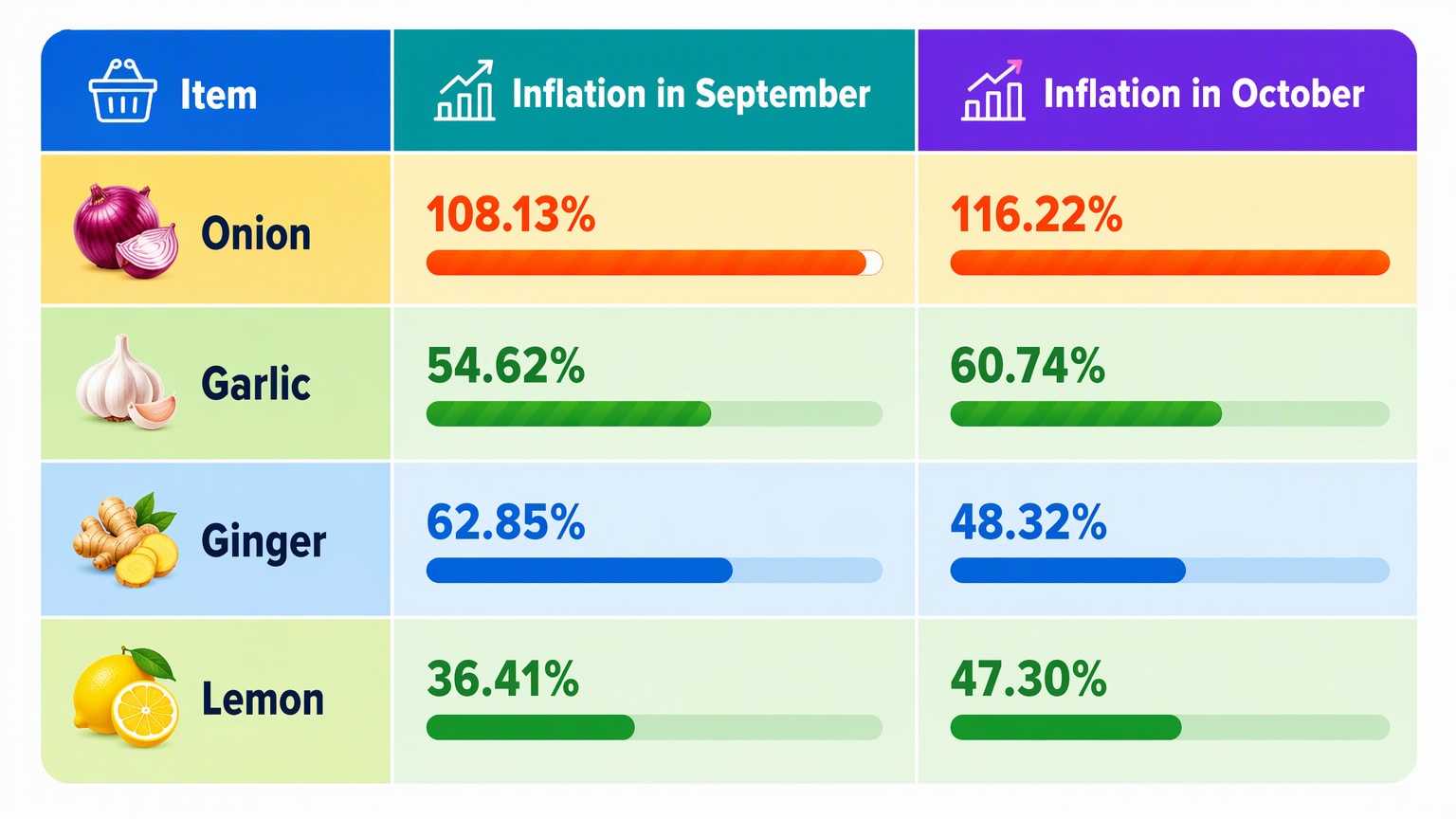
Onion prices were more than twice their levels a year earlier. Garlic inflation crossed 60 per cent. Ginger and lemon remained expensive, even though inflation in ginger eased from September.
These are the kinds of price increases that households feel immediately. They leave little room for families to adjust, particularly those already spending a large share of their income on food.
The pressure is also uneven. Rural inflation climbed to 6.63 per cent in October, compared with 5.41 per cent in urban India. Rural food inflation stood at 9.09 per cent, against 8.68 per cent in cities. This matters because households with tighter budgets have less flexibility to absorb rising food costs.
The Surprising Inflation Hotspots: Restaurants, Personal Care And Transport
The MoSPI data throws up a striking contrast. Some of the fastest price increases are happening outside the grocery basket.
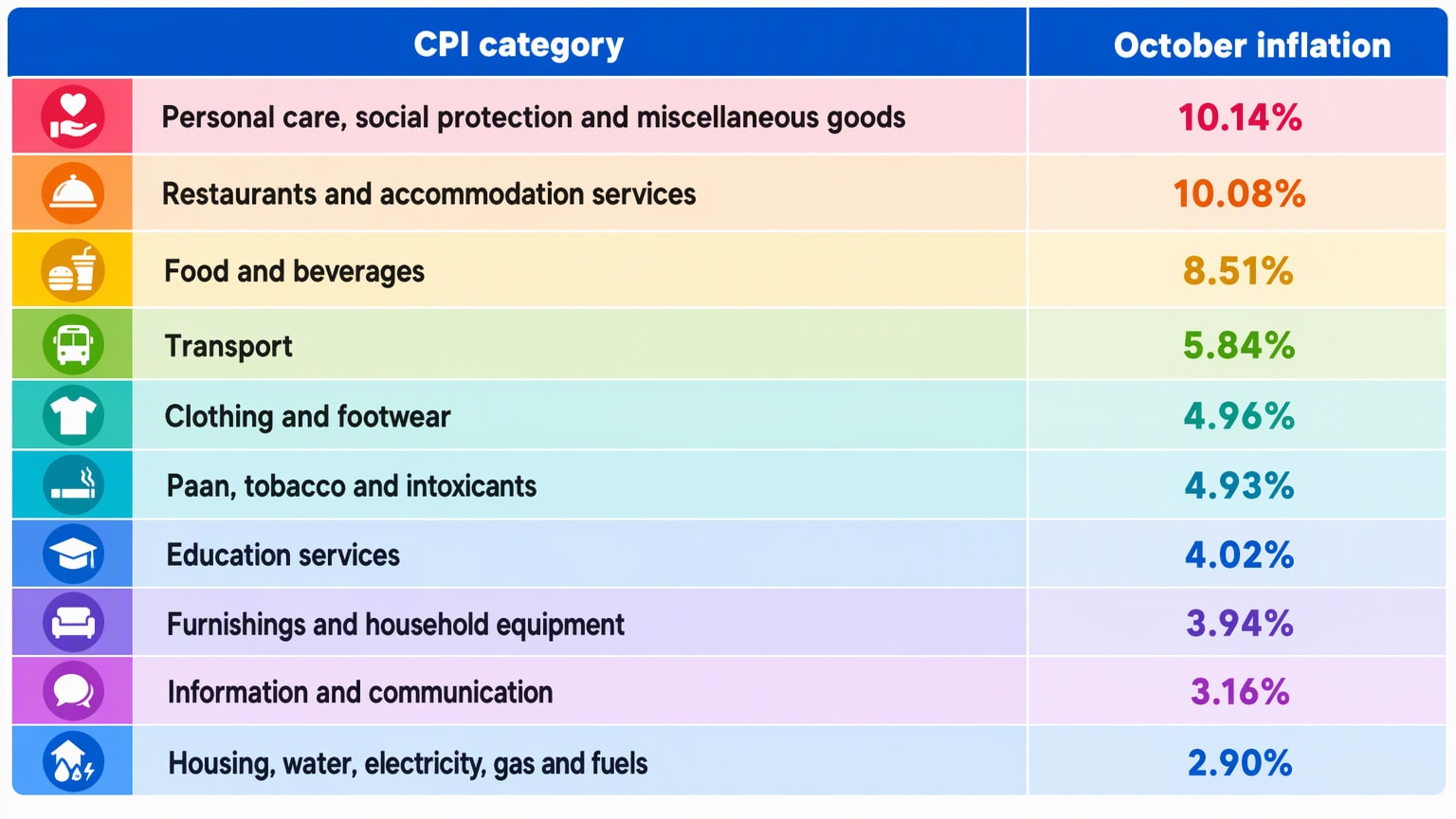
Inflation is often discussed as a single number. But the household experience depends on what is becoming expensive, how frequently people buy it and how much of their income goes towards it.
A family may be able to postpone buying a new appliance when prices rise. It cannot easily postpone groceries, school expenses, transport or medical requirements.
That is why a wider increase across price categories can become more difficult to manage than a temporary spike in a few vegetables.
The October data also offers a useful counterpoint. Housing inflation remained at 2.90 per cent, while health inflation was 2.05 per cent. Not every category is experiencing equally strong price increases. This means the current inflation shock is broadening, but it is not uniform.
RBI Rate Hike In December: Why Inflation Breach Matters
The inflation breach comes at a particularly sensitive time for monetary policy.
The RBI raised its repo rate by 25 basis points to 5.50 per cent in October and shifted its policy stance to calibrated tightening. That effectively put rate cuts off the table in the near term, leaving a hike or a pause as the likely options.
The October inflation reading strengthens the case for another increase. Siddharth Maurya, Founder and Managing Director of Vibhavangal Anukulakara, told NDTV that the latest inflation figure is worrying because price pressures are no longer affecting only select food groups.
He added that food inflation of 8.94 per cent was particularly concerning for lower- and middle-income households, whose monthly budgets are more vulnerable to higher prices. "The increase in overall price level adds to the difficulty faced by the RBI while maintaining the growth-inflation balance," he said.
Maurya believes the inflation breach has significantly raised the likelihood of another rate increase. "As the level of inflation is high, the chances of a 25 basis point interest rate hike in December are high," he said.
Economists surveyed by Reuters also expect another 25-basis-point increase in December. The RBI's own October projections had pegged inflation at 6 per cent for the October-December quarter and 5.2 per cent for the full financial year.
What Happens If Inflation Stays Above 6%?
The immediate concern is that inflation may not cool quickly enough.
Some economists expect inflation to remain above the RBI's upper tolerance limit for several months. Risks include weather-related disruptions, food supply constraints and the continued pass-through of higher input costs into consumer prices.
The RBI faces a difficult balancing act. Higher interest rates can help contain demand and prevent inflation expectations from becoming entrenched. But they cannot directly produce more onions, garlic or edible oil.
A rate hike also makes borrowing more expensive. Home loans, personal loans and business credit can become costlier, potentially affecting household spending and investment.
The real test for the RBI is whether food inflation begins to ease before price increases elsewhere become more persistent. If food prices remain elevated while transport, clothing, services and other non-food categories continue to rise, bringing inflation back within the tolerance band could become considerably harder.
For households, that means the next few months could be about more than expensive groceries. The cost of maintaining an ordinary monthly budget may increasingly become the bigger concern.
KioskNews shows a cleaned-up reading view extracted from the publisher’s page — the original always lives on their site, not ours.