Colby Cosh: The mechanical monster storming through an ancient priesthood
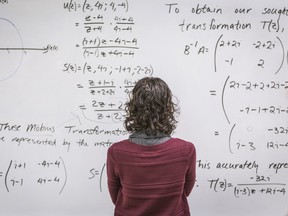
Oct. 6 will be remembered in mathematics as the day the bomb went off. OpenAI, the San Francisco-based “public benefit corporation” that has been making impressive mathematical advances every few weeks for a while now, unleashed a flood of 377 new machine-generated papers, each of which contains a new result. Literally hundreds of outstanding theoretical conjectures of longstanding interest have been resolved, found true or false, without human intervention.
Sign In or Create an Account
Some of these have resisted human solution for decades. (The one known as “Hilbert’s tenth problem” has been partially open since 1900.) No active subfield of higher mathematics is left untouched; the mechanical monster has stormed through the corridors of number theory, algebraic geometry, combinatorics, topology and computing science. And while the degrees of claimed rigour in the new papers vary slightly, the typical reaction of most expert human inquirers into the results they are capable of understanding has been, “Gee, this looks pretty solid,” often with a side of, “I didn’t think of trying that solving strategy back in 2003 when I spent 18 months on this problem.”

Columnist Jesse Kline keeps you up to date with what’s happening in Israel and the effects of antisemitism on life here in Canada. Friday mornings.
By signing up you consent to receive the above newsletter from Postmedia Network Inc.
A welcome email is on its way. If you don't see it, please check your junk folder.
The next issue of Channel Israel will soon be in your inbox.
We encountered an issue signing you up. Please try again
As you already know if you are close to any professional mathematician, OpenAI’s earlier accomplishments have already led to total moral crisis in the world of mathematics. None of the questions that OpenAI’s software has answered for us are easily explainable to a layman without some prior education. That certainly includes me; I’ve spent a weirdly large amount of time “studying” higher math and listening to lectures in a superficial way over the last few years, so I have a journalistic, half-comprehending sense of what mathematicians value and what sorts of questions absorb them. I don’t see a paper in this barrage that I could discuss intelligently and specifically, with you or with anyone else.
The big picture is that mathematicians are a privileged caste that civilizations, western and non-western alike, have sustained for thousands of years in a state of sacralized purity. There are specialists in “applied” mathematics, but in general, no mathematician is ever expected to create anything economically or practically “useful” to anyone but another mathematician. It is the fostering of the whole tribe, with a necessary stellar core of persons engaged in pure thought, that sometimes delivers technological value to the rest of us and justifies its existence.
Long ago a priesthood embarked on tackling questions about number and geometric magnitude and how they’re related. These questions proved unexpectedly fertile and complex. Notions of dimension and probability entered the picture. Concepts of number began to multiply confusingly. The fundamental binary of “true” versus “false” began to be joined by other dichotomies: infinite versus finite, countably infinite versus uncountably infinite, algebraic versus non-algebraic, computable versus noncomputable, decidable versus undecidable.
Humankind has kept the priesthood going, complete with a species of apostolic succession to rival that of any religious faith. The practical returns, perhaps diminishing, arrive at unpredictable intervals. The paradoxical price appears to be that we don’t demand practical rewards from any individual in the priesthood. The best acolytes, selected by the caste itself, are rewarded with enormous social prestige and a decent, secure living. I am describing what might be the oldest continuously existing human institution.
And, yes, it has reached a major turning point. Tuesday’s announcement and the torrent of data that accompanied it suggest that organized mathematical discovery might be automatable to an arbitrarily high degree. What the pocket calculator was to children learning arithmetic and accountants doing sums, AI now is, or may soon become, to all mathematicians. Part of the moral injury inflicted on Tuesday was that a machine spewed forth answers to truth-queries that might have provided lifetimes of honest work for human mathematicians. Some mathematicians are quitting the caste, right now, in despair.
But it is not in fact obvious that we will “need” fewer mathematicians as a consequence of automatization: we may need orders of magnitude more of them. They are suffering because they have been trained, and taught by millennia of tradition, to regard formal verification of mathematic conjectures as the essence of their craft. In the absence of computers, and of any other species that can do mathematics, this was true.
The math profs are facing what they cannot help regarding as an undignified transition from knight on horseback to chauffeur. Many just aren’t good at teaching others, although mathematics has an inherent kernel of persuasion; and some elite mathematicians may scorn teaching as a grubby, awkward technique necessary for caste survival — something best handled by the folk who can glom a PhD, but who will never contribute to the vanguard of progressive exploration.
And then Techno-Columbus comes along and discovers another hemisphere. Social questions of authorship and priority, frighteningly ancient norms and expectations and credentials, are going right out the window. Everybody in mathematics has potential (but unequal!) access to computer-assisted superpowers. There’s another paradox here: if mathematics is about the pure pursuit of new truth, without regard to the means, the significance of Oct. 6 is that pure truth will now begin arriving in industrial, hard-to-digest quantities. It will be, and is, too much for some to take. And the implications for the rest of us are hopelessly uncertain, for math is both a defining human activity and a unique human activity.
Get more Colby Cosh, subscribe to the NP Platformed newsletter.
Join the Conversation
This website uses cookies to personalize your content (including ads), and allows us to analyze our traffic. Read more about cookies here. By continuing to use our site, you agree to our Terms of Use and Privacy Policy.
KioskNews shows a cleaned-up reading view extracted from the publisher’s page — the original always lives on their site, not ours.