Will Taiwan issue derail Washington and Beijing’s latest reset? Analysts are sceptical
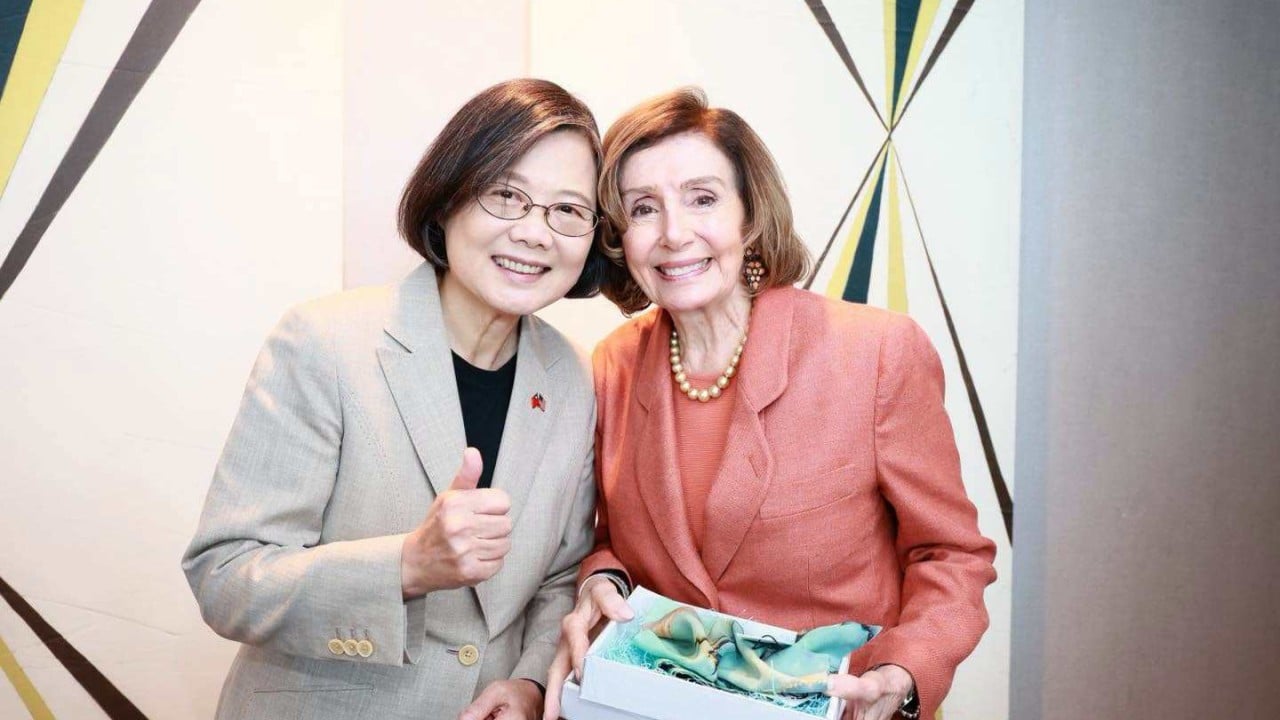
Tsai’s itinerary included a meeting with former US House speaker Nancy Pelosi and a speech to Stanford University on Taiwan’s role in global stability.
It is her first trip to the US since her eight-year spell as leader ended in May 2024 and also her first meeting with Pelosi since the then speaker visited Taiwan in 2022 – a move that triggered large-scale military exercises around the island by the People’s Liberation Army and a continued stepping up of military pressure since then.
Her publicly released itinerary suggests she will remain in California throughout the trip.
Beijing has yet to respond publicly to Tsai’s visit, but her trips to Japan and Europe after leaving office have prompted the mainland’s Taiwan Affairs Office to affirm its opposition to independence for the island.
“At this point, it remains to be seen what kind of political arrangements, if any, the United States will make for Tsai Ing-wen’s visit to the US, or whether the visit will be merely symbolic,” Zhu Feng, professor and dean of Nanjing University’s School of International Studies, said.
He added that from Beijing’s perspective, there was no need to be “completely confrontational” over the Taiwan issue, pointing out that Tsai was no longer the island’s leader.
Zhu said the visit further illustrated the complexity of the Taiwan issue in China-US relations and it was not something that could be “resolved overnight”.
On Wednesday, Tsai spoke at a conference on technology and national security at Stanford, where she accused Beijing of carrying out “grey zone” activities – ways of exerting pressure without resorting to all-out warfare – around Taiwan
She also called for greater industrial cooperation between the island and democratic partners, saying this would not only strengthen Taiwan’s own security but also “the stability of the Indo-Pacific and the resilience of the wider democratic community”.
Meanwhile, Taiwan’s foreign ministry described the opening of a new de facto consulate in Arizona as a “milestone in the Taiwan-US economic and trade partnership” that would help strengthen exchanges in areas such as economics, technology, education and supply chains.
As part of a three-day visit to the US, the island’s foreign minister Lin Chia-lung attended the opening of the Taipei Economic and Cultural Office in Phoenix on Monday.
Meanwhile, the US ambassador to China David Perdue defended Donald Trump against criticisms that he was too soft on Beijing over the Taiwan question.
He wrote on social media that Trump was “as strong on Taiwan as I’ve ever seen anybody” and had authorised 50 per cent more arms transfers to Taiwan than any US president since 1979, the year Washington formally established diplomatic relations with Beijing.
He also said the US stance on Taiwan had not changed, adding: “We don’t support independence. We don’t support coercion either.”
Beijing regards Taiwan as part of China and has never ruled out the use of force to reunite it with the mainland.
The US, in common with most countries, does not recognise the island as independent but is opposed to any attempt to seize it by force.
Washington is also legally committed to supplying Taiwan with arms to defend itself and last week the island finally received two F-16V fighter jets that had been due to arrive earlier this year.
02:20
US accuses mainland China of targeting Taiwan leader’s family in surveillance case
They were part of a NT$247.2 billion (US$7.8 billion) package of 66 F-16Vs approved in August 2019 during Trump’s first term.
Zhu and other analysts said Beijing was now more concerned about a US$14 billion weapons package for Taiwan that has been on hold for months waiting for Trump’s approval.
Zhu said it was possible that the US president would approve the deal before next month’s midterm elections as he sought to portray himself as securing greater benefits for Americans.
Zhu said Trump signing off on the package would damage China-US relations “but I do not think this would overturn the consensus on cooperation”.
Shi Yinhong, an international relations professor with Renmin University, said recent engagements between Washington and Taipei had not produced any major results and were unlikely to affect the next possible meeting between Xi and Trump at the Asia-Pacific Economic Cooperation summit in Shenzhen in November.
“The most notable development concerning Taiwan in the context of China-US relations is Trump’s continued delay in making a decision on a major new arms sale to Taiwan,” Shi said.
But he added that Washington would continue to support the island and suggested the delay was “a tactical move” on Trump’s part.
KioskNews shows a cleaned-up reading view extracted from the publisher’s page — the original always lives on their site, not ours.