Fantasy Baseball: 12 bold predictions for 2027 see George Kirby changing hands, Bryce Eldridge making a leap
If you need help in either regard, we still have articles to address that, as we have all year, but otherwise, there isn't much left to say about 2026. We're just playing out the string now.
The natural transition, then, is to look toward 2027, and that process begins for me here, with the boldest claims I'm prepared to make right now.
If nothing else, it'll give you a peek into my early leanings on certain players and perhaps introduce some possibilities that you hadn't considered yet.
First of all, there will be a 2027
Sorry to all the doomsayers scoffing at the mere suggestion of a 2027 season amid the latest labor negotiations. I realize there's no clout in white-pilling on the internet, where entertaining anything better than the worst-case scenario is grounds for ridicule, but let me ask you ... how often in the history of baseball labor negotiations has the worst-case scenario come to pass? How often in the history of anything has it?
This is one of my tricks for staying sane in an insane world. I can imagine the most terrible thing happening, too, but then I remind myself, "Yeah, but it won't." That doesn't mean it couldn't. It doesn't mean it never will. In fact, you could surely point to instances in history when it has done so. But our lives over the entire span of history are a blip. We won't see many of those instances, and the ones we do see are rarely the ones we imagine. At the heart of every hypothetical is an army of individuals even more committed than we are to ensuring it doesn't happen.
That's especially true as far as these negotiations are concerned. Baseball took it on the chin in 1994, as you may have heard, and it's taken about this long for it to reclaim its place in the zeitgeist. The sport has real momentum. There are dollars to be made, and while the two sides can dispute their share, there remains a reminder, within living memory of how fragile that state can be.
I don't claim to be an expert on labor disputes, but as someone who's followed baseball since, well, 1994, I've observed about a half dozen of them before. They always sound bleak until the agreement is just about done. There's a lot of posturing right now, a lot of fanciful ideas that need to come back to reality, but eventually, the calendar will have its say. Even for as bad as 1994 was, no seasons were lost -- a World Series, yes, and a few dozen games off the schedule, but not an entire season. With the kind of headwinds the sport has now, a disruption of even that magnitude would be self-defeating.
So sure, take an interest in the labor talks. They're sure to dominate offseason coverage, after all. But understand that at the end of them, there will be a 2027 season of some substantial length. It doesn't hurt to imagine what that might look like, so let's do that.
The early rounds will be relative mayhem
I have my doubts about this one because, as with every online culture, groupthink in Fantasy Baseball is all but inevitable. If there was ever a year, though, for individuals to color outside the lines early in drafts, it's 2027. Think of all the mainstays who have fallen well short of expectations in 2026 -- a group that includes Jose Ramirez, Ronald Acuna, Paul Skenes, Julio Rodriguez, Kyle Tucker, Garrett Crochet, Gunnar Henderson, Vladimir Guerrero and Francisco Lindor. We could keep going. Aaron Judge, Juan Soto, Tarik Skubal and Nick Kurtz were hurt much of the year. Shohei Ohtani played banged up. Bobby Witt and Corbin Carroll were pretty good, but not worth the price we paid for them. That's 16 of the first 24 drafted right there, and all still have extensive track records and/or remain in the prime of their careers.
In other words, they're the kind of players to whom we normally give a pass individually, but to give them all a pass would be to repeat the same first two rounds, sans Cal Raleigh. That's not going to happen, but I imagine when we start sorting through which disappointments we most trust to bounce back and at what cost, opinions will vary. Such decisions are more a matter of faith than data, after all.
And which newcomers will we welcome into the fold? I'm already seeing some momentum for Pete Crow-Armstrong being the No. 1 overall pick, which would make sense if we're just running back 2026. Still, normally, we'd bet against a player with no established baseline repeating an outlier season. As of now, I couldn't see myself taking him ahead of Ohtani or Judge, and I'd have to think hard about Bobby Witt, Juan Soto, Yordan Alvarez and Junior Caminero as well. That's just one example, but it's a testament to how little I'm looking forward to putting these names in an order that's actually defensible -- and then having to defend it when the groupthink inevitably goes another direction.
Payton Tolle will win the AL Cy Young
On second thought, I'm not sure this one is bold enough. When a top prospect armed with a plus fastball goes on to deliver a 3.15 ERA, 1.08 WHIP and 10.4 K/9 as a rookie, of course, he profiles to be in future Cy Young discussions. But then again, if Cam Schlittler really is who he's shown to be in 2026 -- putting together a 2.01 ERA, 0.92 WHIP and 11.1 K/9 -- he's going to be awfully hard to beat. The reason why I think Payton Tolle can close the gap is that I trust him to recognize that he's underutilizing his curveball. Over the 14 starts in which he's thrown it less than 10 percent of the time, he has a 4.04 ERA, 1.26 WHIP and 9.1 K/9. In the 10 starts in which he's thrown it more than 10 percent of the time, which isn't some big ask, he has a 1.98 ERA, 0.88 WHIP and 12.2 K/9.
Sal Stewart will have an even stronger follow-up
Sal Stewart has put together a 30-homer, 15-steal season and may well go on to lead the majors in RBI. It's the sort of storybook rookie performance that most any player would struggle to follow up, and seasoned Fantasy Baseballers figure to bet against a repeat in 2027.
Would it be so crazy of me, though, to think he's left some meat on the bone? For as impressive as the totals are, his .264/.335/.477 slash line defies the sort of player I thought he'd be. He ran higher line drive rates and lower strikeout rates in the minors, and some improvement in both areas, which is hardly unheard of for a second-year player, could make him a batting average standout. Or even if he doesn't go that route, he also has ground to gain as a power hitter, having achieved this year's big home run total despite just a 13.5 percent pull-air rate, which ranks in the lower half of the league. Bottom line is that, for as good as Stewart already is, he has multiple paths to becoming an absolute monster.
Luke Keaschall will outperform Brice Turang
You may wonder, based on my Sal Stewart optimism, what precedent there is for a player improving his pull-air rate from Year 1 to Year 2. Enter Luke Keaschall, whose improvement isn't reflected so much in his season-long rate, but if you isolate it to just his past 56 games, during which he's hit seven of his nine home runs, it becomes more pronounced, climbing five points from 14 percent to 19 percent. Keaschall's exit velocities are some of the lowest among full-time players, but a respectable pull-air rate in the minors allowed him to hit 15 homers over 103 games in his one full season there. His latest 56-game pace is similar and it has me thinking he could out-homer Brice Turang, whose pull-air rate is consistently in the 7-8 percent range even though he makes much higher-quality contact.

MIN Minnesota • #15 • Age: 24
2026 Stats |
|||||
AVG.274 |
HR9 |
SB17 |
OBP.368 |
OPS.756 |
AB471 |
What advantage would Turang have otherwise? They're similar base-stealers and on-base threats, but Keaschall has a much better contact rate. Maybe I'd be singing a different tune if Turang wasn't being kicked around so much in the second half, batting .238 with a .685 OPS.
Mason Montgomery will be the No. 2 closer
I'm not so bold as to predict Mason Montgomery overtaking Mason Miller, who may well be the most dominant closer in history, pitch for pitch. But Montgomery has done a pretty good impression, only from the left side, over his past 30 appearances. He has just 11 saves because he didn't step into the role for the Pirates until August, having been delayed by an uncharacteristic rough patch in June. Still, since then, he has a 0.62 ERA, 0.62 WHIP and 15.5 K/9 over the aforementioned 30 appearances.
In addition to Miller, Cade Smith is likely to be drafted ahead of Montgomery next year, as are Jhoan Duran, Josh Hader and likely Louie Varland and Bryan Baker. For as good as Montgomery has been, he doesn't have a long history of dominance, and wacky things can happen over small relief samples. But I'm betting he really is good enough to hang with any reliever not named Miller next year.
George Kirby will get traded and enjoy a career high in strikeouts
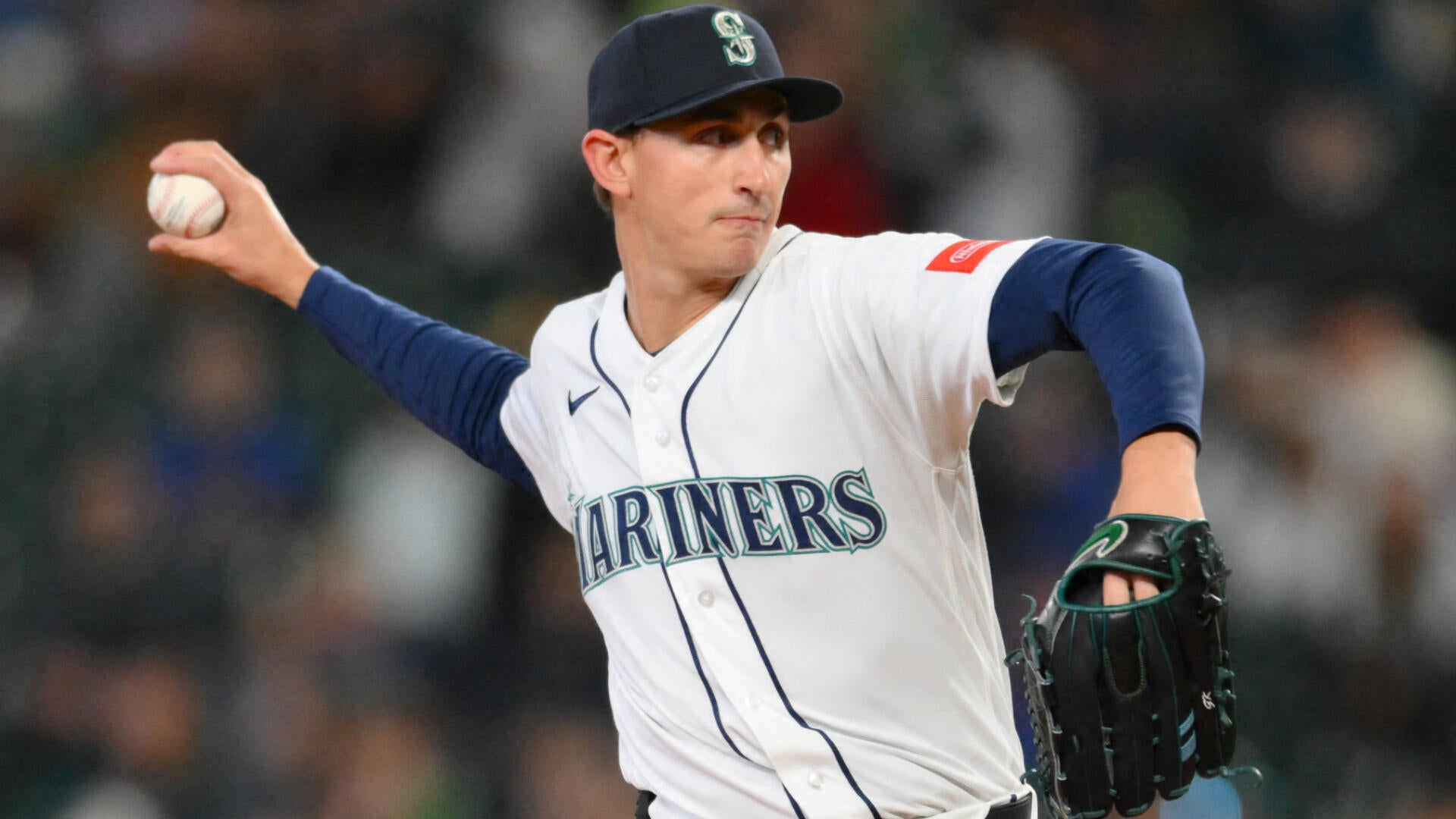
I don't have a lot of hard data to back up my claim here, just a nagging feeling that the Mariners have lost the plot with George Kirby and need to give some other team the opportunity to find it again. He was once regarded as an inevitable ace, finding instant success upon getting the call in 2022, but every year since then has seen him take a step back, resulting in back-to-back seasons with an ERA over 4.00. His control remains elite, and his stuff has rated about the same throughout. But his arsenal is more complicated now, perhaps undermining the simplicity of his once fastball-heavy approach. It's a common thread among Mariners pitchers, unfortunately, and to me, it's telling that Kirby has a 1.06 ERA, 0.95 WHIP and 9.2 K/9 across the four starts in which he's thrown his fastball 40 percent or more of the time.
But I'm a simple Fantasy Baseball writer. Here's what pitching guru Nick Pollack had to say about the prospect of Kirby being moved at the trade deadline:
Just because it didn't happen that doesn't mean it won't in the offseason.
Reid Detmers will get traded and compete for a Cy Young
Speaking of pitchers who probably should have been moved at the trade deadline, Reid Detmers remained on an Angels team that's going nowhere, but he's continued to have the quietest breakout of 2026. The perennial tease has finally put it all together with improved control and a more lethal slider. His overall numbers are impressive enough, but what really brings it home are his past 19 starts (two-thirds of his season, basically), during which he has compiled a 2.47 ERA, 0.91 WHIP and 10.4 K/9. So why does he need to be traded to get the recognition he deserves? For all his success, the Angels have inflicted him with a 5-8 record. Again, they're going nowhere, and he has just two years of control after this one. Now would seem like an appropriate time for them to cash in.
Bryce Eldridge will hit 35 home runs
Bryce Eldridge always earned high marks as a prospect, which you could call a prerequisite for being promoted at age 20. I harbored doubts because he seemed to fit the profile responsible for the most Fantasy fakeouts: Big-time power combined with big-time contact issues.

SF San Francisco • #8 • Age: 21
2026 Stats |
|||||
AVG.268 |
HR16 |
OPS.820 |
AB362 |
BB55 |
K111 |
I'm here to tell you my concerns were unfounded. As a 21-year-old rookie, he has struck out just 26 percent of the time. That's not some amazing number, but it's tenable for a hitter who impacts the ball like he does, which is to say really freaking hard. His 92.5 mph average exit velocity is 94th percentile, and his 113.4 mph max exit velocity is 91st percentile. Those numbers were the selling point for him as a prospect and put him in the Matt Olson and Rafael Devers class of power hitters as a 21-year-old. You'll notice both of those guys have 35-plus home runs this year. I see no obvious reason why Eldridge would be unlikely to follow suit. The usual suspect would be launch angle, but his ground ball rate is only 38 percent. He could stand to pull the ball more, perhaps, but his power is the sort that plays to all fields. You may wonder about his home venue, which is notoriously pitcher-friendly, but it's the same one Devers is playing in, and by the way, Eldridge has hit 10 of his 16 home runs there.
Franklin Arias and Sebastian Walcott will be on the opening day roster
You may think this is a stretch for a couple of 20-year-olds (though both will be 21 by opening day), and the fact that both remain in the minors now, even as their parent clubs fight for playoff positioning, would fly in the face of conventional promotion practices. Prospects in the running for an opening-day job generally get a chance to get their feet wet the year before.
But that's not universal. Kevin McGonigle and JJ Wetherholt were both denied late-season promotions last year, yet still made the opening-day roster, to great effect. Walcott, in particular, has a good excuse for the delay. He only recently came back from an internal bracing procedure on his elbow and has been limited to DH so far. But did I mention that he's thriving in that capacity, batting .329 with 10 homers, 10 steals and a 1.036 OPS in just 36 games? Arias, meanwhile, has coupled his already existing contact skills with newfound power for a .324/.403/.561 slash line between Double- and Triple-A. Both may have to move off shortstop to get the call, as McGonigle and Wetherholt did, but neither the Red Sox's nor the Rangers' infield has a stalwart at every position.
The Dodgers will move on from Teoscar Hernandez to free up a spot for one of their young outfielders
I'm unwilling to specify which of the Dodgers' young outfielders because they have so many. Now that Josue De Paula, who's generally regarded as the best of the lot, has bypassed Triple-A to fill in for Shohei Ohtani, he would seem to be the odds-on favorite. Other candidates include Mike Sirota, who brings the most defensive value, and James Tibbs, who's probably the most overdue for a chance. The 23-year-old has spent the entire year at Triple-A, slashing .292/.415/.537 with 28 homers in 132 games.
Regardless, there needs to be an opening for any of these three to have an extended stay. Since Ohtani obviously isn't going anywhere, Teoscar Hernandez makes for the most logical path. The 33-year-old has one guaranteed year left on his contract, along with a couple of conditional years that haven't vested yet. Though his second-half performance has gone a long way toward salvaging his season stat line, free-swingers like him generally don't age well, and the Dodgers would probably prefer to make that some other team's concern even if it means eating a portion of Hernandez's salary.
Cam Smith will have a breakout akin to Jordan Walker's 2026
We've gotten used to prospects reaching the majors fully baked and ready to fulfill their potential, but historically, that's the exception. Even today, certain standouts arrive at their potential more deliberately, with Jordan Walker, who has only now amounted to something in his fourth season, being a prominent example.
HOU Houston • #11 • Age: 23
2026 Stats |
|||||
AVG.216 |
HR19 |
SB10 |
OPS.683 |
AB458 |
K128 |
I see a lot of similarities with Cam Smith, who was hurried to the majors after a meteoric rise up the prospect rankings and has generally impacted the ball well, just without a lot to show for it. Walker's average bat speed is in the 100th percentile. Smith's is in the 99th. Walker's max exit velocity is in the 99th percentile. Smith's is in the 95th. Both have similar strikeout and pull-air rates, with each being in need of improvement but not a total deal-breaker either. And ultimately, that's what I think needs to happen for Smith: small improvements that come from repeated exposure to the best pitching the world has to offer. I couldn't point to one obvious adjustment Walker has finally made to deliver on his potential, and I think Smith's breakthrough will happen similarly. His talent, which should be obvious from our outside perspective, will simply manifest.
KioskNews shows a cleaned-up reading view extracted from the publisher’s page — the original always lives on their site, not ours.